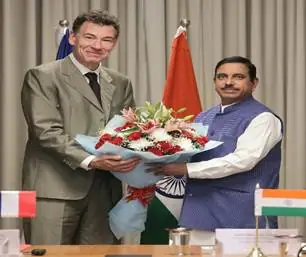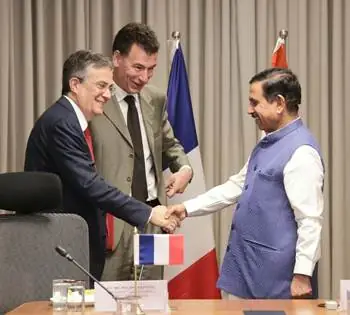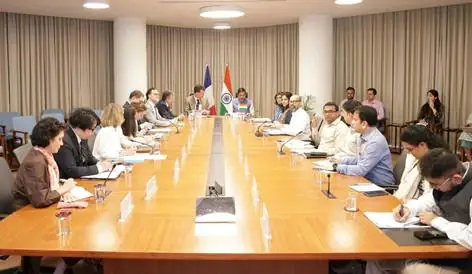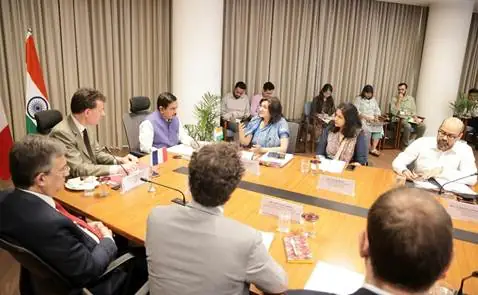
India and France used a high-level meeting in New Delhi to reaffirm a partnership that is increasingly spanning universities, laboratories and space-related research, with both sides signalling interest in deeper institutional engagement. Union Education Minister Pralhad Joshi met Philippe Baptiste, France's Minister for Higher Education, Research and Space, in a bilateral discussion that placed academic cooperation and scientific exchange at the centre of the agenda.
The meeting comes at a time when India is working to broaden the global footprint of its higher-education system while also building stronger links between education policy and advanced research. France, meanwhile, has been positioning itself as a key European partner for India in innovation, technology and strategic science. The inclusion of space in the French minister's portfolio gives the dialogue added significance, linking universities and research institutions to one of the most strategically important sectors in both countries.
Education-Research Convergence
The talks are best understood as part of a wider effort to connect higher education with research outcomes and industry-relevant innovation. For India, this is a policy priority that aligns with its ambitions to improve global rankings, attract foreign collaboration and create more pathways for students and researchers to move between institutions and disciplines. For France, the engagement offers an opportunity to expand academic partnerships in one of the world's largest and fastest-growing education markets.
Bilateral education engagement between India and France has traditionally included student exchanges, joint degree programmes and institutional partnerships. But the presence of the research and space portfolio in the French delegation suggests a more ambitious agenda, one that could extend beyond conventional academic diplomacy. Such cooperation can help universities on both sides build shared research capacity, especially in science, technology, engineering and applied research domains.
The meeting also reflects a broader diplomatic trend: education is increasingly being treated not as a standalone sector but as a strategic instrument of national capability. In that sense, the New Delhi talks fit into a larger framework of knowledge diplomacy, where universities, research institutions and government ministries work together to support long-term economic and technological goals.
Space Adds Strategic Weight
The space dimension gives the bilateral engagement a sharper strategic edge. India's space programme has gained global visibility through cost-effective missions and a growing commercial ecosystem, while France remains an important European power in aerospace and scientific research. Bringing space into the education and research conversation suggests that both sides see value in linking talent development with advanced scientific cooperation.
That linkage matters because space capability today depends not only on launch systems and satellites, but also on a pipeline of trained scientists, engineers and researchers. Universities and research centres are central to that pipeline. A stronger India-France framework could therefore support collaborative research, technical training and innovation partnerships that feed into broader national objectives.
For India, such cooperation also complements its push to internationalise higher education under recent policy reforms. The government has been encouraging foreign universities, joint research and global academic partnerships as part of a wider effort to make Indian institutions more competitive and globally connected. France has emerged as a natural partner in that effort, given its established academic infrastructure and longstanding interest in Indo-European scientific ties.
Policy Signals From Delhi
The New Delhi meeting sends a clear policy signal: India is seeking partnerships that go beyond ceremonial diplomacy and move toward practical collaboration in education, research and frontier science. That approach is consistent with the government's broader emphasis on skills, innovation and knowledge-based growth.
While no formal announcement of new agreements was detailed in the immediate account of the meeting, the political significance lies in the continuity and breadth of the dialogue. High-level ministerial engagement often lays the groundwork for future memoranda, institutional exchanges and joint programmes. In this case, the combination of education, research and space suggests a multi-layered agenda with potential implications for universities, laboratories and policy planners.
The India-France relationship has long been marked by trust and strategic alignment in several sectors, and the latest meeting indicates that higher education is becoming an even more important pillar of that partnership. As both countries look to strengthen innovation ecosystems and prepare talent for emerging technologies, such bilateral conversations are likely to become increasingly consequential.
For now, the New Delhi talks stand as another sign that education diplomacy is moving closer to the centre of India's international engagement, with France positioned as a significant partner in that effort.