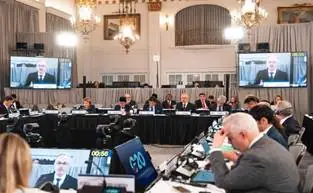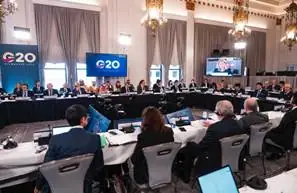
India's Commerce and Industry Minister Piyush Goyal attended the opening session of the G20 Trade Ministers' Meeting in Milwaukee, a gathering that comes at a sensitive moment for the global economy as governments grapple with slowing trade growth, geopolitical uncertainty, and persistent disruptions across supply chains. The minister's presence at the high-level forum signals India's intent to remain an active and visible participant in shaping the future of international commerce, particularly as major economies debate how to balance openness, resilience, and industrial policy.
The Milwaukee meeting brings together trade ministers from the world's largest economies under the G20 framework, which has increasingly become a venue for managing the tensions between economic interdependence and national security concerns. For India, the platform is strategically important. New Delhi has sought to project itself as a constructive voice in global trade negotiations while also defending policy space for domestic manufacturing, digital development, and food security. Goyal's participation in the opening session reflects that dual approach: engagement with the multilateral system, but on terms that preserve India's development priorities.
Trade Reset Agenda
The agenda in Milwaukee is expected to focus on trade facilitation, supply-chain resilience, and the need to restore confidence in the rules-based trading order. These issues have gained urgency as countries increasingly turn to export controls, subsidy regimes, and selective industrial policies to protect strategic sectors. For India, the challenge is to ensure that such measures do not harden into a fragmented global trade environment that disadvantages emerging economies.
India has repeatedly argued that global trade must be more inclusive and responsive to the needs of developing countries. That position has gained traction in recent years as inflation shocks, logistics bottlenecks, and geopolitical conflicts have exposed the vulnerability of concentrated supply chains. Goyal's attendance at the opening session places India at the center of these conversations, where it can press for greater predictability in trade rules and more equitable access to markets.
The G20 forum also offers India an opportunity to highlight its own economic trajectory. As one of the fastest-growing major economies, India has sought to attract manufacturing investment, expand exports, and deepen its role in global value chains. Trade policy, in this context, is not merely about tariff negotiations; it is tied to industrial strategy, employment generation, and the country's broader aspiration to become a more influential economic power.
India's Multilateral Play
Goyal's participation also carries diplomatic weight. The G20 remains one of the few global platforms where advanced and emerging economies sit together to address systemic economic issues. In an era marked by heightened strategic competition, that makes trade diplomacy more consequential than ever. India has used such forums to argue for reform rather than retreat: reform of institutions, reform of trade rules, and reform of the assumptions that have long governed global commerce.
The minister's presence in Milwaukee is likely to reinforce India's message that trade policy must support development, not merely efficiency. That argument has particular resonance for countries seeking to build domestic capacity in manufacturing, technology, and logistics while remaining integrated with the world economy. India's stance has often been to support open markets in principle, but only when they are accompanied by fairer terms of participation and stronger safeguards for vulnerable economies.
The meeting also comes at a time when the global trading system faces pressure from multiple directions, including disputes over industrial subsidies, digital trade regulation, and the treatment of critical minerals and energy transition technologies. These are not abstract issues for India. They affect the country's export competitiveness, its ability to scale clean-energy manufacturing, and its prospects for integrating more deeply into resilient supply networks.
For New Delhi, the Milwaukee session is therefore more than a ceremonial appearance. It is part of a broader effort to ensure that India remains in the room when the rules of global commerce are discussed and revised. As trade becomes increasingly entangled with geopolitics, the ability to influence multilateral outcomes will be central to India's economic diplomacy.
Goyal's attendance at the opening session of the G20 Trade Ministers' Meeting underscores that India intends to be not just a participant, but a shaper of the global trade conversation. In a period of uncertainty, that role may prove as important as any bilateral deal or domestic reform.