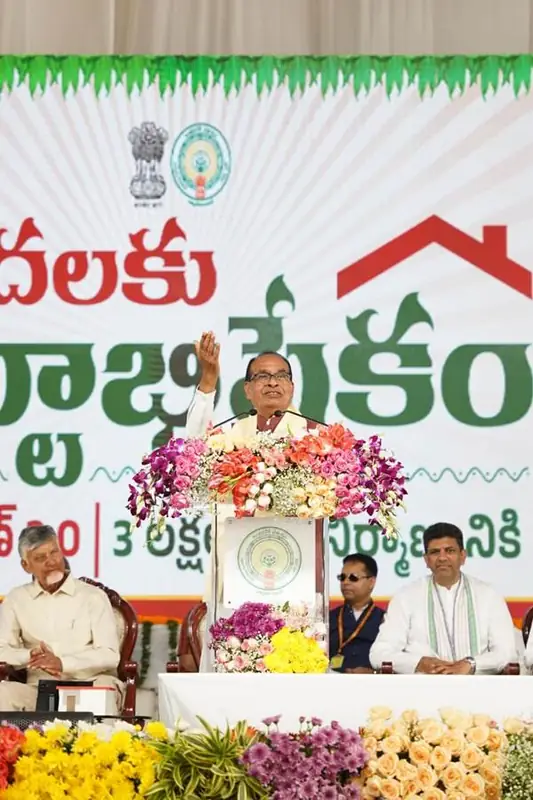
The Union government's promise to deliver 300,000 permanent homes to Andhra Pradesh has emerged as a major policy announcement with immediate political and administrative significance. Framed as a historic welfare intervention, the commitment places housing back at the centre of the Centre-state development agenda and underscores the continuing importance of direct asset creation in India's governance model.
Housing as policy signal
The announcement was made in Burripalem, where Union Agriculture Minister Shivraj Singh Chouhan and Andhra Pradesh Chief Minister N. Chandrababu Naidu jointly projected the housing push as a decisive step toward improving living standards for low-income families. The scale of the commitment is notable not only for its size but also for the message it sends: housing remains one of the most visible and politically consequential welfare instruments in Indian public policy.
For Andhra Pradesh, the pledge arrives at a time when the state is seeking accelerated support for infrastructure, livelihoods and social protection after years of fiscal stress and uneven development outcomes. Permanent housing is especially significant in a state that has large rural populations, climate-sensitive settlements and a continuing need for durable public assets that can outlast electoral cycles. The promise of 300,000 pucca homes, if executed on schedule, would represent a substantial intervention in household security, sanitation and long-term economic stability.
The event also reflects the broader strategy of linking welfare delivery with political credibility. Housing schemes in India are rarely just about construction; they are also about land access, documentation, beneficiary identification, local implementation capacity and the ability of governments to convert announcements into visible outcomes. In that sense, the Burripalem event was as much about administrative intent as it was about symbolism.
Burripalem takes spotlight
Burripalem, the venue for the announcement, carried its own political resonance. Public events in smaller towns and villages often serve as staging grounds for national messaging because they allow leaders to present development commitments in a setting that is closely associated with the intended beneficiaries. By choosing a location rooted in rural Andhra Pradesh, the leadership sought to anchor the announcement in the everyday realities of families most likely to benefit from permanent housing.
Chouhan and Naidu used the platform to emphasise development momentum, presenting the housing commitment as part of a wider push to strengthen the state's growth narrative. The optics of a Union minister and a chief minister appearing together on a welfare announcement also matter in a federal system where coordination between New Delhi and Amaravati can determine the pace of implementation. Such joint messaging is often intended to reassure beneficiaries that the project has both political backing and administrative priority.
The announcement comes amid a national policy environment in which housing continues to be treated as a foundational welfare right rather than a narrow construction target. Permanent homes are linked to better health outcomes, school attendance, women's safety and household asset formation. In policy terms, they also reduce vulnerability to seasonal displacement and disaster exposure, both of which remain important concerns in parts of Andhra Pradesh.
Delivery will decide impact
The central question now is execution. Large housing commitments frequently face bottlenecks in land availability, beneficiary verification, funding disbursal, contractor capacity and coordination between state and central agencies. The credibility of the announcement will depend on whether the promised homes move from political declaration to ground-level delivery with measurable timelines.
If implemented effectively, the programme could generate a wide range of secondary benefits beyond shelter. Construction activity can stimulate local employment, support material supply chains and create demand in allied sectors. For households, ownership of a permanent home can improve access to credit and provide a more stable base for economic activity. For the state, the successful rollout of such a programme would strengthen claims that development is being translated into tangible household-level gains.
At the same time, the scale of the pledge means scrutiny will be intense. Beneficiary selection, quality standards and completion rates will all be watched closely by local communities and political opponents alike. In India's competitive welfare politics, the gap between announcement and delivery is often where public trust is won or lost.
For now, the Burripalem event has placed Andhra Pradesh at the centre of a major housing commitment and given the state a prominent place in the Centre's welfare narrative. The promise of 300,000 permanent homes is both a development announcement and a test of administrative capacity. Its ultimate significance will be measured not by the size of the pledge alone, but by how quickly and transparently it reaches the families it is meant to serve.