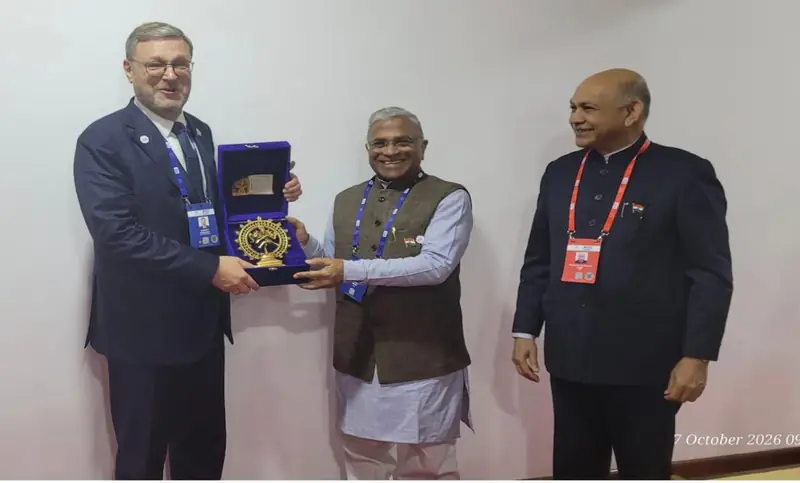
India's parliamentary delegation maintained an active presence at the 153rd Inter-Parliamentary Union Assembly in Arusha on the third day of proceedings, with Rajya Sabha Deputy Chairman Harivansh leading the team through a packed diplomatic and legislative agenda on October 7, 2026. The continued participation reflects New Delhi's sustained interest in parliamentary diplomacy as a tool for advancing India's policy priorities in global forums.
The Inter-Parliamentary Union, one of the world's oldest multilateral parliamentary bodies, provides a platform for lawmakers to exchange views on democratic governance, institutional reform, peace-building, and international cooperation. India's engagement in this setting is significant not only for its symbolic value, but also because it allows the country to project its democratic credentials and contribute to debates that increasingly shape the norms of global governance.
Parliamentary Diplomacy
Harivansh's leadership at the assembly signals the importance India attaches to parliamentary-level engagement beyond executive diplomacy. In recent years, India has sought to broaden the reach of its foreign policy through legislative exchanges, committee-level dialogue, and participation in international parliamentary networks. Such forums enable Indian representatives to present the country's experience with scale, diversity, digital public infrastructure, and institutional resilience.
The Arusha assembly comes at a time when parliaments worldwide are under pressure to respond to public demands for transparency, inclusion, and accountability. For India, participation in the IPU offers an opportunity to highlight the functioning of its democratic institutions while also listening to comparative perspectives from other legislatures. That exchange is often as important as formal resolutions, because it helps shape practical approaches to lawmaking, oversight, and citizen engagement.
Global Governance Agenda
The third day of the assembly is typically where substantive committee work, thematic discussions, and bilateral interactions intensify. India's delegation is expected to use such sessions to reinforce positions on institutional reform, equitable development, and the role of legislatures in addressing transnational challenges. These include economic uncertainty, digital regulation, climate-linked vulnerabilities, and the need for stronger parliamentary oversight in an era of rapid policy change.
The IPU's relevance has grown as global politics becomes more fragmented and multilateral institutions face questions over legitimacy and effectiveness. In that context, parliamentary diplomacy offers a less formal but often more politically grounded channel for consensus-building. India's presence in Arusha therefore serves both immediate and long-term objectives: it allows the country to contribute to current debates while strengthening relationships with counterparts from Africa, Asia, Europe, and the wider developing world.
Tanzania's hosting of the assembly also carries regional significance. As an East African nation with a strong tradition of parliamentary engagement, Tanzania provides a setting that encourages South-South dialogue and wider cooperation among developing democracies. For India, such venues are especially valuable because they align with its broader outreach to Africa and its emphasis on partnerships built around development, capacity-building, and institutional exchange.
Strategic Institutional Outreach
The delegation's continued participation on the third day suggests a deliberate and sustained approach rather than a ceremonial appearance. In multilateral parliamentary settings, continuity matters: it allows delegations to build credibility, participate in drafting processes, and engage in the informal negotiations that often determine the tone and substance of final outcomes.
Harivansh's role is particularly notable because the Rajya Sabha Deputy Chairman represents the upper house of Parliament, a chamber often associated with review, federal balance, and institutional continuity. His presence at the head of the delegation underscores the Indian Parliament's intent to project a mature and coordinated voice in international legislative forums.
While the assembly's detailed outcomes will depend on committee deliberations and final resolutions, India's ongoing participation already reinforces a broader message: parliamentary institutions are not peripheral to foreign policy, but increasingly central to how states communicate priorities, build trust, and shape global norms. In Arusha, India is using that platform to remain visible, engaged, and institutionally present in a changing international landscape.