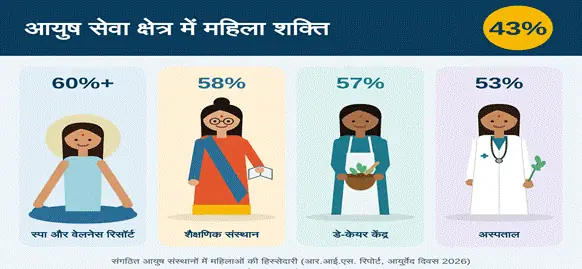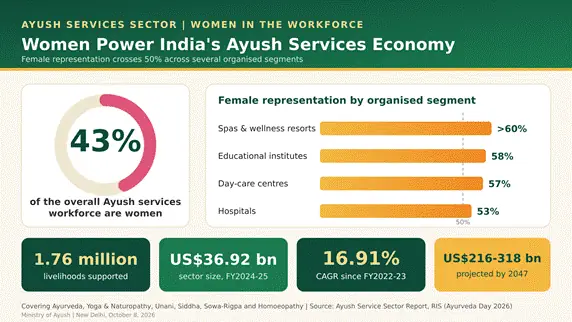
India's AYUSH sector has emerged as a notable pocket of female participation in the broader health and wellness economy, with women comprising 43 percent of its workforce and exceeding 50 percent in several prominent segments. The numbers highlight a workforce profile that is more gender-diverse than many other parts of the formal economy, and they arrive at a time when the government is seeking to expand the reach, credibility and institutional capacity of traditional medicine systems.
Female Workforce Share
The latest workforce profile suggests that women are not merely present in the AYUSH ecosystem but are central to its functioning across clinical, educational, research and service-related roles. A 43 percent overall share is significant in a sector that combines public institutions, private providers, teaching establishments and wellness-linked enterprises. In several key areas, female participation rises above the halfway mark, indicating that women are already the dominant or co-dominant labour force in parts of the system.
That pattern matters because workforce composition often shapes the accessibility and social acceptance of health services. In sectors where care, counselling, community outreach and patient interaction are essential, women's participation can influence service delivery models and the public's willingness to engage with providers. The figures also suggest that AYUSH may be offering a more inclusive employment pathway than many conventional sectors, especially for professionals seeking roles in healthcare, education and allied wellness services.
Policy And Employment Signal
The data carries broader policy significance for the government's governance agenda. AYUSH has been positioned in recent years as both a public health complement and an economic opportunity, with emphasis on domestic manufacturing, institutional training, research, and global promotion of traditional systems. A workforce in which women hold a substantial share strengthens the case for treating the sector not only as a cultural or medical asset but also as a meaningful generator of jobs for skilled women.
For policymakers, the challenge is to ensure that high female participation translates into leadership, pay equity, professional mobility and safe working conditions. In many Indian sectors, women's numerical presence does not automatically lead to decision-making power or career advancement. The AYUSH workforce profile therefore raises a familiar but important question: whether representation at the entry and mid-levels is being matched by access to senior roles in hospitals, colleges, research institutions, regulatory bodies and industry.
The figures also come with implications for training and infrastructure. If women constitute a large share of the workforce, then policy design must account for workplace safety, flexible scheduling, maternity support, transport access and digital training tools. These are not peripheral concerns; they are central to retention, productivity and the long-term professionalisation of the sector.
Sector With Growth Potential
AYUSH has increasingly been linked to India's larger health diplomacy and wellness economy, and a gender-diverse workforce can enhance that narrative. Women practitioners and educators often play a visible role in community health awareness, preventive care and family-level engagement, all of which are important to the sector's outreach model. In that sense, the workforce composition is not just a labour statistic but a strategic indicator of how the sector may evolve.
At the same time, the numbers should be read with caution. A high share of women does not by itself resolve structural issues such as uneven regulation, variable standards across institutions, or the need for stronger evidence-based integration with mainstream health systems. The workforce profile is encouraging, but it does not substitute for quality assurance, research investment or clearer career pathways.
Still, the headline figure of 43 percent female participation, with several segments crossing 50 percent, places AYUSH among the more gender-inclusive parts of India's national employment landscape. For a sector seeking legitimacy, scale and public trust, that may prove to be one of its most consequential strengths.