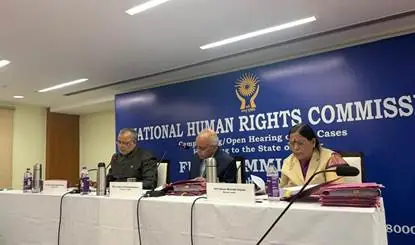
The National Human Rights Commission of India has wrapped up its two-day open hearing and camp sitting in Patna, marking another attempt by the country's apex rights body to decentralize grievance redress and make the human rights process more accessible to ordinary citizens. The exercise, held in Bihar's capital, placed the commission directly before complainants, officials, and local stakeholders, allowing cases to be heard in a public setting rather than being confined to distant administrative channels.
The Patna camp is significant not merely as a procedural event, but as a signal of the NHRC's broader institutional strategy. By taking hearings outside Delhi, the commission seeks to reduce the distance—literal and bureaucratic—between vulnerable citizens and the state machinery meant to protect them. In a state like Bihar, where questions of policing, welfare delivery, labor rights, custodial safeguards, and access to basic public services frequently enter the rights discourse, such field-based sittings can carry practical weight well beyond symbolism.
Access To Justice
Open hearings are designed to do more than process files. They create a visible forum in which complainants can see their grievances acknowledged in real time, and where officials are compelled to respond under public scrutiny. That transparency matters in a system where many rights-related complaints are delayed, diluted, or lost in layers of correspondence. For the NHRC, the camp model is a way to test whether institutional presence can improve compliance and accelerate remedies.
The Bihar sitting also reflects the commission's recognition that rights enforcement in India is often uneven across regions. While the NHRC has national jurisdiction, its impact depends heavily on how effectively it can engage state authorities, local administrations, and law enforcement agencies. Open hearings help bridge that gap by creating direct accountability. They also allow the commission to identify recurring patterns in complaints, which can inform broader recommendations on governance and institutional reform.
Bihar's Governance Test
Bihar remains a critical state for any national conversation on rights and public administration. Its large population, persistent development deficits, and complex administrative challenges mean that grievances often cluster around access to justice, service delivery, and state responsiveness. In that context, the NHRC's camp sitting is more than a ceremonial outreach exercise; it is a diagnostic tool that reveals where the system is failing and where intervention may be needed.
The commission's presence in Patna comes at a time when public institutions across India are under pressure to demonstrate responsiveness and credibility. Rights bodies, in particular, face the challenge of remaining relevant in a landscape where citizens expect faster, more visible outcomes. Field hearings can help restore confidence, but only if they lead to follow-through. The real test begins after the microphones are switched off: whether recommendations are implemented, whether departments comply, and whether complainants receive tangible relief.
Institutional Reach Matters
The NHRC's camp sitting also highlights a larger policy question: how national institutions can remain effective in a federal system where many rights violations are experienced locally but adjudicated centrally. The answer increasingly lies in mobility, outreach, and public engagement. By convening hearings in state capitals and other regions, the commission can widen participation, improve awareness of rights mechanisms, and pressure local authorities to treat complaints with greater seriousness.
For citizens, such sittings can lower the barriers to entry that often prevent them from pursuing justice. Travel costs, procedural complexity, and lack of information frequently discourage complainants from following through. A local hearing reduces some of those burdens. It also sends a message that rights protection is not an abstract promise but a public function that must be visible and accessible.
The conclusion of the Patna camp is therefore best understood as part of a continuing institutional experiment. Its success will be measured not by the number of speeches delivered or files reviewed, but by the quality of redress that follows. In a democracy as large and administratively complex as India, the credibility of human rights enforcement depends on exactly this kind of proximity: to people, to problems, and to the machinery of the state that must answer for both.