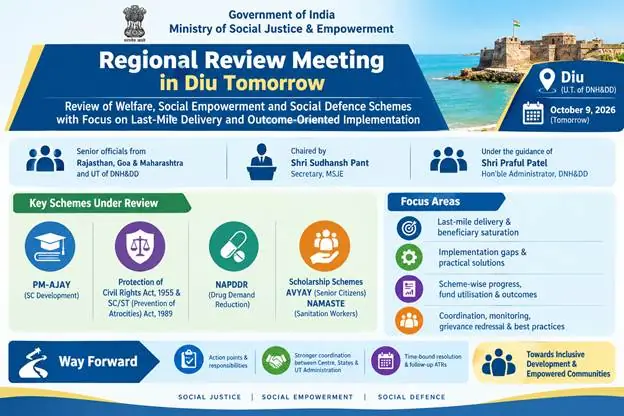
The Ministry of Social Justice and Empowerment is set to hold a regional review meeting in Diu tomorrow, in a move that underscores the Centre's continuing focus on monitoring welfare delivery and administrative execution at the field level. The meeting comes at a time when the government is under pressure to ensure that social justice programmes reach intended beneficiaries efficiently, with measurable outcomes and tighter coordination across implementing agencies.
Although the ministry has not publicly detailed the full agenda, such regional reviews typically serve as a mechanism to assess the pace of ongoing schemes, examine compliance gaps, and resolve operational bottlenecks that can slow delivery. In a geographically dispersed country like India, where implementation quality often varies sharply between regions, these meetings are increasingly being used as a tool of governance rather than a ceremonial exercise. Diu, as a Union Territory administration with a relatively small but strategically important governance footprint, offers a setting where administrative review can be conducted with direct oversight and limited bureaucratic layering.
Administrative Oversight
Regional review meetings have become a central feature of the Union government's governance strategy, especially in ministries that handle beneficiary-oriented programmes. For the Social Justice and Empowerment Ministry, the challenge is not only policy design but also ensuring that benefits reach vulnerable communities without delay, duplication, or exclusion. That includes monitoring schemes related to marginalised groups, persons with disabilities, senior citizens, and other targeted welfare categories that depend heavily on local administrative efficiency.
The Diu meeting is likely to focus on implementation status, fund utilisation, inter-departmental coordination, and the responsiveness of local systems. Such reviews often bring together officials from the Centre, Union Territory administration, and line departments responsible for delivery. The purpose is to identify where policy intent is being diluted by procedural delays, staffing shortages, data mismatches, or weak grievance redressal mechanisms.
For the ministry, these meetings also provide a feedback loop. Field-level reports can reveal whether schemes are being accessed as intended, whether outreach is adequate, and whether vulnerable populations are being left out because of documentation barriers or administrative inertia. In policy terms, this is where governance meets ground reality.
Welfare Delivery Pressure
The timing of the meeting is significant because social justice programmes are increasingly judged not by announcements but by execution. Across India, the government has sought to strengthen the delivery architecture for welfare schemes through digital monitoring, periodic reviews, and tighter accountability. Yet implementation gaps remain a recurring concern, particularly in smaller jurisdictions where administrative capacity may be limited and local coordination uneven.
A regional review in Diu suggests that the ministry is seeking closer supervision of outcomes in the western coastal region. While the meeting may not produce immediate policy changes, it can shape follow-up action, including corrective instructions, additional support, or revised timelines for pending work. In practice, such reviews are often the point at which unresolved issues are escalated and tracked for compliance.
The broader policy significance lies in the Centre's attempt to maintain direct visibility over welfare performance. For ministries dealing with social protection, the credibility of the system depends on whether beneficiaries experience the state as accessible, responsive, and reliable. Regional reviews are one way to test that credibility in real time.
Centre-State Coordination
The Diu meeting also reflects the continuing importance of coordination between the Union government and local administrations. Even in Union Territories, where the Centre has a more direct administrative role, effective delivery still depends on the cooperation of field officers, district-level structures, and implementing departments. A review meeting creates a formal setting for that coordination and allows the ministry to align priorities with on-ground realities.
In governance terms, this is a reminder that policy delivery is rarely linear. It requires repeated supervision, course correction, and institutional discipline. For the Social Justice and Empowerment Ministry, regional meetings are not just about reporting progress; they are about ensuring that the machinery of the state remains attentive to the needs of those the welfare system is meant to serve.
The Diu review is therefore more than a routine administrative event. It is part of a broader effort to tighten oversight, sharpen accountability, and keep social justice delivery anchored in measurable performance rather than broad assurances. As the ministry convenes the meeting tomorrow, attention will be on whether the exercise produces concrete follow-up actions and a clearer roadmap for implementation in the region.