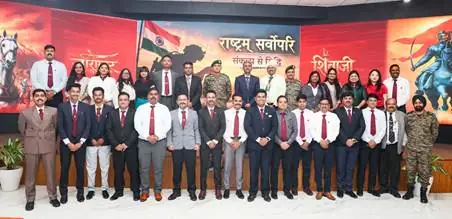
The defence correspondents' training course concluded in Tezpur on Wednesday, marking the end of a programme designed to strengthen journalists' understanding of military structures, operational culture and the broader policy environment in which the armed forces function. The course, held in one of India's key military locations in the Northeast, brought together reporters covering defence and security issues for a structured exposure to the institutional and professional realities of the services.
The closing of the course comes at a time when defence reporting in India is becoming more consequential and more complex. With the armed forces increasingly central to debates on border management, force modernisation, jointness, technology adoption and civil-military communication, the demand for accurate and context-rich reporting has grown sharply. Training programmes of this kind are intended to narrow the gap between public discourse and the technical, procedural and strategic dimensions of military affairs.
Media Literacy Push
The Tezpur course appears to have been aimed not merely at familiarising correspondents with military terminology, but at building a more disciplined framework for reporting on defence matters. In a sector where precision matters and where incomplete information can easily distort public understanding, such courses serve a practical purpose. They help journalists interpret institutional language, understand command structures and distinguish between operational facts, policy signals and ceremonial messaging.
For the armed forces, the value of engaging with defence correspondents lies in fostering a more informed media ecosystem. Defence communication in India has evolved significantly over the past decade, with the services and the Ministry of Defence increasingly conscious of the need to explain reforms, capability upgrades and strategic priorities to the public. A better-trained press corps can contribute to that objective by reporting with greater accuracy and fewer assumptions.
Tezpur, home to important military formations and training infrastructure, is a fitting venue for such a programme. The location itself reinforces the practical character of the course, placing correspondents in direct proximity to the operational environment they cover. That setting is especially relevant for journalists reporting on the Northeast, a region where geography, border sensitivities and force posture intersect in ways that demand careful and informed coverage.
Strategic Reporting Matters
The conclusion of the course also highlights a broader institutional trend: the recognition that national security reporting is no longer a niche beat. India's defence establishment is navigating a period of transition shaped by technological change, lessons from recent conflicts, evolving doctrines and a stronger emphasis on indigenous capability. Reporters covering this space are expected to track not only deployments and exercises, but also procurement, reform, inter-service coordination and strategic signalling.
That makes training initiatives more than ceremonial engagements. They are part of a larger effort to professionalise the interface between the military and the media. In a high-stakes information environment, where speculation can travel faster than verified reporting, correspondents with deeper subject knowledge are better positioned to serve the public interest. They can ask sharper questions, avoid simplistic narratives and place developments in the right institutional context.
The Tezpur programme is also a reminder that defence communication is increasingly about trust. The armed forces depend on public confidence, and the public depends on credible reporting to understand decisions that affect national security, budgets and policy priorities. Courses for defence correspondents can help build that trust by encouraging mutual familiarity without compromising journalistic independence.
Broader Policy Context
The timing of the course is notable because defence and security issues remain prominent in India's policy agenda. From border infrastructure and surveillance to modernisation and readiness, the armed forces are under pressure to adapt to a more demanding strategic environment. In that setting, informed reporting is not a peripheral concern; it is part of how democratic accountability is sustained.
While the course itself is a limited institutional event, its significance lies in what it represents: a continuing effort to improve the quality of public conversation around defence. For journalists, it offers a chance to deepen expertise. For the military, it provides an avenue to communicate more effectively with the public. And for policymakers, it reinforces the importance of a media environment capable of handling national security issues with seriousness and precision.
The conclusion of the Tezpur training course therefore carries a significance that extends beyond the classroom or briefing hall. It reflects the growing recognition that defence journalism must be as rigorous as the subject it covers, and that informed reporting is an essential part of India's broader national security architecture.