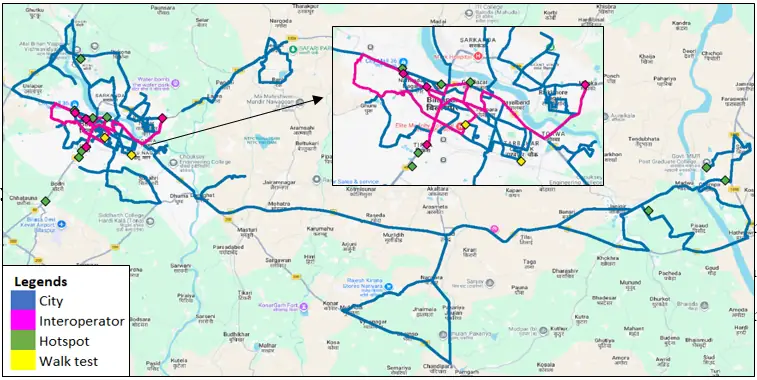
The Telecom Regulatory Authority of India has carried out mobile network quality assessments in Bilaspur and Janjgir-Champa under the Madhya Pradesh Licensed Service Area, in a move that highlights the regulator's continuing focus on service monitoring in India's tier-two and tier-three urban markets. The exercise is part of TRAI's broader drive to measure how telecom operators perform in real-world conditions, where network congestion, coverage gaps and inconsistent data speeds can directly affect daily communication, commerce and public services.
Network Monitoring Push
TRAI's field-level assessment comes at a time when mobile connectivity has become central to everything from digital payments and government services to education and emergency communication. In smaller cities such as Bilaspur and Janjgir-Champa, users increasingly expect the same quality of service available in larger metros, even as operators face different terrain, traffic patterns and infrastructure constraints. By testing network quality in these locations, the regulator is effectively checking whether service benchmarks are being met outside India's most commercially attractive markets.
The significance of such inspections lies not only in identifying weak spots, but also in establishing accountability. Telecom operators are required to maintain service quality across voice and data parameters, and TRAI's measurement framework is designed to determine whether consumers are receiving the level of connectivity promised under regulatory norms. For users, the issue is practical: dropped calls, delayed internet access and unstable coverage can disrupt work, education and access to digital services. For operators, the findings can influence network planning, investment priorities and customer retention strategies.
Why Smaller Cities Matter
The choice of Bilaspur and Janjgir-Champa is notable because it reflects a regulatory emphasis on markets that are often overlooked in national telecom debates. Much of India's network-quality conversation tends to focus on major metropolitan centres, where competition is intense and infrastructure investment is more visible. Yet the real test of telecom quality often lies in districts where demand is rising but network economics are less favourable.
In such areas, service quality can vary sharply depending on tower density, backhaul capacity and spectrum utilisation. Even where nominal coverage exists, actual user experience may fall short during peak hours or in densely populated pockets. TRAI's monitoring therefore serves a dual purpose: it provides a consumer-facing check on service standards and offers a data point for policymakers tracking the digital divide between urban cores and emerging regional centres.
The assessment also fits into a wider national context in which telecom quality has become a policy issue rather than merely a commercial one. As India expands digital governance, online service delivery and mobile-first public infrastructure, weak network performance can become a bottleneck to inclusion. Reliable connectivity is no longer a luxury; it is increasingly a prerequisite for participation in the economy and access to state services.
Regulatory Signal To Operators
Although the immediate findings of the assessment were not detailed in the headline announcement, the act of testing itself sends a clear signal to operators: service quality will be watched closely, and not only in high-profile markets. TRAI's field inspections are part of a broader regulatory architecture that relies on measurement, benchmarking and public accountability to improve telecom standards.
For the industry, such checks can act as both a warning and a guide. Where performance is strong, operators gain validation. Where gaps are exposed, they face pressure to improve coverage, optimise network capacity and address consumer complaints. In a market as competitive as India's, even incremental differences in quality can shape customer behaviour, especially as users become more sensitive to latency, call drops and inconsistent broadband performance.
The focus on Bilaspur and Janjgir-Champa also underlines a policy reality: India's telecom story is increasingly about depth, not just reach. The challenge is no longer limited to connecting the unconnected; it is about ensuring that connected users receive dependable, high-quality service regardless of geography. TRAI's latest assessment suggests that this remains a live regulatory priority, with smaller cities firmly within the frame of national telecom oversight.