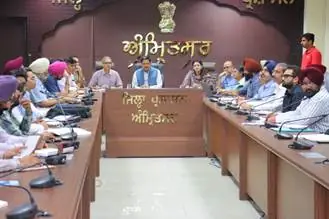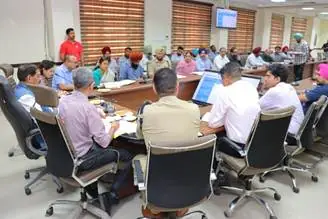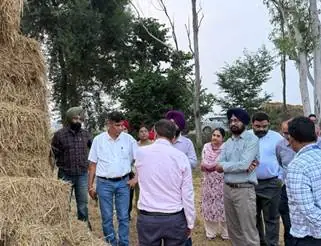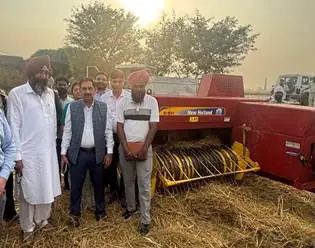
The Commission for Air Quality Management (CAQM) has stepped up its field-level oversight in Punjab, reviewing anti-stubble burning measures with the district administrations of Amritsar and Tarn Taran and visiting villages identified as high-risk hotspots for crop residue fires. The exercise comes as northern India braces for the seasonal deterioration in air quality that typically follows the paddy harvest, when open burning of stubble can send pollution levels sharply higher across Punjab, Haryana, Delhi and the wider Indo-Gangetic plain.
The review underscores a familiar but still unresolved policy challenge: translating repeated directives, monitoring systems and incentive schemes into sustained compliance on the ground. While the central and state governments have spent years trying to reduce residue burning through machinery subsidies, enforcement drives and awareness campaigns, the practice remains deeply tied to the economics of short harvest windows, labour shortages and the cost of residue management. The CAQM's engagement with district officials suggests a renewed push to test whether local administration can close the gap between policy design and field execution.
Field-Level Enforcement
According to the thrust of the review, the focus was not limited to paperwork or broad compliance targets. Officials examined the readiness of district teams, the deployment of monitoring mechanisms and the response capacity in villages where burning incidents have historically clustered. Such hotspot mapping has become central to anti-smoke strategy because it allows authorities to concentrate inspections, mobilise village-level outreach and intervene early where the risk of ignition is highest.
Amritsar and Tarn Taran are among the districts that have repeatedly figured in Punjab's stubble-burning enforcement efforts. Their agricultural profile, with extensive paddy cultivation and tight harvesting schedules, makes them especially vulnerable to residue fires during the transition from harvest to wheat sowing. In such districts, even modest non-compliance can have outsized air-quality consequences, particularly when weather conditions trap pollutants close to the ground.
The CAQM's visit to hotspot villages also signals an attempt to move beyond a purely punitive model. In recent years, authorities have increasingly recognised that fines and warnings alone cannot eliminate burning unless farmers have practical alternatives and timely access to machinery such as super seeders, mulchers and balers. The effectiveness of these interventions often depends on whether local officials can coordinate custom hiring centres, ensure machine availability at the right time and maintain continuous engagement with farmers' groups.
Compliance Meets Constraints
The broader policy context remains difficult. Punjab has made repeated commitments to reduce crop residue burning, and the state administration has expanded awareness drives and enforcement teams. Yet the structural pressures on farmers remain formidable. Many small and marginal cultivators operate under narrow margins and cannot afford delays in field preparation. When harvest timelines compress, burning is often viewed by farmers as the fastest and cheapest option, despite its environmental cost.
That is why district-level reviews matter. They provide a real-time assessment of whether anti-burning measures are merely present on paper or actually functioning in villages. They also help identify whether local administrations are adequately equipped to respond to violations, whether machinery is being used effectively and whether farmers are receiving the support needed to avoid open burning. In a policy environment where air pollution has become a national governance issue rather than a seasonal nuisance, such field inspections are increasingly part of the regulatory architecture.
The CAQM's involvement also reflects the commission's broader mandate to coordinate action across state boundaries and enforce measures aimed at improving air quality in the National Capital Region and adjoining areas. Stubble burning in Punjab remains a politically sensitive issue because its effects are not confined to the state itself. Smoke from agricultural fires can travel hundreds of kilometres, contributing to the post-monsoon pollution spike that routinely engulfs Delhi and surrounding regions.
Pressure Before Peak Season
The timing of the review is significant. Authorities are entering the most critical phase of the anti-burning calendar, when harvest activity accelerates and the number of fire incidents can rise quickly if preventive systems are weak. By visiting hotspot villages now, the CAQM and district administrations appear to be trying to pre-empt a seasonal surge rather than merely react to it.
The challenge ahead is whether this heightened oversight can produce measurable change. Success will depend on the speed of field response, the credibility of enforcement, and the ability of local administrations to persuade farmers that alternatives are available, affordable and reliable. Without that combination, the cycle of warnings, violations and pollution spikes is likely to repeat.
For now, the review in Amritsar and Tarn Taran indicates that the anti-stubble burning campaign remains a live administrative priority, with the CAQM pressing districts to demonstrate not just intent but operational readiness. In a region where agricultural practice and air quality are tightly linked, the coming weeks will test whether intensified supervision can finally reduce one of northern India's most persistent sources of seasonal pollution.