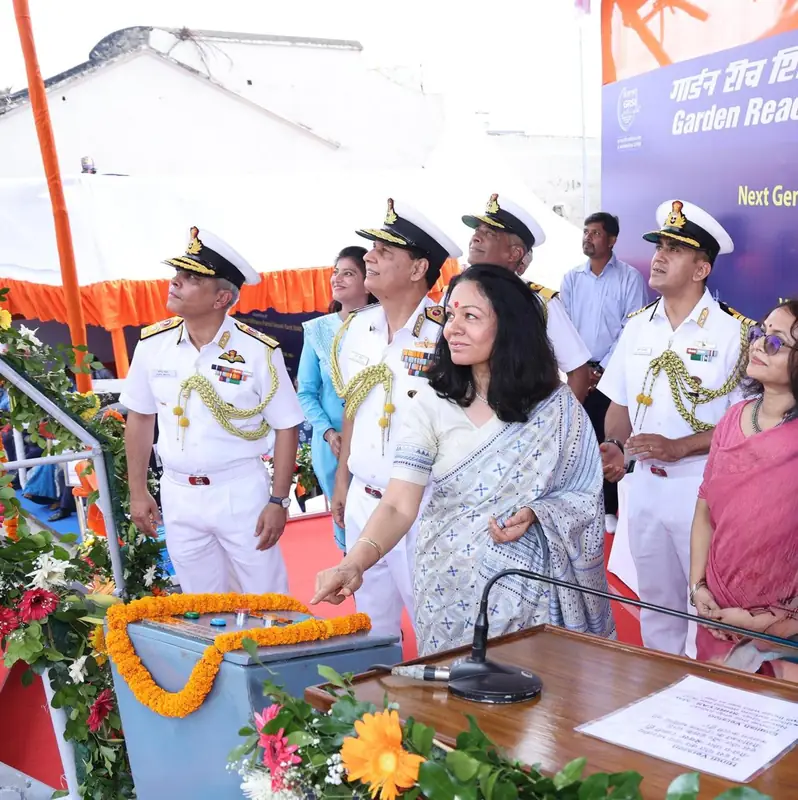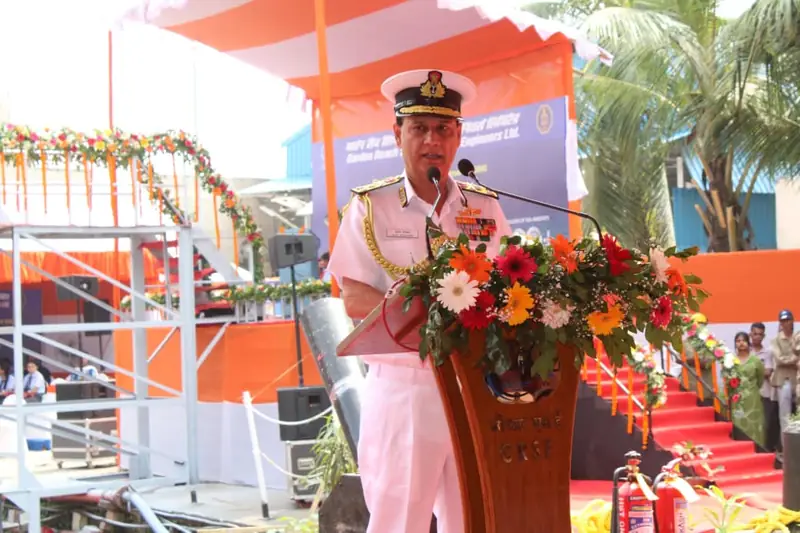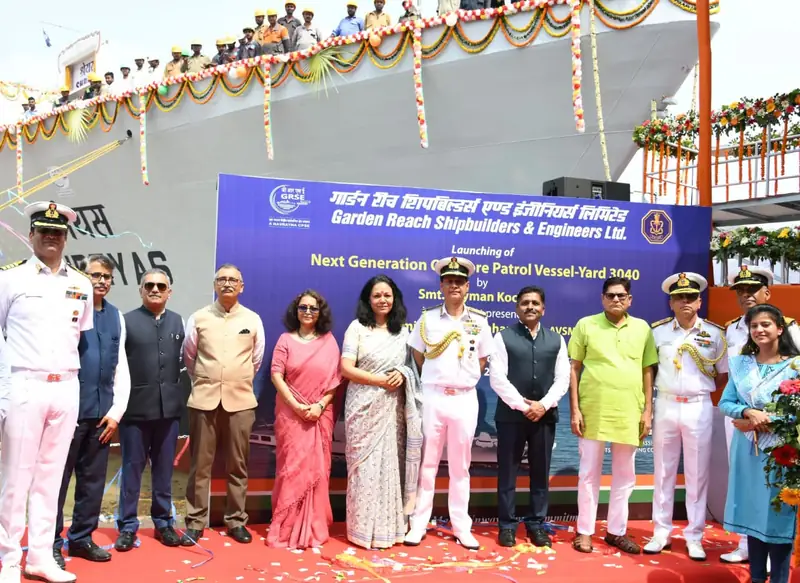
Garden Reach Shipbuilders and Engineers (GRSE) on Thursday launched Shreyas, a next-generation offshore patrol vessel built as Yard 3040, at its Kolkata shipyard, adding a new platform to India's expanding indigenous naval production pipeline. The launch is significant not merely as a routine industrial milestone, but as part of a broader policy architecture that seeks to strengthen maritime security while deepening domestic defence manufacturing under the country's self-reliance agenda.
The vessel's launch comes at a time when India is placing greater strategic weight on its coastline, island territories, and offshore economic interests. Offshore patrol vessels are central to this effort because they are designed to conduct surveillance, interdiction, search and rescue, and presence missions across wide maritime zones. In practical terms, they help the Navy and other maritime agencies maintain continuous domain awareness in waters where trafficking, illegal fishing, smuggling, and other non-traditional threats can quickly escalate into security concerns.
Indigenous Maritime Push
The launch of Shreyas reflects the state's continuing preference for domestic shipbuilding as a policy instrument. GRSE, a defence public sector undertaking with a long record in naval construction, has become one of the most visible symbols of India's effort to reduce dependence on foreign suppliers for critical maritime platforms. Each new vessel delivered or launched at an Indian yard strengthens the industrial ecosystem around steel fabrication, marine engineering, systems integration, and specialized labour.
That industrial dimension matters because shipbuilding is not a stand-alone activity. It creates downstream and upstream effects across suppliers, design houses, electronics vendors, propulsion specialists, and maintenance networks. In a sector where timelines are long and technical standards are exacting, a successful launch also signals the maturity of the domestic production base. For policymakers, this is as important as the vessel itself: it demonstrates that India can convert strategic intent into hardware at scale.
The launch also aligns with the government's broader emphasis on defence indigenisation, which has increasingly shaped procurement, production, and industrial policy. By supporting platforms built in Indian yards, New Delhi is seeking to build resilience into its maritime posture while retaining more of the economic value chain within the country. That approach has become especially relevant as geopolitical competition intensifies across the Indian Ocean region and navies worldwide invest in patrol, surveillance, and deterrence capabilities.
Security At Sea
Offshore patrol vessels occupy a crucial middle ground in naval force structure. They are not front-line combatants in the traditional sense, but they are indispensable in peacetime and low-intensity operations. Their endurance, range, and flexibility make them well suited for persistent presence missions, maritime policing support, and rapid response across India's vast sea lanes.
For India, that role is increasingly strategic. The country's maritime responsibilities extend far beyond territorial waters, encompassing exclusive economic zones, shipping corridors, offshore energy assets, and island approaches. A vessel like Shreyas adds capacity to monitor these spaces more effectively, especially as maritime security threats become more diffuse and less predictable. In that environment, patrol vessels are not auxiliary assets; they are foundational to maritime governance.
The launch at GRSE also highlights Kolkata's continuing importance in India's defence-industrial geography. The city remains one of the country's key shipbuilding centres, and GRSE's output is closely watched as a barometer of the public sector's ability to deliver complex platforms on schedule. In policy terms, the shipyard's performance feeds directly into debates over manufacturing competitiveness, public investment, and the pace of defence modernization.
Policy And Industrial Signal
Beyond the immediate operational value of the vessel, the launch sends a clear policy signal. India is not only expanding its fleet; it is also trying to institutionalize a maritime-industrial model that can support future requirements without excessive reliance on imports. That is particularly relevant as the Navy, Coast Guard, and other maritime stakeholders face growing demands for surveillance, logistics, and coastal response capabilities.
The launch of Shreyas therefore fits into a larger national narrative: maritime security as an extension of economic security, and shipbuilding as an instrument of strategic autonomy. While the vessel itself will eventually be judged by performance, reliability, and operational utility, the launch already carries significance as evidence of continued momentum in indigenous defence production.
For the government, such milestones help reinforce the credibility of its policy messaging around self-reliance, industrial capability, and national security preparedness. For the shipyard, they validate years of technical investment and workforce development. And for India's maritime planners, they add another platform to a fleet that must cover an increasingly complex and contested ocean environment.
In that sense, the launch of Shreyas is more than a ceremonial event at a Kolkata shipyard. It is a reminder that India's defence modernization is being built not only in ministries and procurement offices, but also on the slips and dry docks where industrial policy becomes operational power.