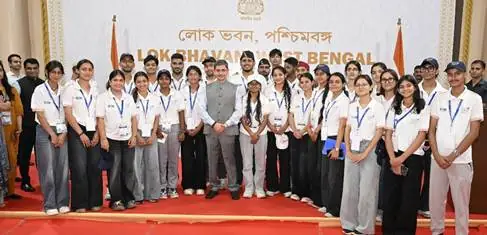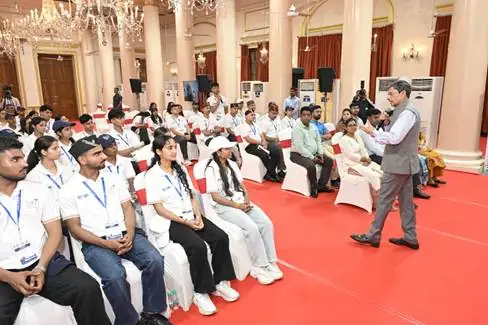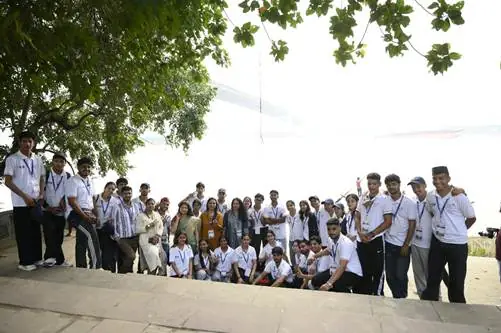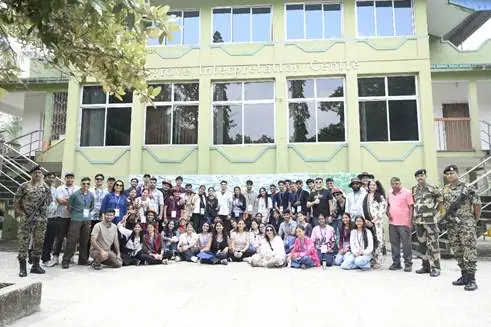
A delegation from Uttarakhand met West Bengal Governor R. N. Ravi during its visit as part of Youth Sangam Phase VII, a programme designed to promote inter-state exposure, civic learning, and youth-led national integration. The interaction, held during the delegation's tour in West Bengal, highlighted the growing emphasis on experiential learning as a policy tool for shaping informed, socially aware young citizens.
The meeting comes at a time when youth engagement programmes are being increasingly viewed not merely as cultural exchanges, but as instruments of governance outreach. By placing students and young participants in direct contact with constitutional authorities and public institutions, such initiatives aim to move beyond symbolic interaction and create a more grounded understanding of India's federal structure, administrative diversity, and democratic responsibilities.
Youth Exchange Agenda
Youth Sangam Phase VII is part of a wider framework intended to connect young people from different states through travel, dialogue, and institutional visits. The programme typically exposes participants to the social, economic, and administrative realities of another state, allowing them to observe governance models and public life beyond their home region. In that sense, the Uttarakhand delegation's meeting with the Governor was not an isolated ceremonial event, but part of a deliberate effort to link youth mobility with civic education.
Such exchanges have gained policy relevance because they address a longstanding challenge in India's federal democracy: the limited cross-state familiarity among young citizens. While digital connectivity has expanded access to information, it has not necessarily replaced direct experience. Programmes like Youth Sangam attempt to fill that gap by encouraging participants to engage with institutions, local communities, and public leadership in person.
The presence of Governor R. N. Ravi added constitutional weight to the interaction. As a state's ceremonial head and a representative of the Union's constitutional framework, the Governor's engagement with a youth delegation carries symbolic significance. It reinforces the idea that democratic institutions are not distant abstractions, but living structures that depend on informed participation and public trust.
Federalism Through Exposure
The Uttarakhand delegation's visit also reflects a broader national policy trend: using youth exchange as a soft-power instrument within the domestic sphere. Rather than relying solely on classroom instruction, the programme encourages participants to observe how another state functions, how public institutions are perceived, and how regional identities coexist within the national framework. This is especially relevant in a country as diverse as India, where social and administrative practices can vary sharply across states.
For Uttarakhand participants, West Bengal offers a distinct political, cultural, and administrative context. The encounter with the Governor would have provided an opportunity to understand how constitutional offices operate within a different state environment, while also reinforcing the shared institutional architecture that binds the Union together. Such exposure can be particularly valuable for students and young professionals who may later enter public service, policy work, academia, or civil society leadership.
The policy logic behind these exchanges is straightforward: national cohesion is strengthened when young people are encouraged to see diversity as a lived reality rather than a slogan. Youth Sangam, in this respect, functions as a bridge between identity and institution. It allows participants to appreciate regional difference while also internalising the common civic framework that underpins the republic.
Civic Learning, National Reach
The meeting in West Bengal also illustrates how youth programmes can serve as low-cost, high-impact public diplomacy within India itself. Unlike large-scale welfare schemes, their value lies less in material transfer and more in shaping attitudes, networks, and civic literacy. The long-term payoff is harder to measure, but potentially significant: a generation that has seen the country beyond its own state borders is more likely to approach governance with nuance and empathy.
For policymakers, the challenge is to ensure that such programmes remain substantive rather than ceremonial. Their credibility depends on meaningful interaction, structured learning, and follow-up engagement after the visit concludes. If executed well, Youth Sangam can become a durable platform for building inter-state understanding and reinforcing the democratic idea of India as a union of diverse but connected societies.
The Uttarakhand delegation's meeting with Governor R. N. Ravi therefore fits into a larger national governance narrative. It is a reminder that youth policy is not only about employment or education in the narrow sense. It is also about citizenship formation, institutional familiarity, and the cultivation of a shared national outlook. In that broader frame, the visit carries significance well beyond the formal handshake and photograph.