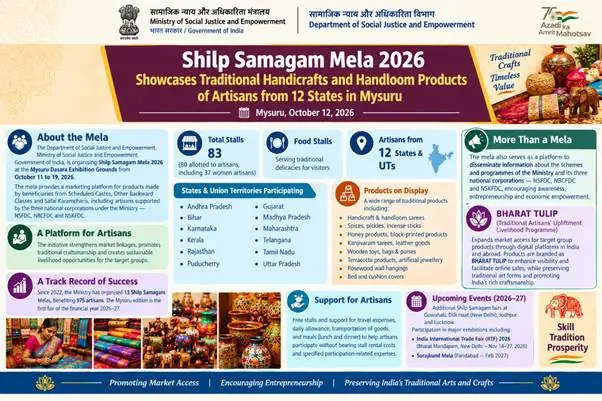
Mysuru is set to become a focal point for India's handicraft economy when a nine-day craft confluence opens on October 11, bringing together artisans, craft entrepreneurs, and policy observers in a format designed to promote traditional skills and market access. The event arrives at a time when the government is increasingly framing handicrafts not only as cultural assets, but also as instruments of livelihood generation, export potential, and local economic development.
The timing and location are significant. Mysuru, long associated with heritage, tourism, and artisanal production, offers a symbolic and practical setting for a national-level craft showcase. By anchoring the event in a city with a strong cultural identity, organisers are effectively linking the preservation of traditional knowledge with the contemporary need to expand demand, improve visibility, and strengthen value chains for small producers.
Craft Economy Focus
The craft confluence is expected to function as more than a retail exhibition. Events of this kind increasingly serve as policy-adjacent platforms where artisans can connect with buyers, intermediaries, designers, and institutional stakeholders. For many craft producers, especially those operating outside major commercial hubs, access remains the central challenge. A structured fair environment can help bridge that gap by creating direct market exposure and by signalling official recognition of the sector's economic importance.
India's handicraft industry occupies a complex place in national policy. It is labour-intensive, geographically dispersed, and deeply rooted in local tradition, yet often vulnerable to weak market linkages, inconsistent incomes, and competition from mass-produced substitutes. A nine-day event in Mysuru therefore has relevance beyond the immediate footfall it may generate. It reflects a broader governance approach that seeks to preserve cultural heritage while also treating craft as a viable economic category.
The event may also support the government's wider emphasis on self-employment and microenterprise. Craft-based livelihoods are especially important in semi-urban and rural areas, where formal job creation remains uneven. By creating a public marketplace for artisans, the confluence can help demonstrate how heritage sectors contribute to inclusive growth, particularly when backed by institutional support, branding, and buyer outreach.
Heritage Meets Markets
What makes such gatherings strategically important is the way they convert intangible cultural value into measurable economic opportunity. Handicrafts often depend on storytelling, provenance, and authenticity as much as on product quality. A well-curated fair can therefore elevate the status of artisans from anonymous producers to recognised cultural entrepreneurs. That shift matters in a market increasingly shaped by consumer interest in handmade, sustainable, and locally sourced goods.
For policymakers, the challenge is to ensure that these events do not remain isolated showcases. The real test lies in whether they lead to sustained orders, repeat buyers, design collaborations, and access to formal credit or digital commerce channels. Without that continuity, even successful exhibitions risk becoming temporary visibility exercises rather than durable economic interventions.
Mysuru's selection also underscores the role of cities outside India's largest metropolitan centres in national economic policy. Decentralised cultural events can distribute attention more evenly across regions and help build local ecosystems around tourism, hospitality, transport, and small business activity. In that sense, the craft confluence is not only about artisans; it is also about the wider urban economy that benefits when cultural events draw visitors and spending.
Policy Signal For Artisans
The broader policy message is clear: traditional crafts are being positioned as part of India's development story, not merely as relics of the past. That framing matters at a time when governments are seeking to balance industrial growth with employment-intensive sectors that can absorb skill, preserve identity, and generate exportable value. A national craft event in Mysuru fits squarely within that logic.
As the nine-day confluence opens, attention will likely focus on the scale of participation, the diversity of crafts represented, and the extent to which the event translates visibility into opportunity. For artisans, the hope is that the fair will do more than celebrate heritage. It should help build markets, strengthen incomes, and reaffirm that India's craft traditions remain economically relevant in a rapidly changing economy.