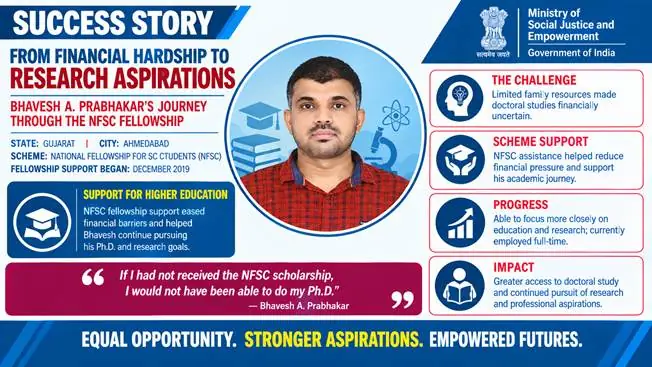
India's research ecosystem is increasingly being tested by a quiet but consequential reality: many of the country's most capable students do not arrive at advanced study from privilege, but from financial constraint. The result is a policy problem that sits at the intersection of education, social mobility, and national competitiveness. For a system that routinely speaks of innovation, self-reliance, and knowledge leadership, the challenge is not merely to identify talent, but to sustain it long enough for it to mature into scholarship.
Financial Barriers Persist
For thousands of students, the path from undergraduate study to research is not a linear academic progression but a series of economic calculations. Tuition, living costs, exam preparation, relocation expenses, and the opportunity cost of years spent in low-paid or uncertain academic training can make research appear less like a vocation and more like a luxury. In practice, this means that intellectual ability alone is rarely sufficient. Students from lower-income households often face a stark choice between immediate employment and the longer, less certain route of research.
This is not a new problem, but it has become more visible as India expands its higher education footprint and raises expectations around research output. The country has built a large university system, yet the financial architecture supporting early-career researchers remains uneven. Scholarships, fellowships, and institutional grants exist, but access is inconsistent, award values are often inadequate relative to urban costs, and delays in disbursement can destabilize even the most determined students. The gap between policy intent and lived experience remains wide.
Talent Needs Support
The broader governance question is whether India can afford to let financial hardship determine who becomes a researcher. In a knowledge economy, the loss is not only personal; it is national. When promising students abandon research because they cannot absorb years of uncertainty, the system forfeits future faculty, scientists, policy analysts, and innovators. That attrition weakens the country's long-term capacity to generate original ideas and to compete in fields where research depth matters as much as scale.
This is especially significant in a country where higher education is expected to serve multiple public goals at once: social inclusion, workforce development, and global competitiveness. Research training is one of the few mechanisms that can simultaneously advance all three. It can lift individuals into stable professional careers, strengthen institutions through better teaching and inquiry, and contribute to national priorities in technology, health, agriculture, and governance. But those outcomes depend on sustained investment, not rhetorical commitment.
The policy challenge is compounded by the unevenness of institutional ecosystems across India. Elite institutions may offer stronger funding, better mentorship, and more predictable academic pathways, while many state universities and smaller colleges struggle with limited resources and administrative bottlenecks. This creates a stratified research landscape in which opportunity is often shaped by geography and institutional pedigree as much as merit. The result is a system that can identify talent but not always nurture it.
Policy Gap, National Stakes
The stakes extend beyond higher education administration. Research capacity is increasingly central to India's ambitions in industrial policy, public health, digital governance, climate adaptation, and strategic autonomy. A country that wants to lead in these domains cannot rely on a narrow pipeline of researchers drawn from financially secure backgrounds. It needs a broader, more inclusive pipeline that allows students from economically constrained households to persist.
That requires more than isolated scholarships or one-time grants. It calls for a more coherent framework: predictable fellowship support, timely payments, stronger hostel and housing access, better mentorship, and clearer pathways from postgraduate study to doctoral and postdoctoral work. It also requires institutions to treat financial insecurity as a structural issue rather than an individual failing. Without that shift, the system will continue to lose talent at precisely the stage when it is most expensive to replace.
The phrase "from financial strain to research ambition" captures both the promise and the fragility of India's academic future. Ambition is abundant. What remains in short supply is the policy design needed to convert aspiration into durable research careers. If governance is to mean anything in this context, it must ensure that the ability to pursue knowledge is not determined by the size of a family's bank balance.
For India, the question is no longer whether there are students willing to do research. There are. The real test is whether the state and its institutions are prepared to make that choice viable.