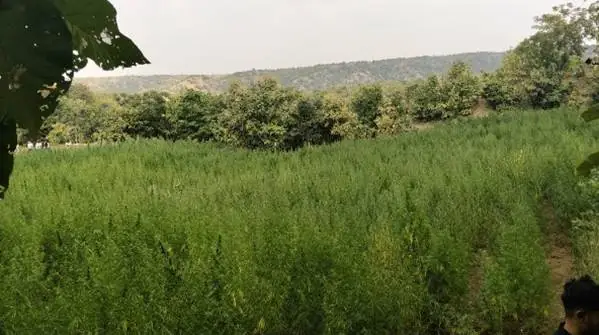
In a significant anti-narcotics operation, the Directorate of Revenue Intelligence and the Central Bureau of Narcotics have destroyed an illegal cannabis plantation cultivated across 2.87 hectares, or 7.08 acres, inside a wildlife sanctuary in Maharashtra's Dhule district. The action, carried out in a protected forest area, highlights both the scale of the illicit crop and the operational challenge posed by remote terrain that can be exploited by traffickers seeking concealment from law enforcement.
The destruction of the plantation is notable not only for its size but also for its location. Wildlife sanctuaries and other protected forest zones are increasingly being misused by criminal networks because of their difficult access, sparse human presence, and natural cover. Such sites can provide temporary insulation from detection, allowing illegal cultivation to proceed until agencies receive intelligence or conduct targeted surveillance. The Dhule case suggests that narcotics enforcement is now extending deeper into environmentally sensitive areas where drug production intersects with forest crime and ecological damage.
Forest Cover Exploited
The use of sanctuary land for cannabis cultivation raises broader concerns about the convergence of narcotics trafficking, land encroachment, and environmental degradation. Cannabis plants grown in such areas are often planted in dispersed patches or hidden clearings, making them harder to identify from the ground and, in some cases, even from routine patrols. The destruction of a plantation of this size indicates that the cultivation was not a small, opportunistic patch but a substantial illicit operation requiring planning, labour, and logistical support.
While officials have not immediately disclosed the identities of those behind the cultivation, the operation points to a recurring enforcement problem: illegal growers frequently rely on remote, difficult-to-monitor landscapes to evade detection. In many such cases, the crop is linked to broader supply chains that move the harvested product into regional and interstate illicit markets. The eradication of the plantation therefore disrupts not just a local cultivation site but potentially a node in a wider narcotics distribution network.
The involvement of both the DRI and the CBN is also significant. The DRI, which primarily focuses on smuggling and revenue-related offences, and the CBN, which is the specialist agency for narcotics control under the Union government, bring complementary capabilities to such operations. Their joint action reflects a more integrated enforcement approach, combining intelligence gathering, field verification, and destruction of the crop. In practice, such coordination is essential when illicit cultivation occurs in hard-to-reach terrain that demands both investigative expertise and on-ground execution.
Enforcement Pressure Rises
The operation comes amid sustained national concern over narcotics trafficking and the misuse of forested and border regions for cultivation and transit. Cannabis remains one of the most commonly cultivated illicit drugs in India, and while enforcement agencies regularly destroy plantations, the persistence of such crops shows that traffickers continue to adapt to geography and enforcement patterns. The Dhule seizure adds to evidence that protected areas are being drawn into the narcotics economy, creating a dual threat to public security and biodiversity.
For policymakers, the case reinforces the need for stronger inter-agency intelligence sharing, more frequent forest surveillance, and closer coordination with local administration and wildlife authorities. Remote sanctuaries can no longer be treated solely as conservation zones; they are also potential concealment spaces for organised illegal activity. That reality places pressure on enforcement agencies to combine traditional anti-drug operations with environmental monitoring, drone surveillance, and community-based reporting mechanisms.
The destruction of 2.87 hectares of illegal cannabis in a wildlife sanctuary is therefore more than a routine seizure. It is a reminder that narcotics enforcement in India is increasingly tied to land use, forest governance, and the protection of ecologically sensitive areas. As agencies intensify operations against cultivation and trafficking, the Dhule action stands out as a clear example of how illicit drug production can infiltrate even protected landscapes, and why coordinated intervention remains essential.