
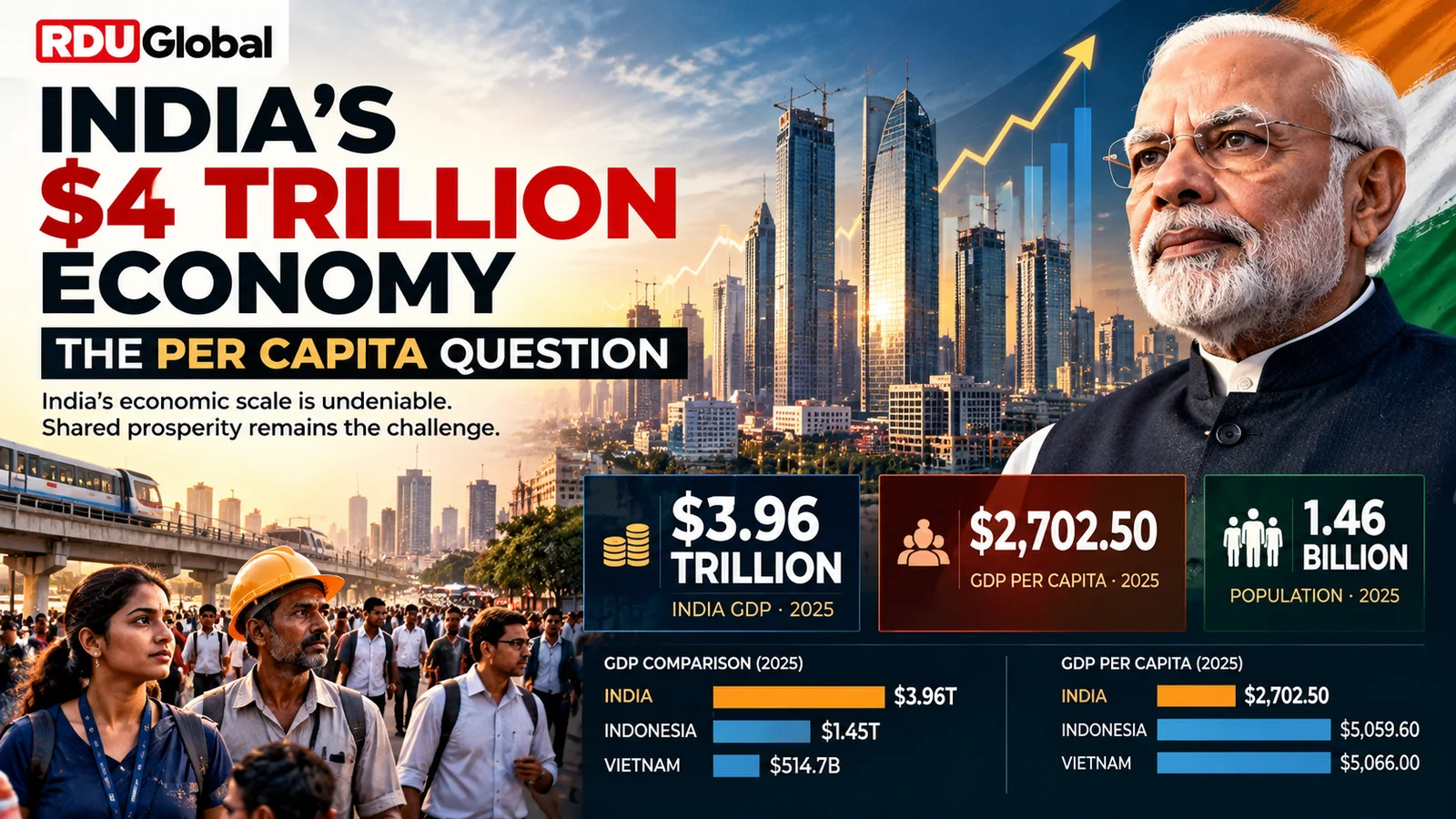
Every time India’s economic growth or its place among the world’s largest economies is discussed, a familiar response follows: look at GDP per capita. India may have crossed the $3 trillion mark, the argument goes, but its output per person remains far below that of many other countries.
The figure matters. But using it to dismiss the achievement of building a large economy confuses two different questions: how much a country produces, and how much it produces for each person.
"The size of an economy and the prosperity of its people are different questions. Neither figure should be used to erase the other."
Imagine a man who worked his way up to become a CEO and now earns ₹5 lakh a month. Twenty people depend on that income. Another household consists of a couple who together earn ₹1 lakh a month. Someone declares the couple better off and, on a per-person calculation, they are: ₹50,000 a month each, compared with ₹25,000 for each member of the CEO’s household. Yet it would be absurd to say that the CEO’s ₹5 lakh income is therefore no achievement. His earning power and the resources available to each person in his household are separate facts.
The same distinction applies, with limits, to national economies. According to the World Bank’s 2025 figures, India’s GDP was about $3.96 trillion, while GDP per capita was $2,702.50. Indonesia produced about $1.45 trillion, but its GDP per capita was $5,059.60. Vietnam produced about $514.7 billion, with GDP per capita of $5,066. India’s total output dwarfs both economies, even as its output per person is considerably lower. These are nominal figures in current US dollars, measured for the same year.
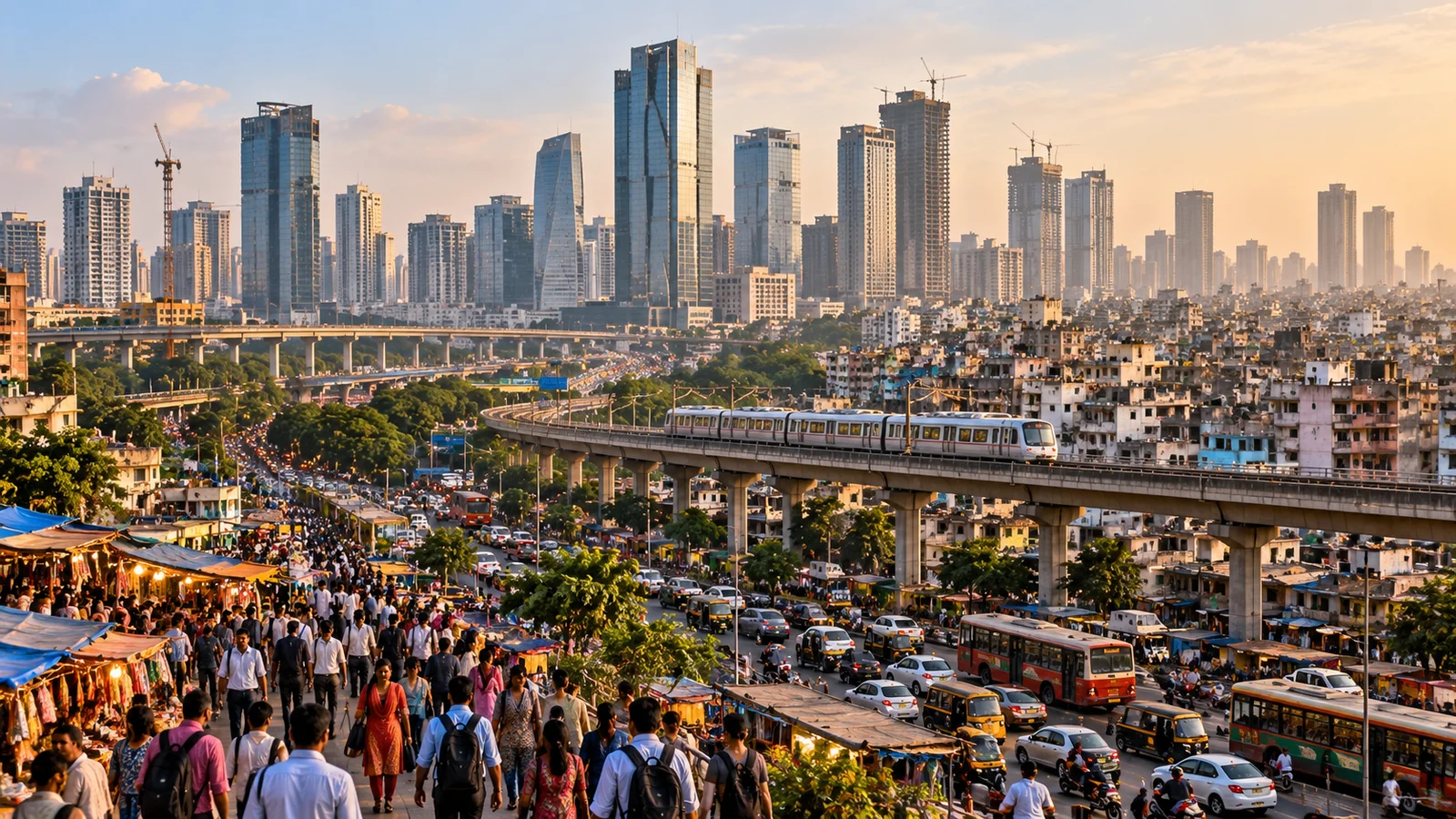
Total GDP tells us something about the scale of production, the size of a market and a country’s potential economic weight. GDP per capita asks a different question about the output available, on average, for each resident. It is not an average salary and tells us nothing, by itself, about who receives the gains. Still, it is a necessary warning against mistaking a high national ranking for widespread prosperity.
The Arithmetic of Scale and Demographics
The arithmetic behind that warning is simple: GDP per capita is total GDP divided by population. Producing more raises the ratio; slowing population growth means each additional gain in output is spread among fewer new people. For India, the second route would have mattered most if pursued effectively decades ago. A country that had built a similar economy with fewer people would, arithmetically, have had more output per person. India’s population of roughly 1.46 billion therefore cannot be treated as irrelevant to its relatively low per-capita figure. The UN Population Fund puts its 2025 population at 1,463,900,000.
That makes population a serious historical question. Earlier and more effective access to education for girls, women’s economic opportunity, maternal healthcare and voluntary family planning could have moderated growth in the number of people among whom each gain in output must be spread. It would be inaccurate, however, to say that past governments ignored the issue: India launched a national family planning programme in 1952. The criticism is that progress across regions and in women’s freedom to make reproductive choices was too slow and uneven, leaving today’s policymakers with the consequences.
Those consequences cannot be reversed by simply announcing a new population target. The UN Population Fund estimates India’s fertility rate at 1.9 births per woman in 2025, below the commonly used replacement benchmark of about 2.1. Yet the population can keep rising for decades because large generations born earlier are now reaching adulthood. A UN analysis describes this as population momentum. Family planning remains important, especially when people cannot exercise their own choices, but it cannot quickly shrink a population already alive.
The Productivity Imperative
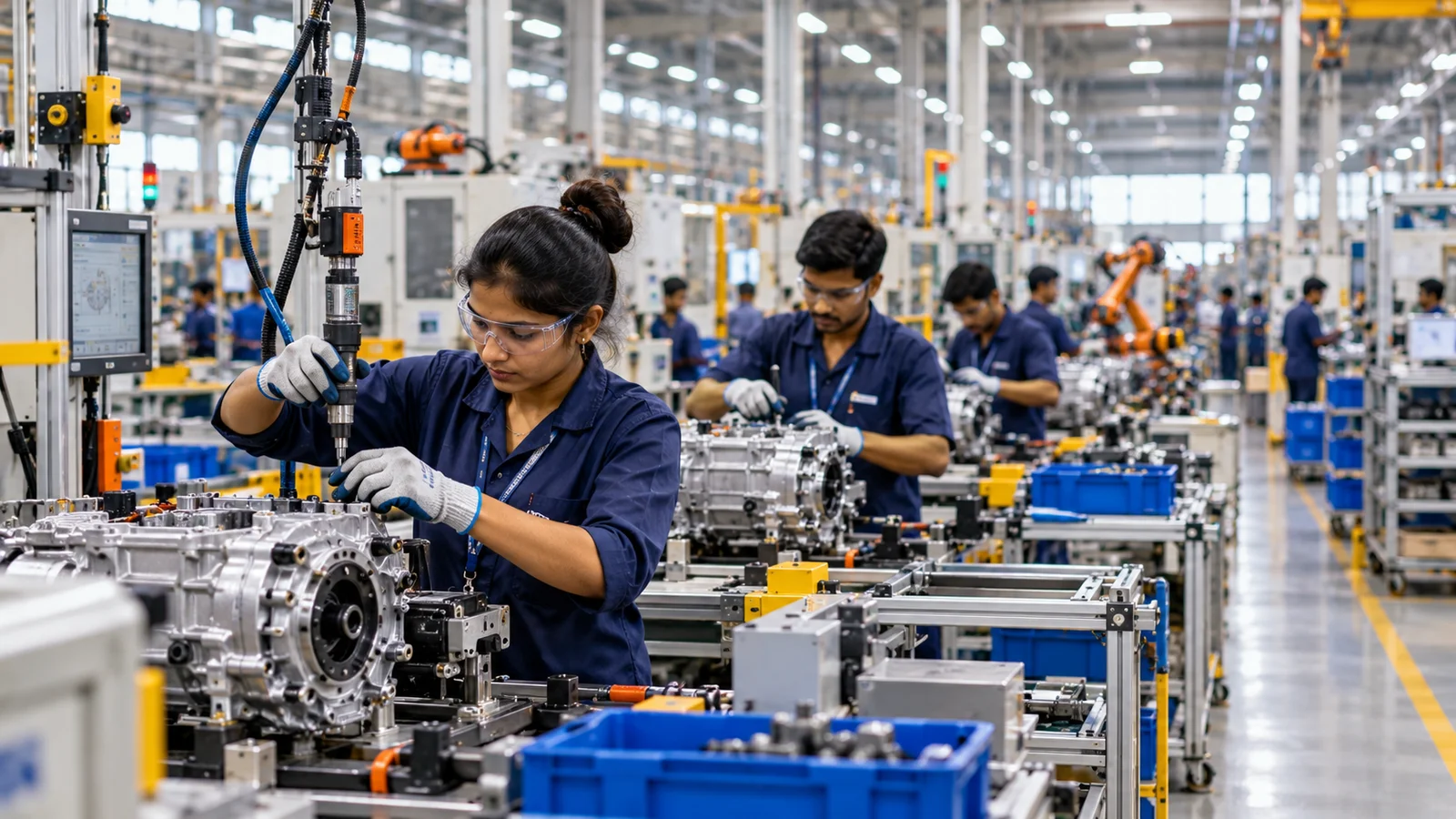
Nor is population size the whole explanation for income per person. China’s 2025 GDP per capita was $13,862, despite a population of about 1.41 billion. The difference points to the harder task facing India now: producing more value per worker, creating better-paid jobs and enabling more women to participate in the economy. Education, health, infrastructure and productive employment will determine whether the country’s scale becomes a source of shared prosperity.


India’s large population is, in part, a legacy of earlier decades. Its nearly $4 trillion economy is a real achievement. Its roughly $2,700 GDP per capita is a real challenge. We should neither use the second figure to belittle the first nor use the first to avoid confronting the second. The measure of progress from here is how much of India’s growing economic strength reaches the people who make that economy possible.