
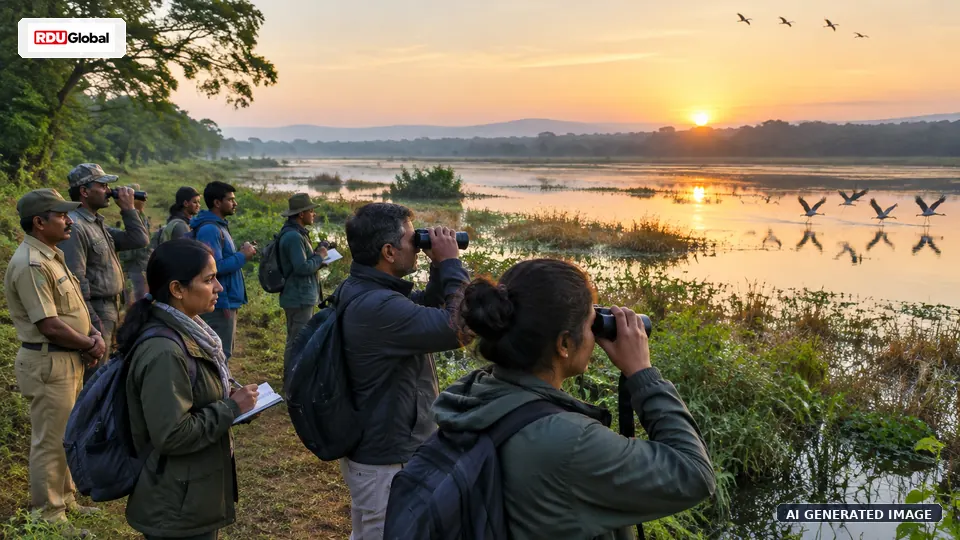
Karnataka is set to stage its first Rajyotsava Bird Count from October 30 to November 2, in a move that blends public participation with biodiversity monitoring at a time when citizen science is gaining wider policy relevance across India. The exercise, announced by the state Forest Department in partnership with Bird Count India, is open to anyone who wants to take part, signalling an unusually broad invitation for an ecological survey that traditionally depends on trained observers.
Citizen Science Push
The launch of the bird count reflects a growing recognition that conservation data cannot rely solely on government field staff and academic researchers. By opening the exercise to the public, Karnataka is effectively widening the base of people contributing to species documentation, habitat awareness and seasonal trend tracking. That matters in a state with a wide ecological range, from the Western Ghats to urban wetlands and agricultural landscapes, each supporting distinct bird populations.
Bird counts are more than a recreational activity for enthusiasts. When conducted systematically, they generate records that can help identify changes in bird abundance, migration patterns and habitat health. In policy terms, such information can support forest management, wetland protection and broader biodiversity planning. The Rajyotsava Bird Count also arrives at a moment when environmental governance is increasingly expected to be participatory, data-driven and locally grounded.
The timing is notable as well. The four-day window coincides with a period when many bird species are active across different habitats, improving the chances of meaningful observations. While the announcement does not frame the count as a formal census, the open call to citizens suggests an emphasis on awareness-building as much as on data collection. That dual purpose is often central to successful public science initiatives: the more people who observe, record and report, the stronger the culture of ecological stewardship becomes.
Statewide Observation Window
The Rajyotsava Bird Count is likely to draw participants from birdwatchers, students, nature clubs, resident groups and first-time observers. For the Forest Department, the exercise offers an opportunity to connect conservation messaging with Karnataka Rajyotsava, the state's annual celebration, and to use the occasion to foreground the state's natural heritage alongside its cultural identity.
The partnership with Bird Count India adds technical credibility. The organisation has been associated with bird monitoring efforts that encourage standardised observation and public participation, helping transform casual sightings into usable ecological records. In practice, such collaborations can improve the quality of reporting by promoting basic field discipline, including careful identification, location tagging and time-bound observation.
The broader significance lies in how the initiative fits into India's evolving environmental governance model. Citizen-led biodiversity surveys have become increasingly important in a country where official monitoring capacity is often stretched across vast and varied terrain. Public participation can help fill gaps, especially in urban and peri-urban areas where birdlife is affected by rapid land-use change, pollution and shrinking green cover.
For Karnataka, the bird count also serves a symbolic function. The state has long positioned itself as one of India's ecologically diverse regions, and a public bird survey reinforces that identity in a practical way. It invites residents to see biodiversity not as a distant conservation issue but as something observable in neighbourhood parks, lakes, forests and farmlands.
Data, Awareness, Policy
The real test of the initiative will be whether it can convert enthusiasm into reliable records and sustained engagement beyond the four-day period. Public science campaigns often succeed when they are easy to join, clearly guided and followed by transparent sharing of results. If the Rajyotsava Bird Count can deliver on those fronts, it may become a model for similar state-level efforts elsewhere.
At a deeper level, the exercise underscores a shift in how conservation is communicated. Rather than presenting biodiversity as the exclusive domain of specialists, Karnataka is framing it as a shared civic responsibility. That approach can broaden environmental literacy, especially among younger participants, while also creating a larger constituency for habitat protection.
The announcement does not yet indicate how observations will be compiled or when findings will be released, but the open nature of the count suggests that participation itself is a central objective. In an era when ecological pressures are intensifying, even a short bird count can serve as a meaningful bridge between public awareness and policy-relevant environmental data.