
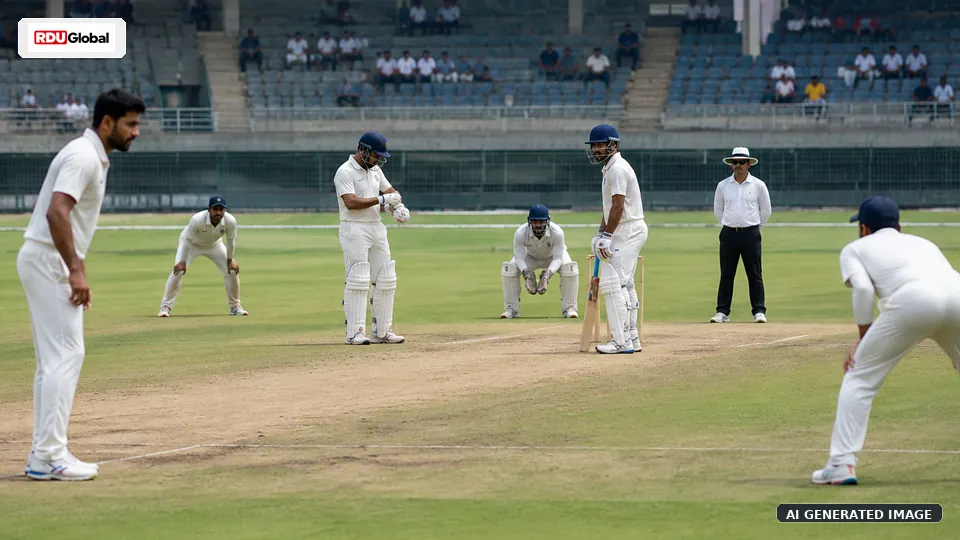
Goa were forced into damage control after Vidarbha's bowlers struck early and repeatedly, but the innings was stabilised by a determined stand from Kasvankar and Misal in a crucial recovery phase. What began as a potentially damaging collapse was gradually converted into a more manageable position, with Goa showing the sort of resilience that can define a long-format contest.
Early Pressure Tells
Vidarbha's opening burst set the tone for the session. Their bowlers attacked the stumps, kept a disciplined line, and denied Goa any easy scoring opportunities in the first phase of the innings. The pressure quickly translated into wickets, leaving Goa vulnerable and briefly on the back foot. In red-ball cricket, such starts can alter the rhythm of an entire day, and Vidarbha appeared well positioned to force a deeper collapse.
The early breakthroughs were not accidental. Vidarbha's attack looked organised and purposeful, using movement off the pitch and sustained accuracy to test Goa's top order. The fielding support matched the bowling intent, with close-in placements and sharp intensity ensuring that every run had to be earned. For Goa, the challenge was not only to survive the spell but to reset the innings without allowing the scoreboard to spiral out of control.
Kasvankar, Misal Respond
That response came through Kasvankar and Misal, who absorbed the pressure with a partnership built on restraint, judgment, and selective aggression. Rather than attempting to counterattack immediately, the pair prioritised survival and rotation of strike, allowing the innings to regain shape after the early setbacks. Their approach was measured but effective, blunting Vidarbha's momentum and forcing the bowlers to search for new answers.
The significance of the stand went beyond the runs themselves. In a situation where another wicket could have opened the door to a full-scale collapse, the partnership offered Goa a platform to rebuild. Both batters showed an understanding of match context, resisting the temptation to play expansive shots against a disciplined attack. That discipline was central to Goa's recovery and may prove decisive if the innings can be extended further.
For Vidarbha, the challenge now is to break the stand and reassert the pressure that defined the opening exchanges. Their bowlers had done the hard work early, but cricket at this level often turns on whether a side can convert pressure into sustained dominance. Goa's recovery has not erased the impact of the early wickets, but it has prevented the innings from slipping beyond repair.
Contest Still Open
The broader contest remains finely balanced. Vidarbha will take encouragement from the fact that their bowlers created immediate problems and exposed weaknesses in Goa's top order. Yet Goa's response has ensured that the match has not tilted decisively in one direction. The innings now depends on whether the lower middle order can build on the foundation laid by Kasvankar and Misal, or whether Vidarbha can return to strike and expose the tail.
This phase of the match also reflects the tactical nature of domestic cricket in India, where momentum can shift rapidly but is rarely permanent. Early wickets often create headlines, but the ability to rebuild under pressure is equally valuable. Goa's recovery has demonstrated that quality resistance can neutralise even a sharp opening spell, while Vidarbha's effort has shown the importance of sustained discipline rather than short bursts alone.
As the innings develops, the key question is whether Goa can convert recovery into a competitive total. Much will depend on how long Kasvankar and Misal's stand can be extended, and whether the batting unit can avoid another cluster of wickets. For now, Goa have survived the worst of the early storm, and Vidarbha must work again to turn promise into control.