
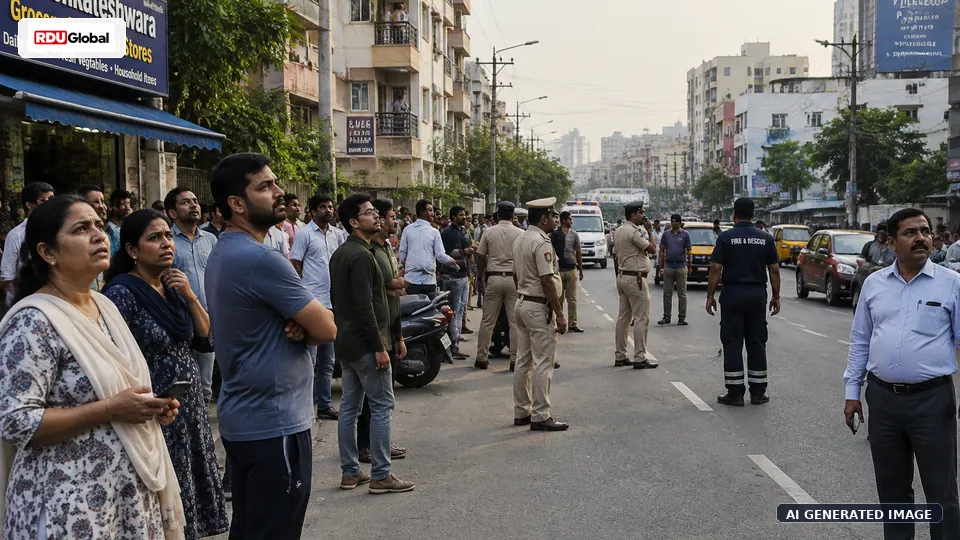
Residents in parts of Hyderabad's Attapur and Rajendranagar areas were jolted on Tuesday afternoon by a loud sound that spread alarm across the neighbourhoods and prompted a rush of speculation on social media and in local communities. The noise, heard around 4:34 PM IST, led many people to step out of homes and shops, with some reporting that the sound was strong enough to be felt across a wider stretch of the western corridor of the city.
Initial reactions reflected the uncertainty that often follows such incidents in dense urban areas. In the absence of an immediate official explanation, residents feared everything from a gas-related accident to an explosion or structural collapse. The rapid spread of unverified claims added to the confusion, underscoring how quickly panic can build in a city where high-density residential pockets sit close to busy roads, commercial activity and construction zones.
Public Alarm Spreads
The first concern was not the source of the sound but its intensity. In neighbourhoods such as Attapur and Rajendranagar, where apartment clusters, roadside businesses and traffic-heavy junctions coexist, a sudden loud noise can travel widely and be interpreted in multiple ways. Witness accounts described a sharp, disruptive sound that was loud enough to draw people outdoors and interrupt routine afternoon activity.
Such episodes are increasingly shaped by the speed of digital communication. Within minutes, residents began sharing their impressions online and through messaging groups, amplifying the sense of urgency before any formal clarification had been issued. In the current information environment, the gap between an unexplained event and an official response is often enough to generate public anxiety, especially in urban centres where memories of fire incidents, gas leaks and isolated blasts remain fresh.
Officials Begin Checks
Authorities were understood to have initiated checks in the affected areas to determine the source of the sound and to rule out any immediate threat to public safety. At the time of reporting, there was no confirmed information indicating injuries, property damage or a security-related incident. The absence of verified details, however, did little to ease concern on the ground, where residents remained alert and cautious.
The episode highlights the operational challenge faced by local administration and emergency responders in fast-growing metropolitan zones. Even when an incident turns out to be minor or non-hazardous, the first priority is to establish whether there is any danger to life, infrastructure or public order. In a city the size of Hyderabad, where multiple agencies may need to coordinate quickly, early communication is often as important as the technical investigation itself.
Urban Panic, Real Risks
While loud unexplained sounds are not uncommon in large cities, they can have outsized consequences when they occur in residential districts with limited immediate visibility of the source. Construction activity, vehicle backfires, industrial operations, electrical faults and other routine urban events can all produce sounds that residents may mistake for something more serious. The challenge lies in distinguishing a harmless disturbance from a genuine emergency before rumours take hold.
The Attapur-Rajendranagar episode also reflects a broader policy issue: the need for stronger local alert systems and faster public communication during ambiguous incidents. When residents receive no immediate official update, the vacuum is often filled by speculation, which can complicate crowd management and emergency response. Clear, timely messaging from authorities can reduce panic and help prevent unnecessary movement or congestion in already busy neighbourhoods.
For now, the incident appears to have been one of alarm rather than confirmed disaster, but the public reaction itself is instructive. It shows how fragile urban calm can be when a sudden sound is left unexplained, and how quickly ordinary afternoon life can shift into uncertainty. As checks continue, residents are likely to look for a definitive explanation that can settle fears and clarify whether the noise was linked to a technical fault, construction activity or some other routine source.
The immediate question is not only what caused the sound, but how quickly authorities can communicate the answer. In a city as large and densely populated as Hyderabad, that distinction matters: a prompt explanation can prevent panic from becoming a public-order issue, while silence can allow a minor event to escalate into a citywide scare.