
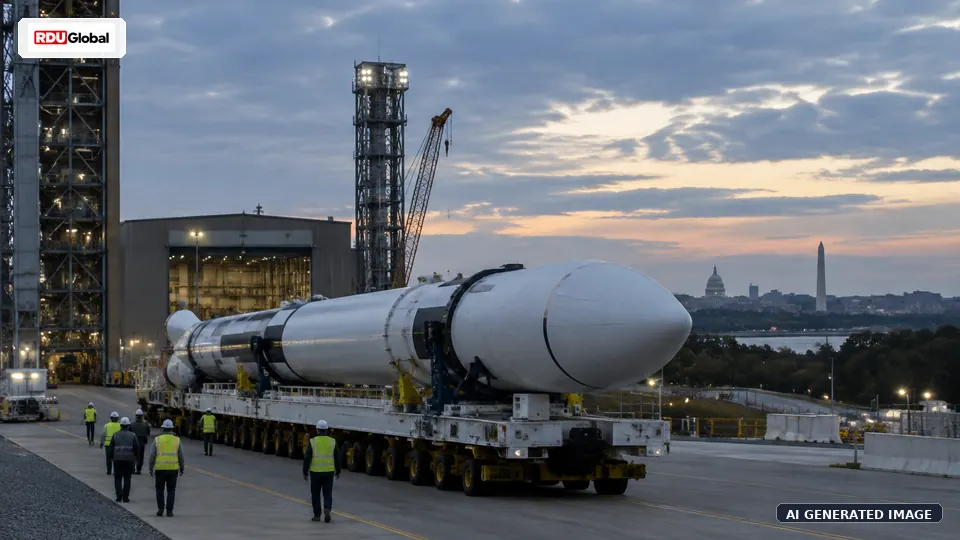
SpaceX's reported decision to pass on certain military launches marks a notable moment in the evolving relationship between private launch providers and government customers. For years, the company has been the dominant force in the global launch market, winning contracts by combining reliability, rapid cadence and aggressive pricing. But the latest development suggests that even the most powerful commercial player is becoming more selective about the missions it accepts, especially where operational complexity, schedule demands or strategic trade-offs may outweigh the commercial upside.
The shift matters because military and national security launches remain among the most valuable and politically sensitive contracts in the sector. They are also central to the broader space economy, which increasingly sits at the intersection of defense, communications and climate monitoring. As governments expand their use of satellites for secure communications, intelligence, navigation and Earth observation, launch access has become a strategic asset rather than a purely commercial service. Any sign that a leading provider is narrowing its focus will be watched closely by competitors, procurement officials and investors alike.
Military Launch Calculus
SpaceX has built its reputation on scale, speed and a willingness to take on missions that legacy providers often found too expensive or too slow. Yet the company's business model has also matured. With a deep backlog of commercial satellite deployments, crewed missions, Starlink launches and government work, it can afford to be choosier than smaller rivals. That selectivity may reflect a simple reality: not every launch is equally attractive when a provider is managing a crowded manifest and balancing reusable fleet operations.
For the Pentagon and other government agencies, the implication is not that SpaceX is retreating from national security work altogether. Rather, it is that the market is entering a more complex phase in which even the leading supplier may prioritize missions that best fit its technical and financial calculus. That could create more room for other launch companies, including newer entrants in the United States and abroad, to compete for contracts that once would have defaulted to SpaceX.
The broader policy significance is substantial. Governments have spent years trying to diversify launch access to reduce dependence on a small number of providers. A more selective SpaceX could accelerate that effort by forcing agencies to broaden their supplier base, even if only incrementally. In a sector where redundancy is a strategic virtue, that diversification may be welcomed by officials seeking resilience in an era of geopolitical tension.
Spain's Rocket Moment
Against that backdrop, the report that a Spanish rocket program is nearly ready carries outsized importance. Europe has long sought to strengthen its independent access to space, especially after supply-chain disruptions, geopolitical shocks and the growing strategic value of orbital infrastructure exposed weaknesses in the continent's launch ecosystem. A near-ready Spanish vehicle would not instantly alter the global balance of power, but it would represent a meaningful step toward a more distributed European launch market.
Spain's progress also reflects a wider shift in the space sector: smaller nations and private startups are increasingly trying to build sovereign or semi-sovereign launch capabilities. That trend is being driven by the same forces reshaping clean energy and climate infrastructure — the need for resilience, domestic industrial capacity and reduced dependence on a narrow set of external suppliers. In space, as in energy, control over critical infrastructure is becoming a strategic priority.
If the Spanish rocket advances from development to operational service, it could help Europe reduce bottlenecks, support smaller satellite operators and improve access for scientific and climate-related missions. That would be especially relevant for Earth observation and environmental monitoring, where timely launch availability can affect data collection on weather, emissions, agriculture and disaster response.
A More Competitive Orbit
Taken together, the two developments point to a launch market that is becoming both more crowded and more selective. SpaceX remains the industry's benchmark, but its choices now shape the competitive field in ways that extend far beyond one company's balance sheet. When the market leader signals that it will not chase every mission, it opens space for rivals — and for governments eager to avoid overreliance on a single provider.
For the clean energy and climate transition sector, the connection is indirect but important. Space-based systems are increasingly essential to climate science, grid planning, methane detection and disaster management. Reliable launch access is therefore part of the infrastructure of the transition itself. A more diversified launch market could improve the resilience of those systems, while also lowering the strategic risk that comes from concentrating too much capability in one company or one country.
The latest developments do not suggest a crisis in launch supply. But they do signal a market in transition, where commercial discipline, national security priorities and regional industrial ambitions are converging. In that environment, the next phase of space competition may be defined less by who can launch the most, and more by who can launch the right missions at the right time.