
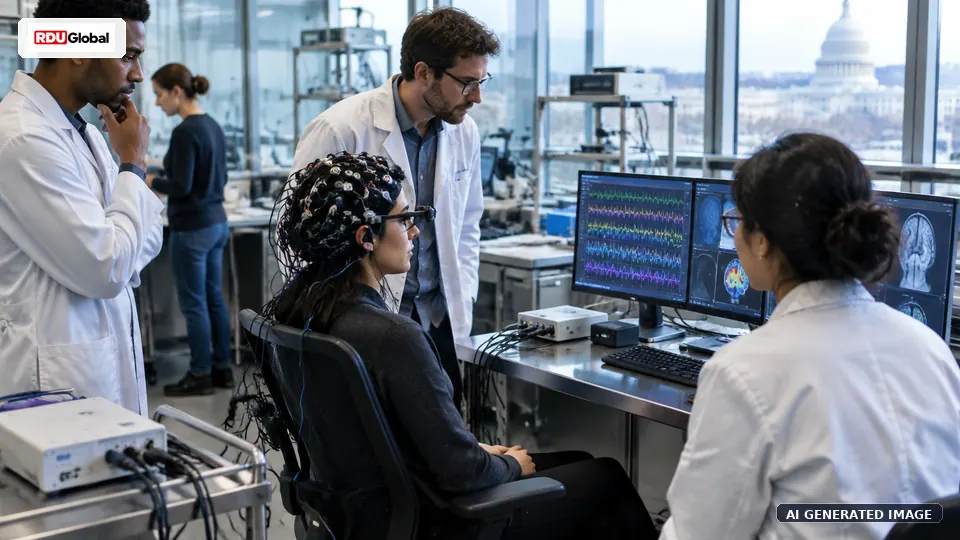
Scientists in the United States have identified neural activity that appears to oscillate between two perceptual states about 15 times a second, offering a fresh window into how the brain decides what we consciously experience and what it suppresses. The work, highlighted in ScienceAlert and related coverage, points to a rapid internal switching process that may help explain why perception can feel seamless even though the underlying machinery is constantly filtering information.
Neural Rhythm Clues
The central finding is not that the brain literally lives in two separate realities, but that it may alternate between competing states of awareness at a speed far faster than subjective experience can detect. In practical terms, the brain appears to sample, prioritize, and suppress incoming information in a rhythmic pattern that could shape what a person notices at any given moment. Researchers observed alternating neural signatures linked to conscious and suppressed face perception, suggesting that awareness may be governed by a recurring cycle rather than a single continuous stream.
This matters because perception is one of neuroscience's most difficult questions: how the brain transforms raw sensory input into a stable sense of reality. The new results strengthen the idea that consciousness is not a static condition but a dynamic process, with neural networks repeatedly opening and closing access to awareness. If confirmed and extended, the findings could help scientists better understand attention, visual processing, and the limits of conscious control.
Why It Matters
The study sits at the intersection of basic neuroscience and applied brain science. A better model of how the brain toggles between visible and hidden information could inform research into attention disorders, perceptual disturbances, and conditions in which conscious processing is altered. It may also help explain why people can miss obvious changes in their environment, a phenomenon long observed in psychology and neuroscience.
The reported rhythm of roughly 15 cycles per second is especially notable because it suggests the brain may use fast oscillations to organize perception. Neural rhythms are already known to play a role in memory, attention, and sensory integration, but this work adds another layer: the possibility that awareness itself is periodically gated. That does not mean the brain is unreliable; rather, it may be highly efficient, continuously selecting which signals deserve priority.
For the clean energy and climate transition sector, the relevance is indirect but real. Human perception and decision-making are central to public support for long-term policy shifts, risk communication, and behavioral change. Research into how the brain filters information can improve the design of messaging around climate science, energy efficiency, and public health, especially when communicators need to cut through noise and attention fatigue.
Bigger Scientific Picture
The broader scientific significance lies in the challenge to the intuitive belief that consciousness flows smoothly. Instead, the brain may be assembling reality in rapid frames, much like a high-speed editor choosing which images make it into the final cut. That framing could reshape how researchers study perception, from laboratory tasks involving faces and visual scenes to clinical work on disorders of awareness.
The study should be read as a promising step rather than a final answer. Neuroscience often advances through patterns that are initially surprising and later refined by replication, larger samples, and improved measurement. Still, the reported alternation between conscious and suppressed perception is consistent with a growing view that the brain is not merely receiving the world, but actively constructing it in real time.
If the findings hold, they may help explain why the mind can seem unified even while the brain is constantly negotiating competing inputs. The result is a more nuanced picture of consciousness: not a single spotlight, but a rapidly flickering system that decides, many times each second, what becomes part of lived experience and what remains below the threshold of awareness.