
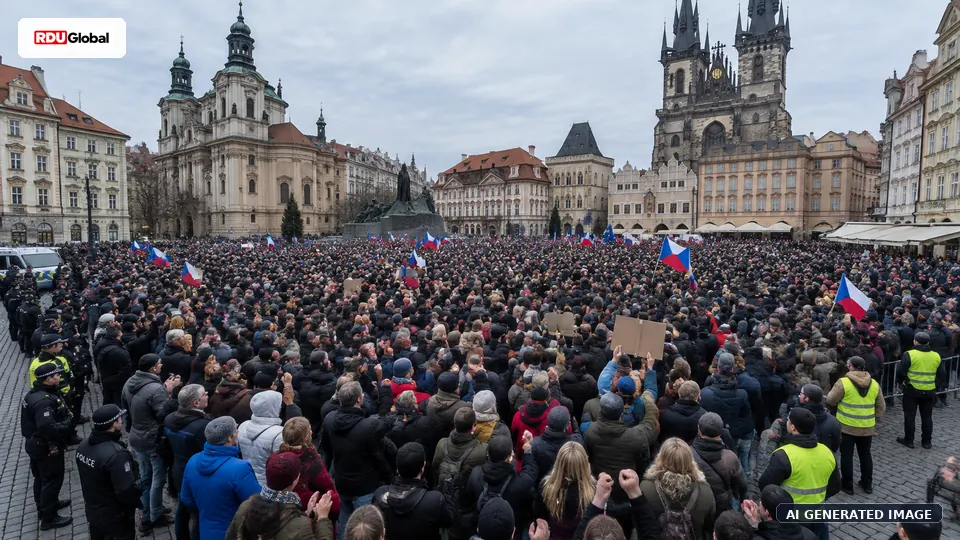
Mass Rally In Prague
Thousands of people filled Prague's Old Town Square on Sunday in one of the largest public demonstrations yet against the Czech government's proposed overhaul of public media funding. Protesters carried signs defending the independence of public broadcasters and chanted against a plan that critics say would undermine the financial stability and editorial autonomy of institutions long viewed as essential to democratic accountability.
The rally was aimed squarely at the government's effort to reshape how public media is financed, including plans that opponents describe as a move to abolish or significantly weaken public media fees. Those fees have traditionally provided a direct funding stream for public broadcasters, insulating them at least partly from annual political bargaining. Demonstrators argued that replacing or diluting that model would leave the media more vulnerable to pressure from whichever coalition is in power.
The scale of the turnout reflected a broader anxiety that the dispute is not merely about budgets, but about the future of institutional independence in a country where public trust in media and politics has often been contested. Speakers at the protest framed the issue as a test of whether the Czech Republic will preserve a firewall between elected officials and the news organizations tasked with scrutinizing them.
Funding Fight Deepens
The government has advanced the overhaul after a rushed parliamentary vote, a process that has sharpened criticism from opposition parties, media workers and civil society groups. They argue that the speed of the legislative push limited meaningful debate on the consequences for public broadcasting and raised doubts about whether the reform was designed to strengthen efficiency or to increase political leverage.
Public media funding is a sensitive issue across Europe, where governments have repeatedly faced accusations of trying to influence broadcasters through budgetary control, board appointments or legal restructuring. In the Czech case, opponents say the proposed changes could create a precedent that weakens the independence of public service media at a moment when disinformation, political polarization and public distrust are already straining democratic institutions.
The protest in Prague also underscored how quickly a technical policy dispute can become a broader political flashpoint. For many participants, the issue is not whether public broadcasters should be modernized, but whether reform can be pursued without eroding the safeguards that keep news coverage free from direct government influence. That distinction has become central to the debate as lawmakers press ahead.
Wider Democratic Stakes
The confrontation over media financing has drawn attention because it touches a core question in democratic governance: who controls the institutions that inform the public? Public broadcasters are often expected to provide balanced coverage, cultural programming and emergency information, while serving audiences that commercial outlets may not fully reach. Their legitimacy depends not only on editorial standards, but also on the perception that they are not beholden to political patrons.
In Prague, protesters appeared to be making that argument in public and in force. The demonstration was as much about principle as policy, with many participants warning that once funding is made more dependent on government discretion, editorial independence can be compromised gradually rather than all at once. That concern has resonated across Europe, where media freedom advocates have repeatedly warned that financial pressure can be as effective as overt censorship.
For the Czech government, the challenge now is to defend the reform as a legitimate modernization effort while convincing critics that it will not diminish public oversight or journalistic independence. The size of the protest suggests that reassurance will be difficult. Even if the legislation moves forward, the political cost may be significant, particularly if opposition parties and media organizations keep the issue alive in the public arena.
The demonstration in Prague is likely to intensify scrutiny of the government's broader approach to institutions that are meant to operate above partisan politics. For now, the message from the square was unmistakable: many Czechs see public media funding not as a narrow administrative matter, but as a frontline issue in the defense of democratic norms.