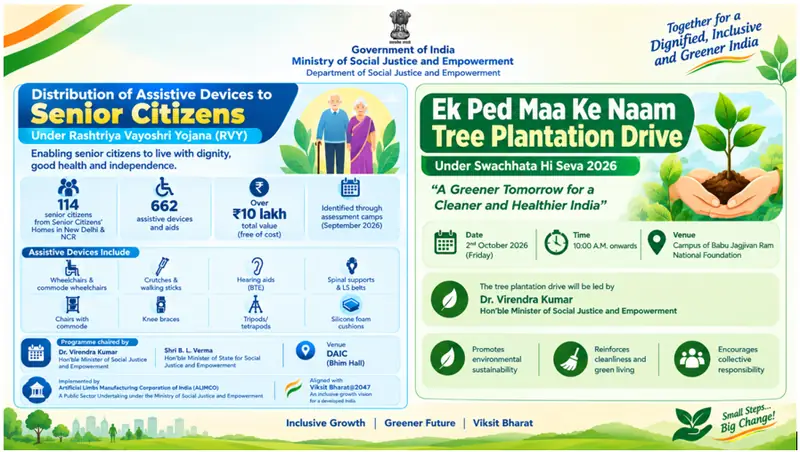
The Union government will mark Swachh Bharat Diwas with a welfare-oriented event in which Dr. Virendra Kumar and B. L. Verma are scheduled to distribute assistive devices to senior citizens, placing a social support initiative at the center of a day traditionally associated with cleanliness, civic responsibility, and public participation. The programme reflects a broader administrative pattern in which national observances are increasingly used as platforms for direct service delivery and visible outreach to vulnerable groups.
Welfare on a National Day
The planned distribution of assistive devices is significant not merely as a ceremonial gesture, but as a policy signal. By aligning the event with Swachh Bharat Diwas, the government is framing welfare delivery as part of a larger narrative of dignity, inclusion, and citizen-centric governance. For senior citizens, assistive devices can be essential to mobility, independence, and daily functioning, and such interventions often carry a direct impact on quality of life.
The involvement of two Union ministers suggests that the programme is being positioned at a high level of political visibility. Dr. Virendra Kumar, who has been associated with social justice and empowerment portfolios, and B. L. Verma, a minister in the Union government, are expected to use the occasion to reinforce the administration's focus on reaching older citizens through tangible support rather than symbolic messaging alone.
Accessibility And Dignity
India's ageing population is placing growing pressure on public policy to move beyond broad welfare rhetoric and toward practical, accessible interventions. Assistive devices, including mobility aids and related support equipment, are among the most direct tools available to help senior citizens remain active and independent. In that sense, the event is part of a wider governance challenge: ensuring that welfare schemes are not only announced, but delivered in ways that are visible, timely, and responsive to need.
The choice of Swachh Bharat Diwas as the occasion also carries institutional meaning. The cleanliness campaign launched over the past decade has evolved into a broader state narrative about behavioural change, civic discipline, and public participation. By pairing it with a senior citizen welfare distribution, the government appears to be extending the symbolism of cleanliness into the domain of social care and public service.
This approach also reflects a familiar feature of contemporary Indian governance: the use of national days to consolidate policy messaging. Such events allow the Centre to demonstrate administrative reach while highlighting specific beneficiary groups. In this case, senior citizens are being placed at the forefront, signalling that welfare policy is not limited to economic support alone, but includes mobility, accessibility, and dignity in everyday life.
Policy Signal To States
The event may also be read as a reminder to state administrations and local bodies that welfare delivery for the elderly remains a continuing governance priority. India's social protection architecture is spread across multiple levels of government, and the effectiveness of such programmes often depends on identification, distribution logistics, and last-mile implementation. Public events like this one can help draw attention to those operational demands.
There is also a political dimension to the timing. As the government continues to emphasize inclusive development, senior citizens represent a constituency that is both socially important and increasingly visible in policy debates. Initiatives that support them can resonate strongly because they are easy to understand, directly beneficial, and broadly non-partisan in appeal.
At the same time, the event will likely be assessed on execution rather than announcement. The real measure of impact will be whether the devices reach intended beneficiaries efficiently and whether the distribution is part of a sustained support framework rather than a one-off ceremony. In that respect, tomorrow's programme will serve as both a welfare exercise and a test of administrative follow-through.
For now, the planned distribution underscores a clear message from the Centre: national observances are being used not only to commemorate ideas, but to deliver services. On Swachh Bharat Diwas, that message will be directed at one of the country's most vulnerable groups, with senior citizens at the center of the government's public-facing welfare agenda.