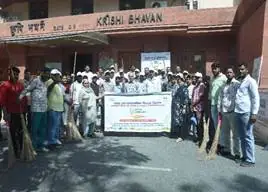
The Food and Public Distribution Department has stepped up its cleanliness and good-governance efforts under Special Campaign 6, placing administrative discipline and workplace hygiene at the center of its current reform agenda. The campaign, part of a broader government-wide push to reduce pendency and improve institutional efficiency, is being used to sharpen internal processes, clear outdated records, and reinforce a culture of accountability across offices linked to food management and public distribution.
Governance Through Cleanliness
The latest phase of the campaign underscores how the Union government is increasingly treating cleanliness not merely as a symbolic exercise, but as a practical tool for administrative reform. In departments that handle large-scale public service functions, even modest improvements in record upkeep, file movement, and office organization can translate into faster decision-making and fewer procedural bottlenecks. For the Food and Public Distribution Department, which operates at the intersection of welfare delivery and supply-chain oversight, such improvements carry direct operational significance.
Special Campaign 6 is designed to identify and resolve long-pending issues that often accumulate in large bureaucracies: obsolete files, redundant physical records, unused office material, and delayed grievance disposal. The department's intensified participation suggests a deliberate attempt to align internal housekeeping with the larger governance narrative of efficiency, transparency, and citizen-centric administration. In effect, the campaign turns cleanliness into a measurable indicator of institutional performance.
Administrative Efficiency Drive
The department's focus is especially relevant because food distribution is among the most visible and politically sensitive areas of public administration. Any improvement in internal workflow can have downstream effects on procurement oversight, storage management, distribution monitoring, and coordination with state-level systems. A cleaner, more organized office environment is not an end in itself; it is meant to support quicker file processing, better documentation, and more reliable institutional memory.
The campaign also reflects a growing emphasis on reducing administrative clutter. Across government departments, the accumulation of old files and unused assets has long been seen as a drag on efficiency and a hidden cost to public administration. By pushing for systematic disposal and review, Special Campaign 6 aims to free up space, reduce maintenance burdens, and make offices more functional. This is particularly important in departments with extensive field linkages and high volumes of correspondence.
The initiative is also consistent with the government's broader messaging around "minimum government, maximum governance," where procedural simplification and internal discipline are presented as prerequisites for better service delivery. In this framework, cleanliness is not cosmetic. It is tied to institutional credibility, smoother workflows, and the ability of the state to respond more effectively to public needs.
Broader Policy Signal
The renewed push carries a wider policy signal as well. Special campaigns of this kind have become a recurring instrument for the Union government to demonstrate administrative responsiveness without waiting for large structural overhauls. They are visible, time-bound, and measurable, which makes them useful both as governance tools and as public accountability exercises. Departments are expected to show concrete outcomes, whether in the form of space reclaimed, files disposed of, or pending matters resolved.
For the Food and Public Distribution Department, this matters because the sector sits at the core of India's welfare architecture. It is responsible for systems that affect millions of households, especially through food security mechanisms. A department that manages such a large and sensitive portfolio must maintain internal systems that are orderly, auditable, and responsive. The current campaign is therefore as much about institutional readiness as it is about cleanliness.
The emphasis on good governance also suggests that the department is seeking to project a more disciplined administrative image at a time when public expectations from the state remain high. Citizens increasingly judge government performance not only by policy announcements, but by the speed, clarity, and reliability of implementation. Campaigns like Special Campaign 6 are intended to show that the machinery of government is capable of self-correction.
While the immediate actions under the campaign may appear procedural, their significance lies in what they reveal about the state's evolving administrative priorities. Clean offices, cleared files, and reduced pendency may not generate headlines on their own, but they can materially improve the functioning of a department that plays a central role in India's welfare delivery system. In that sense, the campaign is both symbolic and operational: a cleanliness drive that doubles as a governance reform exercise.