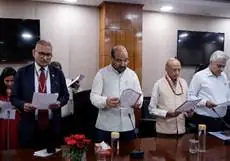
India's agricultural research establishment has placed cleanliness at the centre of its public-facing governance message, unveiling the Swachhata Hi Seva 2026 campaign under the Department of Agricultural Research and Education and the Indian Council of Agricultural Research. The initiative, framed as a participatory drive toward a cleaner and more developed India, reflects how the government is increasingly linking behavioural change, institutional accountability and citizen engagement to the larger Viksit Bharat narrative.
The campaign arrives at a time when sanitation policy in India has moved beyond infrastructure alone and into the realm of social discipline and administrative culture. By anchoring the effort within ICAR, one of the country's most extensive scientific and extension networks, the government is signalling that cleanliness is not merely a municipal concern but a cross-sector governance priority. In practical terms, this gives the campaign reach across laboratories, research farms, training centres and affiliated institutions that interact with farmers, students and local communities.
Civic Duty Focus
The central message of the initiative is that cleanliness must be treated as a shared civic responsibility rather than a one-off government programme. That framing is politically significant. It aligns with the broader Swachh Bharat architecture, which has consistently sought to convert sanitation into a mass movement rather than a narrow public works exercise. The 2026 campaign extends that logic into the research and education ecosystem, where institutional credibility and public example matter as much as operational outcomes.
For ICAR, the campaign also serves a reputational purpose. Agricultural science institutions are often judged by their research output, but their public legitimacy increasingly depends on how effectively they model the values they promote. A cleanliness drive within the agricultural research system can reinforce discipline, environmental awareness and community outreach, all of which are relevant to India's rural development agenda. It also offers a visible way to connect scientific institutions with everyday governance themes that resonate beyond policy circles.
Research Network Reach
The significance of the campaign lies in its scale. ICAR is not a single office but a nationwide network with deep institutional presence. That makes it a useful vehicle for spreading behavioural campaigns across regions and social groups. If implemented seriously, the initiative can influence not only internal campus hygiene but also outreach programmes, farmer interactions and student engagement activities. In that sense, the campaign has the potential to function as both a symbolic and operational intervention.
The agricultural sector has a particular stake in sanitation messaging because clean surroundings, waste management and public health are closely tied to productivity, especially in rural and semi-rural settings. Research institutions that work on soil health, crop protection, livestock systems and food safety are well placed to demonstrate the practical links between sanitation and development. The campaign therefore has a policy logic: it turns cleanliness into an enabling condition for healthier institutions and more credible public service delivery.
At the same time, the success of such drives depends on more than slogans. Past national campaigns have shown that sustained impact requires monitoring, local leadership and measurable participation. Without those elements, cleanliness drives risk becoming ceremonial. The challenge for the department and ICAR will be to ensure that the 2026 initiative produces visible institutional change rather than short-lived publicity.
Viksit Bharat Signal
The campaign's language of participation and development is also politically revealing. By tying Swachhata Hi Seva to Viksit Bharat, the government is reinforcing a broader policy theme: national progress is being defined not only by economic growth and infrastructure expansion, but also by civic habits and institutional order. This is consistent with the current administrative emphasis on citizen participation as a driver of state capacity.
For the agricultural research and education sector, the message is clear. Public institutions are expected to lead by example, and cleanliness is being positioned as part of that leadership. The campaign may appear modest in form, but it carries a larger governance signal: development is being framed as a collective discipline, built through everyday practices as much as through major policy announcements.
If the initiative is implemented with seriousness across ICAR's network, it could strengthen the link between scientific institutions and public trust. In a country where sanitation remains both a public health issue and a political symbol, that linkage matters. The 2026 campaign is therefore more than an observance; it is a statement about how the government wants its institutions to embody the values of a cleaner, more participatory, and more development-oriented India.