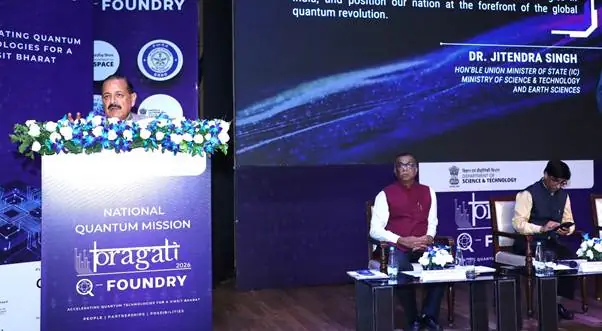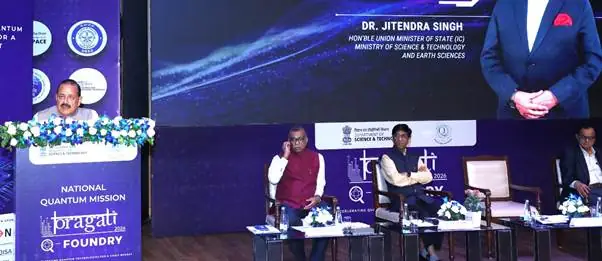
Union Minister of State for Science and Technology Jitendra Singh said the Modi government's enabling policies have helped India's emerging quantum ecosystem gain traction, framing the sector as one of the country's most strategically important technology frontiers.
The minister's remarks come at a time when governments worldwide are racing to secure early advantage in quantum computing, quantum communication and quantum sensing, fields that are expected to reshape cybersecurity, defence systems, pharmaceuticals, materials science and financial modelling. Singh's statement signals that New Delhi sees quantum not merely as a research pursuit, but as a national capability that must be cultivated through public policy, institutional coordination and long-term investment.
Policy Backing
Singh's central argument is that the ecosystem is not developing in isolation. Rather, it is being strengthened by a policy environment that encourages scientific innovation, supports public research institutions and seeks to connect laboratory work with practical deployment. In India's case, that matters because quantum technology remains at an early stage globally, where first-mover advantage can be shaped as much by state support as by private capital.
The minister's framing also reflects a familiar feature of India's technology strategy under the Modi administration: the use of government-led missions and enabling frameworks to accelerate sectors that require high upfront investment, long gestation periods and close coordination between academia, industry and the state. Quantum technology fits that model closely. It is expensive, talent-intensive and infrastructure-heavy, and it depends on sustained public commitment before commercial returns become visible.
For India, the policy challenge is not only to fund research, but to create an ecosystem where universities, national laboratories, startups and industry partners can work in tandem. Singh's comments suggest the government believes that foundation is beginning to take shape.
Strategic Technology Race
Quantum technology has become a marker of geopolitical competition. Countries that establish credible capabilities early may gain advantages in secure communications, advanced simulation and next-generation computing. For India, the stakes are particularly high because quantum systems could eventually strengthen encryption resilience, improve strategic communications and support scientific breakthroughs in sectors ranging from energy to healthcare.
Singh's emphasis on ecosystem-building is significant because it points to a recognition that India cannot rely solely on imported systems if it wants strategic autonomy in emerging technologies. Domestic capability is essential not just for economic reasons, but for sovereignty and security. In that sense, the minister's remarks align with a wider national policy narrative that places advanced science within the architecture of self-reliance and technological resilience.
At the same time, the sector remains in an early and uncertain phase. Quantum technologies are still transitioning from experimental prototypes to scalable applications, and many countries are investing heavily without immediate commercial payoff. India's challenge will be to maintain momentum, avoid fragmentation and ensure that policy support translates into measurable scientific output and industrial readiness.
Building Long-Term Capacity
The broader significance of Singh's statement lies in what it reveals about the government's priorities. By highlighting the quantum ecosystem, the minister is drawing attention to a domain where India can potentially leapfrog in select areas if it sustains investment, nurtures talent and builds institutional depth.
That will require more than announcements. It will depend on research funding, advanced laboratories, skilled personnel, procurement pathways and partnerships that can move ideas from concept to deployment. It will also require patience, because quantum capability cannot be built on short political timelines.
Still, the minister's remarks indicate that the government views the sector as part of a larger national innovation strategy. If the policy environment continues to support experimentation and collaboration, India could strengthen its position in a field that is likely to define the next era of strategic technology competition.
For now, Singh's message is clear: India's quantum ecosystem is gaining strength, and the government intends to keep it on that trajectory through enabling policy support and sustained institutional backing.