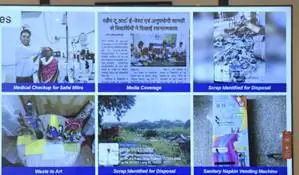
Union Minister G. Kishan Reddy has reviewed the preparedness of Coal India Limited for Special Campaign 6, a government-wide administrative drive focused on cleanliness, disposal of pending matters, and better management of official records and public interfaces. The review reflects the Centre's continuing effort to push measurable governance reforms through state-owned enterprises, especially in sectors that remain central to India's energy security and industrial output.
The assessment comes at a time when public sector companies are under growing pressure to demonstrate not only operational performance but also administrative responsiveness. In Coal India's case, the exercise carries added significance because the company remains one of the country's most important strategic enterprises, supplying the bulk of domestic coal and supporting power generation, manufacturing, and logistics networks. A review of campaign preparedness therefore goes beyond symbolic housekeeping; it signals a push to align internal administration with broader national priorities on efficiency and accountability.
Governance Drive
Special Campaign 6 is part of a recurring framework used by the Union government to clear backlogs, improve workplace hygiene, and identify redundant files, obsolete records, and unresolved public grievances. The campaign has increasingly become a marker of administrative discipline across ministries and public sector undertakings. For a company such as Coal India, which operates through a wide network of subsidiaries and field offices, the implementation challenge is substantial. It requires coordination across dispersed locations, standardization of reporting, and sustained monitoring to ensure that campaign targets are not treated as a one-off compliance exercise.
Reddy's review suggests that the government is seeking early assurance that Coal India is prepared to execute the campaign in a structured and visible manner. Such reviews are often used to reinforce accountability down the chain of command, especially in large organizations where routine administrative slippage can accumulate into delays, inefficiencies, and avoidable public inconvenience. The emphasis on preparedness also indicates that the Centre wants public sector enterprises to internalize these campaigns as part of regular governance culture rather than as periodic formalities.
Coal India's Role
Coal India occupies a unique position in India's policy landscape. While the company is commercially significant, it is also a critical instrument of national energy policy. Any administrative reform within the organization has implications that extend beyond office management. Better record systems, faster disposal of pending matters, and cleaner, more organized workspaces can improve decision-making, reduce procedural bottlenecks, and support smoother coordination with government stakeholders.
The review also comes against the backdrop of a broader administrative modernization agenda within the public sector. The Centre has repeatedly signaled that state-owned enterprises must combine commercial performance with governance reform. In practical terms, that means greater attention to digitization, file movement efficiency, grievance redressal, and the systematic removal of obsolete processes. Special campaigns are one of the mechanisms through which that message is translated into operational action.
For Coal India, the challenge is to ensure that campaign implementation is not confined to headquarters-level compliance but reaches subsidiary units, mines, and regional offices. The scale of the organization makes this especially important. A successful campaign would likely be measured not only by the number of files cleared or spaces cleaned, but also by whether it produces durable improvements in workflow and administrative transparency.
Policy Signal
The minister's review also carries a broader policy signal. In recent years, the government has increasingly used performance reviews, campaign-based monitoring, and public accountability exercises to sharpen the functioning of ministries and public enterprises. This approach reflects a belief that small but visible administrative reforms can produce cumulative gains in governance quality.
For the public sector, such initiatives are also reputationally important. They help project an image of discipline, responsiveness, and modernization at a time when citizens and businesses expect faster service delivery from government-linked institutions. In that sense, Special Campaign 6 is not merely about cleanliness in the literal sense; it is about institutional order, process efficiency, and the credibility of the state's administrative machinery.
Reddy's review of Coal India's readiness therefore fits into a larger pattern of governance oversight. It reinforces the message that major public sector enterprises are expected to meet not only production and financial targets but also standards of administrative excellence. As the campaign unfolds, attention will likely focus on whether Coal India can translate preparation into visible, measurable outcomes across its vast operational footprint.