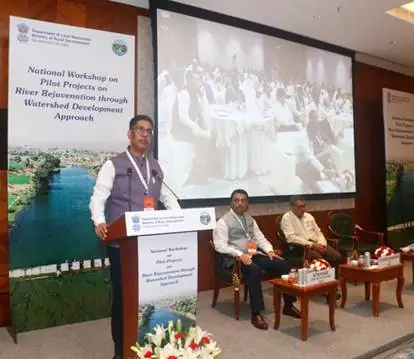
At a time when India is under growing pressure to restore degraded catchments, improve groundwater recharge, and make rural water systems more resilient, the Department of Land Resources is positioning landscape treatment as a unifying framework for environmental recovery. Secretary Narendra Bhushan said the method can simultaneously deliver watershed development and river revival objectives, underscoring a policy direction that seeks to connect land management with hydrological outcomes rather than treat them as separate administrative tasks.
The argument is significant because watershed development in India has often been implemented as a rural livelihood and soil conservation programme, while river rejuvenation has typically been handled through a different set of institutions and funding streams. Bhushan's framing suggests that these objectives need not remain siloed. By treating the landscape as a connected ecological unit, planners can target erosion control, moisture retention, drainage improvement, and vegetation cover in ways that improve both local water security and downstream river health.
Integrated Water Strategy
Bhushan's remarks reflect a growing recognition within policy circles that rivers do not revive through channel cleaning alone. Their condition is shaped upstream by land use, slope treatment, runoff patterns, sediment load, and the health of micro-watersheds. Landscape treatment, in this context, refers to a broader set of interventions across hills, farms, commons, and drainage lines designed to restore the natural functioning of an area. That can include contour measures, afforestation, soil-moisture conservation, and the protection of recharge zones.
For the government, the appeal of this approach lies in its efficiency and scale. If watershed works are planned with river systems in mind, the same investment can produce multiple outcomes: improved agricultural resilience, reduced flash runoff, better groundwater recharge, and lower sedimentation in rivers and reservoirs. In a country where water stress is increasingly shaped by climate variability and land degradation, such convergence is likely to attract policy attention.
The concept also fits into India's broader governance challenge: coordinating across departments that historically operate in parallel. Land resources, rural development, water resources, environment, and local bodies all have a stake in landscape restoration, but fragmented execution has often diluted impact. Bhushan's statement indicates an effort to move toward more integrated planning, where ecological outcomes are treated as part of the same development architecture rather than as afterthoughts.
From Catchments To Rivers
The practical importance of the idea is especially clear in river basins where upstream degradation has accelerated siltation and seasonal flow disruption. In such settings, watershed treatment can help slow surface runoff, increase infiltration, and stabilize soils, thereby reducing the pressure on downstream river channels. The result is not an instant restoration of river health, but a more durable foundation for it.
This is also where the policy conversation becomes more than technical. River revival has become a politically visible issue across India, but many restoration efforts have struggled when they focus narrowly on urban stretches, pollution cleanup, or beautification. Landscape treatment broadens the lens. It implies that river recovery must begin in the catchment, with land interventions that address the causes of degradation rather than only its symptoms.
For rural communities, the benefits could be tangible if implementation is sustained. Better moisture retention can support crops, reduce dependence on erratic rainfall, and improve the reliability of wells and ponds. For downstream users, healthier catchments can moderate floods, reduce sediment burden, and improve base flows. The challenge, as always, will be execution: selecting the right sites, ensuring maintenance, and aligning incentives across institutions and local communities.
Bhushan's remarks therefore carry policy weight beyond a single technical observation. They point toward a development model in which land restoration is not just an environmental measure but a water governance strategy. If translated into program design and field implementation, landscape treatment could become one of the few approaches capable of serving both watershed development and river revival at the same time.
The broader implication is that India's water future may depend less on isolated projects and more on integrated landscape management. That would require stronger coordination, better data, and a willingness to measure success not only by assets created, but by ecological function restored. In that sense, the secretary's message is as much about governance reform as it is about water conservation.