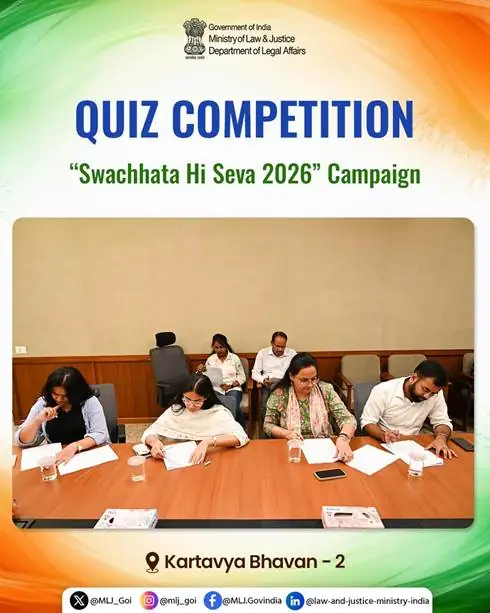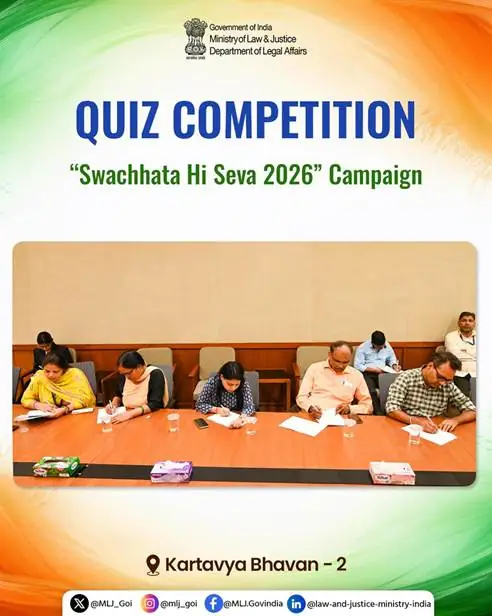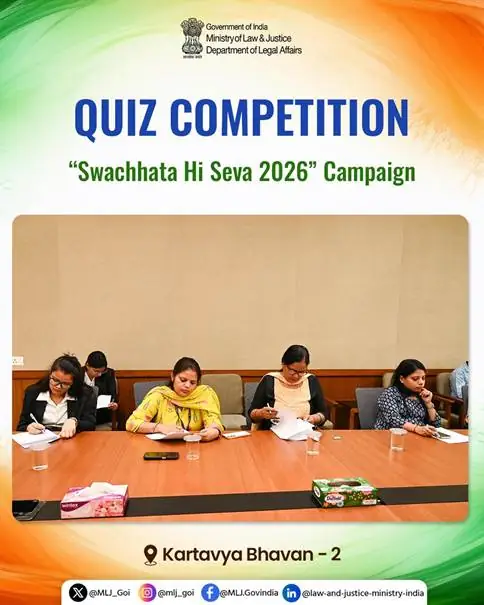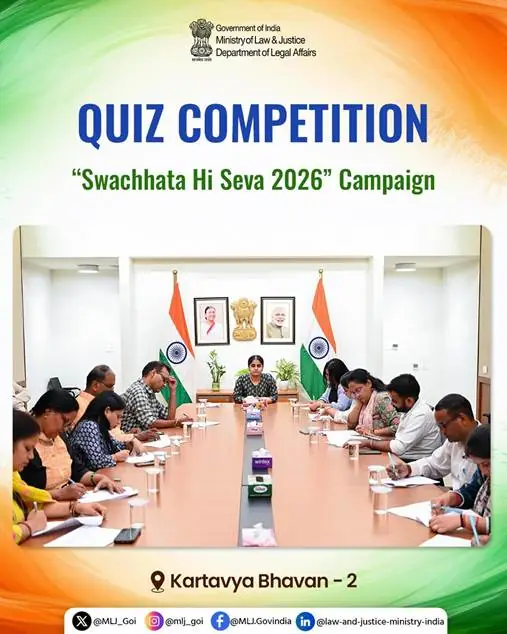
The Law and Justice Department has marked its participation in Special Campaign 6 and Swachhata Hi Seva 2026 with a quiz competition designed to promote awareness, engagement, and a stronger culture of public service. The event, while modest in format, fits into a broader administrative push across the Union government to link cleanliness drives with governance reform, employee participation, and institutional discipline.
At a time when ministries are under pressure to demonstrate measurable improvements in efficiency and workplace standards, such activities are no longer treated as ceremonial add-ons. Instead, they are increasingly being used as tools to reinforce behavioral change inside government offices. The quiz competition organized by the department appears to have been framed in that spirit: to encourage staff participation, deepen familiarity with the objectives of the campaign, and underscore the idea that cleanliness is not merely a physical exercise but part of administrative responsibility.
Campaign With Governance Focus
Special Campaign 6 and Swachhata Hi Seva 2026 are part of a continuing official emphasis on cleanliness, record management, disposal of pending matters, and better use of public office space. In recent years, such campaigns have evolved beyond symbolic cleanliness drives into structured governance exercises that seek to improve office efficiency, reduce clutter, and create more responsive institutions. The Law and Justice Department's quiz competition should be seen against that backdrop.
For a ministry that sits at the center of India's legal and policy architecture, the messaging carries added significance. The department is not only responsible for legal coordination and legislative support but also serves as a visible example of how central government offices can translate broad administrative campaigns into internal practice. By using a quiz format, the department has chosen an accessible method to engage employees while reinforcing the campaign's themes in a non-bureaucratic way.
Such initiatives also serve a managerial purpose. They help departments communicate policy priorities without relying solely on circulars or formal instructions. In a large and layered administrative system, awareness-building exercises can be an effective way to ensure that campaign goals are understood across different levels of staff. They also create a sense of participation, which is often essential for the success of government-wide reform drives.
Cleanliness As Public Policy
The emphasis on cleanliness in government offices has become a recurring feature of India's administrative calendar, especially through the Swachhata framework. What began as a public hygiene and sanitation message has gradually expanded into a broader governance narrative that includes file disposal, space optimization, digital record management, and service delivery discipline. The Law and Justice Department's event reflects this evolution.
The significance of such campaigns lies in their attempt to make governance visible at the workplace level. Clean offices, organized records, and active staff participation are presented not just as aesthetic goals but as indicators of administrative seriousness. In that sense, the quiz competition is part of a larger effort to make government employees stakeholders in reform rather than passive recipients of directives.
The timing of the event also matters. As ministries prepare for the operational demands of the year-end administrative cycle, campaign-linked activities can help renew attention on pending tasks and internal housekeeping. They also allow departments to project alignment with central priorities at a moment when public institutions are expected to demonstrate efficiency, transparency, and responsiveness.
Symbolism And Administration
While a quiz competition may appear routine, its value lies in the symbolism of participation. It signals that campaign objectives are being internalized through staff engagement rather than treated as external compliance requirements. For the Law and Justice Department, that symbolism is especially relevant because legal institutions are expected to embody order, precision, and procedural discipline.
The broader policy message is clear: cleanliness campaigns are now being used as instruments of administrative culture-building. They are intended to shape habits, improve awareness, and strengthen the connection between governance and everyday workplace conduct. In that sense, the department's initiative is less about the competition itself and more about the institutional message it sends.
As Special Campaign 6 and Swachhata Hi Seva 2026 continue, similar events across ministries are likely to remain part of the government's effort to translate national campaigns into practical office-level action. The Law and Justice Department's quiz competition shows how even small-format events can be used to advance larger goals of administrative reform, public service ethos, and institutional cleanliness.