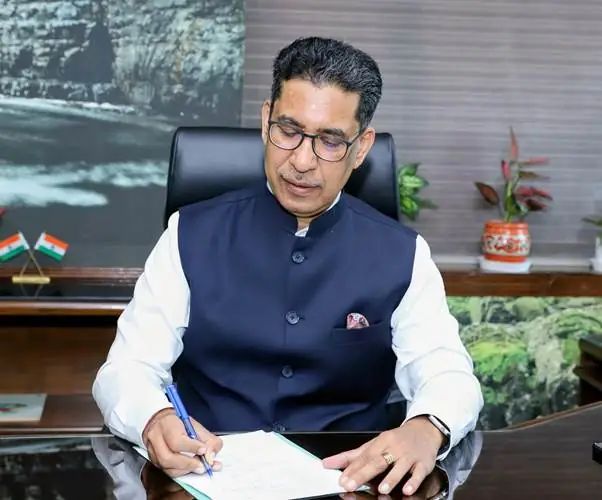
Narendra Bhushan has taken charge as Secretary in the Ministry of Environment, Forest and Climate Change, marking a significant administrative transition in a department that sits at the intersection of development policy, ecological regulation, and India's climate commitments. The appointment places a senior bureaucrat in a role that carries direct responsibility for shaping the government's approach to environmental clearances, forest conservation, pollution control coordination, and climate-related policy execution.
Policy Command Post
The environment ministry is among the most closely watched arms of the Union government because its decisions affect infrastructure, mining, manufacturing, urban expansion, and conservation outcomes simultaneously. As secretary, Bhushan will be expected to oversee a portfolio where every major policy move has implications for economic growth and environmental safeguards. The role demands not only administrative control but also the ability to reconcile competing pressures from industry, state governments, regulators, and civil society.
His assumption of charge comes at a time when India is under increasing scrutiny to demonstrate that growth and sustainability can advance together. The ministry's agenda typically includes the processing of environmental and forest clearances, oversight of statutory bodies, and coordination on national climate targets. In practical terms, the secretary's office functions as the operational nerve centre for decisions that can accelerate or delay major projects while also determining how firmly environmental norms are enforced.
High-Stakes Regulatory Balance
The ministry's work has become more complex in recent years as India has pursued rapid infrastructure build-out alongside stronger climate and biodiversity commitments. That tension is likely to define the policy environment Bhushan inherits. On one side is the government's push for faster approvals and more predictable regulation for investors and project developers. On the other is the need to maintain ecological standards, protect forests, and respond to growing public concern over air quality, land use, and climate resilience.
The secretary's office is central to this balancing act. It must ensure that the clearance process remains credible and legally robust while also avoiding unnecessary delays that can stall public and private investment. The ministry's credibility depends heavily on whether it can deliver transparent decision-making without appearing either overly permissive or excessively restrictive. Bhushan's administrative approach will therefore be closely observed by stakeholders across sectors.
The post also carries significance for India's broader climate diplomacy. As the country continues to present itself as a development model that seeks low-carbon growth without compromising poverty reduction or industrialisation, the environment ministry plays a key role in translating national commitments into domestic action. That includes policy coordination across emissions, adaptation, forest cover, and environmental governance.
Administrative Continuity Ahead
Bhushan's appointment is also important from the standpoint of continuity in governance. Senior bureaucratic transitions in ministries such as environment and climate change can influence the pace and tone of policy implementation, especially where projects involve multiple layers of approval and inter-ministerial coordination. A secretary's leadership often determines how effectively the ministry can respond to court directives, parliamentary scrutiny, and state-level implementation challenges.
The ministry's responsibilities extend well beyond headline environmental issues. It must manage technical institutions, monitor compliance frameworks, and support policy design in areas where scientific evidence and administrative judgment must work together. That makes the secretary's role particularly demanding, requiring both policy fluency and operational discipline.
For Bhushan, the immediate challenge will be to establish control over a portfolio that is politically sensitive, legally complex, and nationally consequential. The ministry's decisions can affect everything from industrial corridors and highways to protected areas and climate adaptation planning. In that sense, the new secretary's tenure begins at a moment when environmental governance is no longer a niche administrative function but a core test of state capacity.
His assumption of charge signals the government's intent to keep the ministry's machinery moving at a time when India's development and environmental agendas are increasingly intertwined. The coming months will show how the new leadership navigates the trade-offs between regulatory efficiency, ecological protection, and the country's long-term climate strategy.