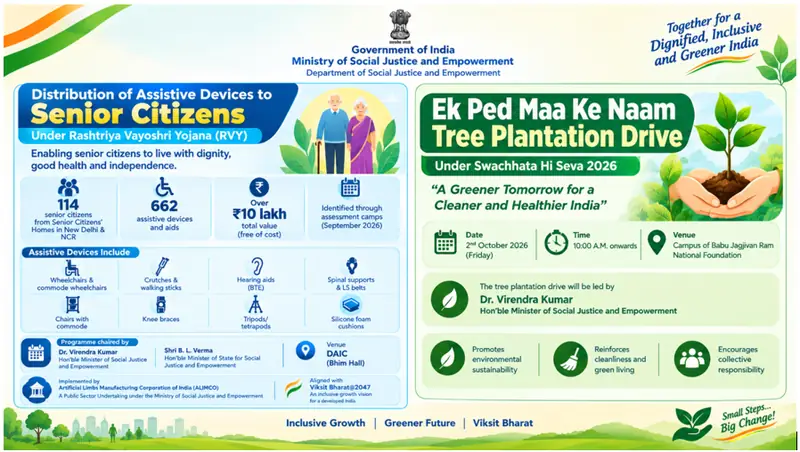
The Union government is set to mark Swachh Bharat Diwas with a welfare-focused event in which Dr. Veerendra Kumar and Minister of State B. L. Verma will distribute assistive devices to senior citizens. The programme, scheduled for tomorrow, places a social welfare initiative within the framework of a day better known for sanitation and civic responsibility, underscoring how the government continues to use national observances to advance multiple policy messages at once.
The distribution of assistive devices is significant not merely as a ceremonial gesture but as a practical intervention aimed at improving mobility, independence, and quality of life for older citizens. In policy terms, such events often serve two purposes: they deliver visible benefits to beneficiaries and they signal administrative attention to vulnerable groups that may otherwise remain outside the spotlight of large-scale governance announcements. For senior citizens, access to assistive equipment can be the difference between dependence and autonomy, particularly in households where care resources are limited.
Welfare Meets Symbolism
The choice of Swachh Bharat Diwas as the occasion for the distribution is politically and administratively notable. Swachh Bharat Diwas, observed annually to commemorate the national cleanliness mission, has evolved into a platform for wider messaging around public health, dignity, and civic participation. By aligning senior-citizen support with this day, the government is effectively broadening the meaning of cleanliness from physical sanitation to social responsibility and inclusive governance.
This approach also reflects a familiar pattern in central government communication: pairing service delivery with symbolic dates to maximize visibility and reinforce policy continuity. Such events are often designed to demonstrate that welfare is not confined to budget documents or parliamentary speeches, but is being translated into tangible support on the ground. In that sense, the distribution of assistive devices becomes both a service event and a statement of administrative intent.
Focus On Senior Citizens
India's ageing population has made senior-citizen welfare an increasingly important policy area. While the country remains demographically young overall, the absolute number of older citizens is rising, and with it the demand for accessible healthcare, mobility support, and age-sensitive public services. Assistive devices, including mobility aids and related support equipment, are a relatively low-cost but high-impact form of intervention, especially for citizens facing physical limitations, chronic illness, or reduced family support.
The event also carries a broader governance message: welfare delivery is being framed not only as income support or entitlement transfer, but as an effort to preserve dignity and participation. That distinction matters in a policy environment where the Centre has repeatedly emphasized direct benefit delivery, last-mile access, and targeted outreach to specific social groups. Senior citizens, particularly those with limited mobility, are among the clearest beneficiaries of such an approach.
The presence of Dr. Veerendra Kumar and B. L. Verma adds institutional weight to the programme. High-level participation in distribution events is often intended to reassure beneficiaries that the initiative is not a one-off local exercise but part of a larger policy framework. It also helps project continuity between political leadership and field-level implementation, a recurring theme in the government's welfare communication strategy.
Policy Signal Ahead
Beyond the immediate distribution, the event is likely to be read as part of the Centre's broader effort to associate governance with visible, citizen-facing outcomes. In recent years, the government has increasingly used public events to showcase delivery of benefits rather than only announcing schemes in abstract terms. That method is especially effective in sectors such as social welfare, where the impact is personal, immediate, and easy to communicate.
The timing on Swachh Bharat Diwas may also be intended to reinforce the idea that public policy is holistic. Cleanliness, accessibility, and social inclusion are being presented as connected elements of a modern welfare state. For senior citizens, the practical benefit of assistive devices is straightforward. For the government, the event offers a chance to demonstrate that national observances can be used to advance both symbolic and substantive goals.
As the programme unfolds, attention will likely focus on the scale of distribution, the categories of devices being provided, and whether the initiative is linked to a wider outreach effort for elderly citizens. Even without the language of a major new scheme, the event is a reminder that in Indian governance, the politics of delivery often matter as much as the announcement of policy itself.