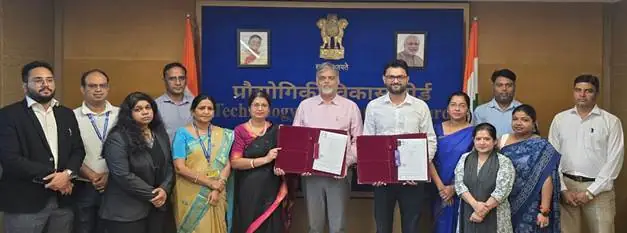
The Technology Development Board has entered into an agreement with Multi Nano Sense Technologies for research, development and innovation support worth Rs 37.51 crore to advance the creation of an indigenous multi-gas sensor platform, in a move that fits squarely within India's broader technology sovereignty agenda.
The funding commitment is significant not only for its size but also for the sector it targets. Multi-gas sensors are core components in industrial safety, environmental monitoring, process control, smart infrastructure and several defence-adjacent applications. By backing a domestic platform, the government is signalling that it wants Indian firms to move beyond assembly and into the design of advanced sensing technologies that are often imported from a narrow set of global suppliers.
Strategic Tech Push
The agreement comes at a time when New Delhi is intensifying its focus on self-reliance in critical technologies. Sensors may not attract the same public attention as semiconductors or telecom equipment, but they are foundational to modern manufacturing and digital infrastructure. A reliable multi-gas sensing platform can be deployed across refineries, chemical plants, mines, laboratories, urban air-quality systems and emergency response networks, making it a commercially broad and strategically relevant technology.
For policymakers, the appeal is twofold. First, indigenous development can reduce exposure to supply-chain disruptions and foreign procurement dependencies. Second, it can create a domestic intellectual property base that supports exports, licensing and downstream product innovation. In a technology landscape increasingly shaped by standards, certification and data integration, control over sensor design can translate into long-term industrial leverage.
The TDB's role is also notable. As a public innovation financier, it is designed to bridge the gap between laboratory development and market readiness, especially for projects that are technically promising but commercially risky. By extending RDI assistance rather than a conventional grant, the board is effectively betting that the project can mature into a scalable platform with industrial relevance.
Industrial Use Cases
Multi-gas sensing platforms have practical value across a wide range of sectors. In heavy industry, they can detect hazardous leaks and improve worker safety. In environmental applications, they can support air-quality surveillance and emissions monitoring. In urban systems, they can be integrated into smart city infrastructure, public safety networks and building management systems. The technology also has relevance in defence and disaster response, where rapid detection of toxic or combustible gases can be critical.
The domestic market opportunity is substantial, but execution will matter more than announcement value. India has often struggled to convert promising hardware research into mass-manufactured products with consistent calibration, durability and certification. Sensor technologies are especially demanding because performance can vary depending on operating conditions, packaging, signal processing and long-term reliability. If Multi Nano Sense Technologies can demonstrate a platform that is both accurate and cost-competitive, it could help close a gap that has long favoured imported systems.
The agreement also reflects a wider policy pattern: the government is increasingly using targeted public support to build niche technology capabilities where India can realistically compete. Rather than attempting to localise every component of a complex supply chain at once, the strategy appears to be focused on high-value nodes where domestic innovation can create multiplier effects.
Policy And Market Signal
The Rs 37.51 crore support package sends a clear signal to India's deep-tech ecosystem. It suggests that the state is willing to underwrite technically complex projects that may take time to commercialise, provided they align with national priorities. That matters for start-ups and specialised engineering firms that often face a financing gap between prototype development and industrial deployment.
At the same time, the project will be judged on outcomes rather than intent. The key tests will include whether the platform can achieve robust multi-gas detection across different environments, whether it can be manufactured at scale, and whether it can meet regulatory and industrial certification requirements. If successful, the initiative could strengthen India's position in a category of sensing technology that is increasingly important to safety, sustainability and industrial automation.
For now, the agreement stands as another marker of India's evolving governance approach to innovation: selective, strategic and increasingly focused on building domestic capability in technologies that matter to both economic resilience and national interest.