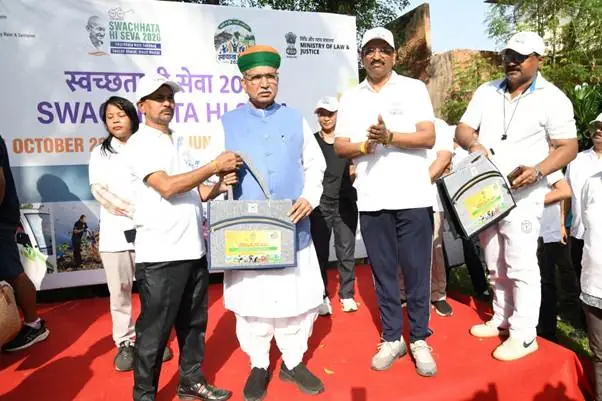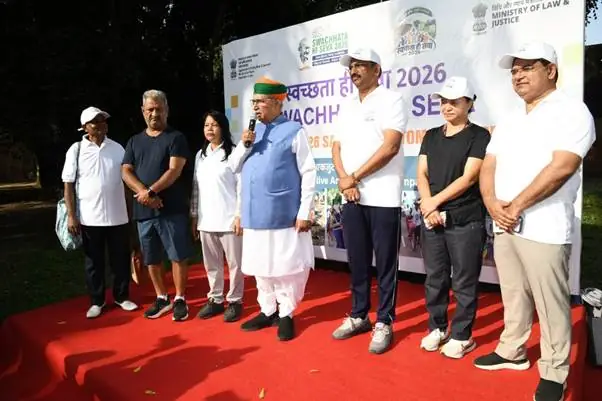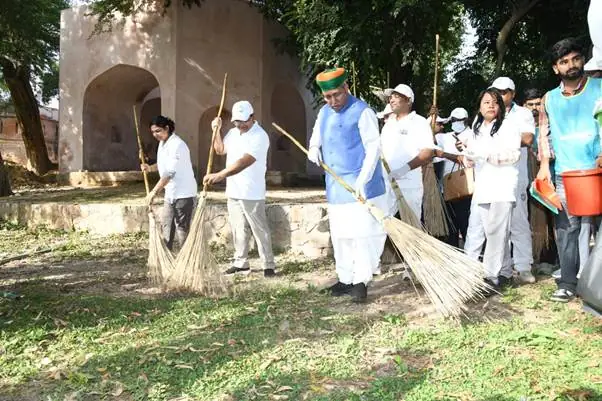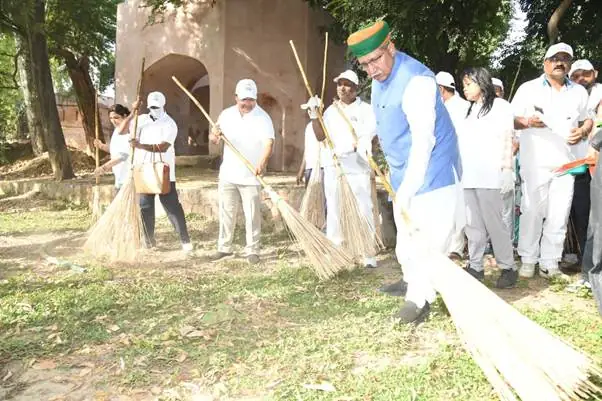
The Legislative Department and the Department of Legal Affairs on Friday jointly conducted a labour volunteer programme in New Delhi under the Swachhata Hi Seva 2026 campaign, adding a bureaucratic and institutional layer to the government's annual cleanliness push. The initiative, framed as a collective service exercise, comes at a time when the Union government continues to position sanitation not merely as a municipal responsibility but as a broader governance ethic tied to public accountability, workplace discipline, and citizen participation.
Institutional Cleanliness Push
The programme brought together officials from two key departments that sit at the core of India's legal and legislative machinery. By participating in a cleanliness-oriented volunteer drive, the departments signalled that the sanitation campaign is being treated as an internal administrative priority rather than a ceremonial public-relations exercise. Such events have become a recurring feature of the Centre's governance calendar, but their significance lies in the message they send: that cleanliness is expected to begin within government offices, not only in public spaces.
Swachhata Hi Seva has, over the years, evolved into a nationwide mobilisation platform that blends symbolic participation with practical civic action. For ministries and departments, the campaign offers an opportunity to demonstrate alignment with the Prime Minister's broader cleanliness agenda while also encouraging staff engagement in community-oriented service. In New Delhi, where the administrative machinery is concentrated and highly visible, such programmes carry added weight because they are watched as indicators of how seriously institutions internalise official policy priorities.
The joint nature of the event is also notable. The Legislative Department and the Department of Legal Affairs serve distinct but closely connected functions within the Union government. Their participation together suggests an attempt to project administrative unity around a non-partisan public cause. In policy terms, this matters because sanitation campaigns are increasingly being used by the government as a means of reinforcing behavioural norms across the civil service, including workplace hygiene, waste segregation, and shared responsibility for public assets.
Governance Through Service
The labour volunteer format is significant because it moves the campaign beyond speeches and pledges. Labour-based participation is intended to embody the principle that public service includes physical effort and direct engagement with the environment. In government communications, such activities are often presented as small but visible acts that help build a culture of cleanliness from the top down. That approach is consistent with the broader Swachh Bharat framework, which has relied heavily on institutional participation to sustain public momentum after the initial mass-mobilisation phase.
For the legal and legislative establishment, the symbolism is especially relevant. These departments are associated with rule-making, statutory interpretation, and the legislative process, yet their involvement in a cleanliness drive underscores a wider administrative philosophy: that governance is not confined to drafting laws, but also includes setting behavioural standards through example. The campaign therefore serves as a reminder that public institutions are expected to model the civic values they seek to promote.
The timing of the programme also fits into the government's recurring effort to use annual cleanliness drives to renew public attention on sanitation outcomes. While such events are often brief, they are part of a larger effort to keep cleanliness on the policy agenda and to prevent it from being treated as a one-off campaign. In that sense, the New Delhi programme is less about the immediate scale of the activity and more about the continuity of the message.
Symbolism And Policy
At the policy level, these drives help sustain the narrative that sanitation is a shared administrative duty spanning ministries, local bodies, and citizens. They also serve a practical internal function by encouraging offices to review housekeeping standards, waste disposal practices, and the condition of shared spaces. Even when the immediate impact is modest, the repeated visibility of such programmes can influence bureaucratic culture over time.
The joint effort by the Legislative Department and the Department of Legal Affairs therefore fits into a larger governance pattern: using organised service activities to translate national campaigns into institutional behaviour. In a capital city where government symbolism is closely scrutinised, the event reinforces the Centre's attempt to keep cleanliness embedded in the everyday functioning of the state apparatus.
As Swachhata Hi Seva 2026 continues, similar departmental initiatives are likely to be used to project administrative participation and to sustain the campaign's public relevance. For now, the New Delhi labour volunteer programme stands as a small but telling example of how the government is seeking to align its internal machinery with a national message of civic cleanliness and collective responsibility.