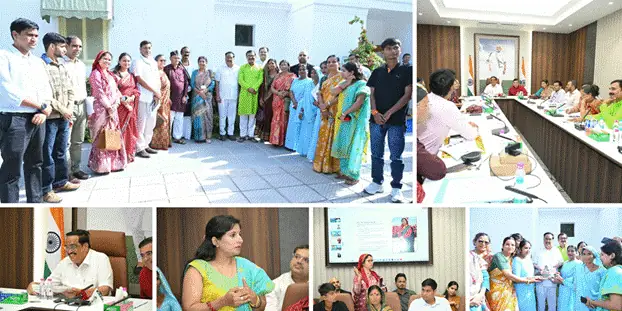
Union Jal Shakti Minister C. R. Patil on Tuesday hosted water conservation champions from across the country at his official residence, turning a symbolic gathering into a broader statement on the centrality of citizen participation in India's water policy agenda. The meeting brought together individuals and groups associated with conservation work in different regions, reflecting the government's effort to elevate local stewardship as a core pillar of water security.
The interaction comes at a time when water management has become one of India's most consequential governance challenges. Rapid urbanisation, uneven monsoon patterns, falling groundwater tables, and rising demand from agriculture and industry have intensified pressure on both surface and underground water systems. In that context, the minister's decision to host conservation advocates at his residence signals an attempt to keep the issue visible beyond formal policy announcements and administrative reviews.
Grassroots Water Politics
The gathering was notable not merely as a ceremonial courtesy, but as a political acknowledgment that water conservation in India increasingly depends on decentralised action. From village-level recharge efforts to urban rainwater harvesting and community awareness drives, the country's most effective interventions often originate outside the formal state apparatus. By receiving these practitioners personally, the minister effectively reinforced the message that local initiative remains indispensable to national water strategy.
Such engagements also serve a strategic communication function. They allow the government to project alignment with civil society actors who work on the ground and to frame water conservation as a shared national responsibility rather than a purely bureaucratic exercise. That framing is especially important in a policy environment where implementation gaps often determine whether ambitious schemes deliver measurable outcomes.
The minister's outreach also fits into a wider administrative narrative that has increasingly linked water security with behavioural change, public participation, and district-level execution. In recent years, central and state authorities have repeatedly stressed the need to move beyond infrastructure alone and toward demand management, reuse, recharge, and conservation-oriented planning. The presence of conservation champions from multiple parts of the country suggests an effort to draw lessons from diverse local models and amplify them nationally.
Policy Meets Public Action
India's water challenge is not only about scarcity; it is also about governance. The country's water stress is shaped by fragmented responsibilities across departments, uneven enforcement of conservation norms, and the difficulty of sustaining public attention on an issue that often becomes urgent only during droughts or urban shortages. Against that backdrop, the minister's meeting can be read as part of a broader attempt to keep water policy anchored in public consciousness.
The symbolic value of hosting conservation advocates at a ministerial residence should not be underestimated. In Indian political culture, such gestures can help validate citizen-led work and create a bridge between policy makers and field practitioners. They may also encourage replication of successful local interventions by giving them a national platform. For conservation workers, recognition at the highest levels can translate into greater visibility, stronger networks, and potentially more influence in shaping future programmes.
At the same time, the gathering highlights the limits of symbolism. India's water crisis will not be addressed by recognition alone. It requires sustained investment in watershed management, groundwater regulation, urban infrastructure, wastewater treatment, and agricultural efficiency. It also demands stronger coordination between ministries, states, and local bodies. The minister's engagement with conservation champions is therefore best understood as one component of a larger policy ecosystem that must deliver on the ground.
National Water Imperative
The timing of the meeting is significant because water conservation has become inseparable from India's broader development and climate agenda. As temperatures rise and weather patterns become more erratic, the resilience of cities, farms, and rural communities will increasingly depend on how effectively water is stored, shared, and reused. That makes public mobilisation as important as technical planning.
By hosting water conservation leaders from across India, Patil underscored a central truth of contemporary governance: the state cannot solve water stress alone. It must work with communities, local innovators, and civic actors who understand the geography of scarcity at the ground level. The meeting therefore carried both symbolic and practical weight, reinforcing the idea that India's water future will be shaped as much by participation as by policy.
For now, the minister's outreach serves as a reminder that water conservation remains a national priority with political, environmental, and developmental dimensions. The challenge is to convert recognition into sustained action, and symbolic support into measurable gains in water security across the country.