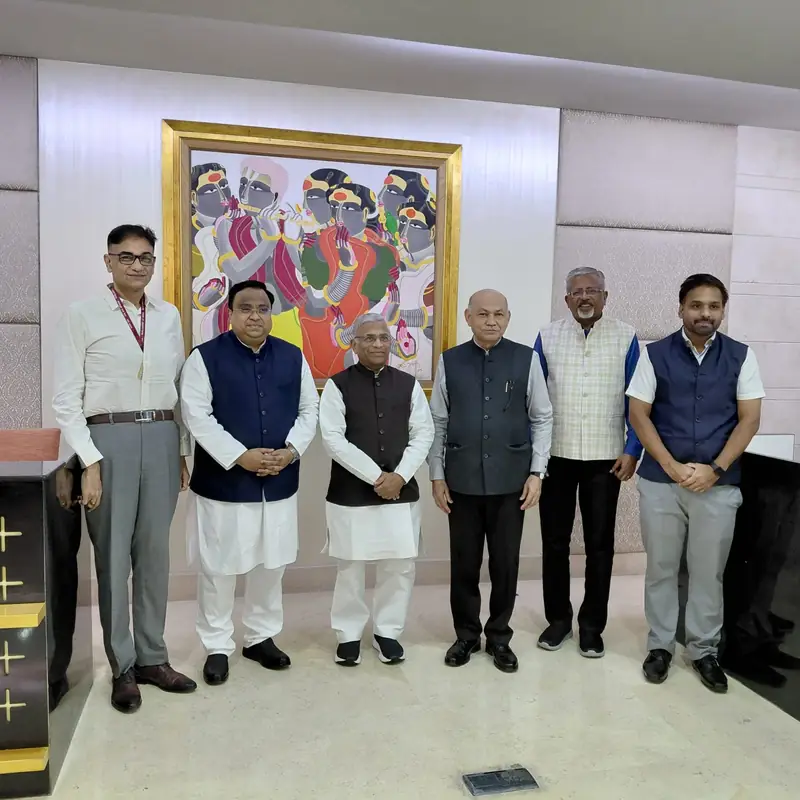
India's parliamentary outreach took centre stage in Tanzania as Rajya Sabha Deputy Chairman Harivansh headed the Indian delegation to the 153rd Assembly of the Inter-Parliamentary Union, a gathering that brings together lawmakers from across the world to deliberate on democracy, governance and global cooperation. The participation reflects New Delhi's effort to project parliamentary diplomacy as a meaningful extension of its foreign policy, especially in forums where legislative institutions shape the language of accountability and international norms.
Parliamentary Diplomacy
Harivansh's leadership of the delegation signals the importance India attaches to legislative engagement beyond executive-level diplomacy. The Inter-Parliamentary Union, one of the oldest and most established global parliamentary bodies, offers a platform where elected representatives exchange views on issues ranging from democratic institutions and human rights to peacebuilding and sustainable development. For India, a country that frequently positions itself as the world's largest democracy, such participation is not ceremonial. It is a strategic affirmation of democratic legitimacy and institutional confidence.
The 153rd Assembly in Tanzania comes at a moment when parliaments worldwide are under pressure to respond to polarisation, digital disruption, economic uncertainty and public distrust. In that context, India's presence carries both symbolic and practical weight. It allows Indian lawmakers to present the country's democratic experience, while also engaging with counterparts on common legislative challenges such as oversight, representation and policy scrutiny. The delegation's composition and Harivansh's role suggest an emphasis on continuity, institutional stature and measured engagement.
Global Forum, Indian Voice
The IPU assembly is not a policy summit in the conventional sense, but its significance lies in the convergence of parliamentary voices that often influence how governments frame legislation and international commitments. India's participation therefore serves a dual purpose: it reinforces the country's standing in multilateral parliamentary networks and gives its representatives a channel to articulate perspectives on governance, development and global stability.
For New Delhi, such forums are increasingly valuable as the international order becomes more fragmented. Parliamentary diplomacy can complement traditional statecraft by building trust, widening dialogue and creating informal channels for consensus. It also allows India to highlight its democratic institutions at a time when questions of representation, inclusion and institutional resilience are central to global political debate. Harivansh's leadership at the assembly places the Indian Parliament in that conversation with visible authority.
The Tanzania meeting also reflects India's broader engagement with the Global South. Parliamentary exchanges with African and Asian legislatures have become an important part of India's outreach strategy, especially as it seeks to deepen political, economic and developmental partnerships across regions. In that sense, the delegation's presence at the IPU is not only about multilateral protocol; it is also about strengthening India's network of legislative relationships in emerging and developing economies.
Strategic Institutional Signal
The choice of Harivansh to lead the delegation is notable because it underscores the role of parliamentary leadership in India's external representation. As Deputy Chairman of the Rajya Sabha, he brings institutional continuity and procedural authority to the forum. That matters in international parliamentary settings, where the credibility of a delegation often depends on the stature and experience of its leadership.
The assembly in Tanzania also offers India an opportunity to align its domestic democratic narrative with its international messaging. At a time when governance debates increasingly focus on institutional trust, legislative transparency and democratic renewal, India's active role in the IPU helps reinforce the image of a country willing to engage on those terms. The delegation's participation is therefore best understood as part of a broader strategy: to ensure that India's voice is heard not only in diplomatic capitals, but also in the chambers where global parliamentary norms are debated and shaped.
While the immediate outcomes of such assemblies are often procedural rather than dramatic, their cumulative effect is significant. They help sustain relationships, build legislative familiarity and keep India embedded in the architecture of international parliamentary cooperation. Harivansh's leadership in Tanzania is a reminder that in contemporary diplomacy, parliaments are not peripheral actors. They are increasingly central to how nations present themselves, build influence and defend democratic values on the world stage.