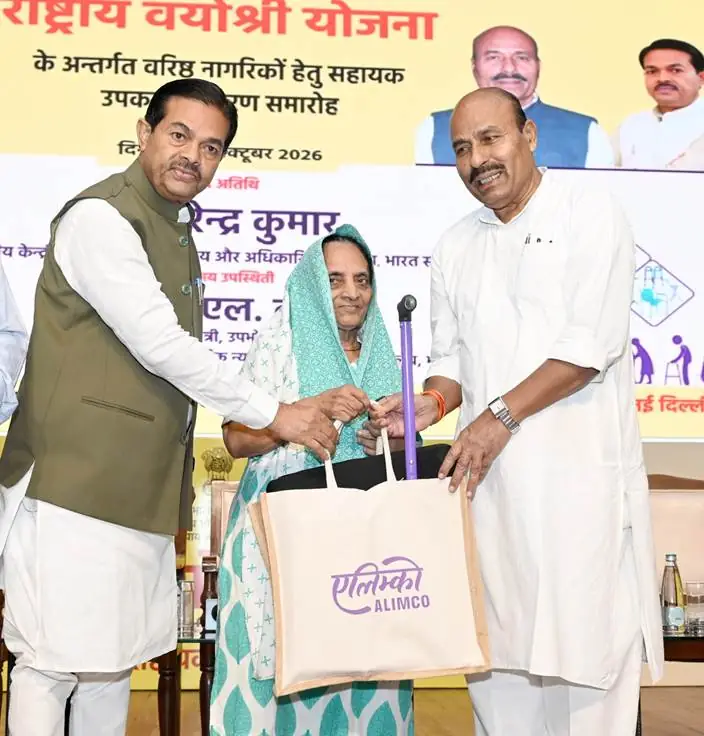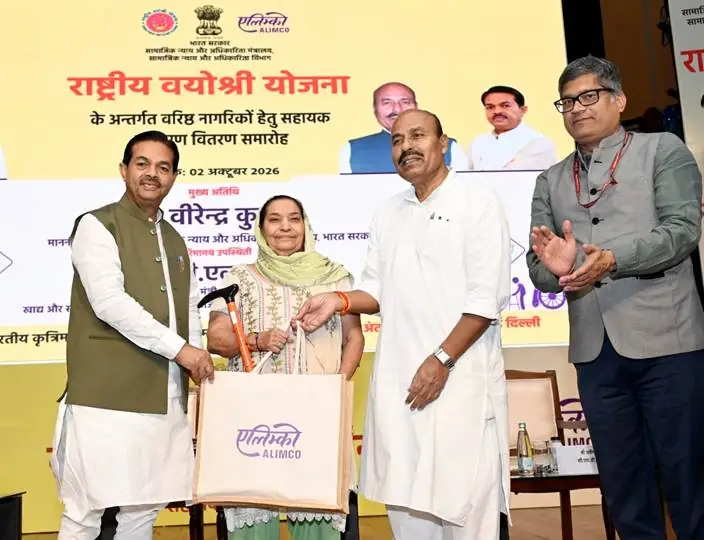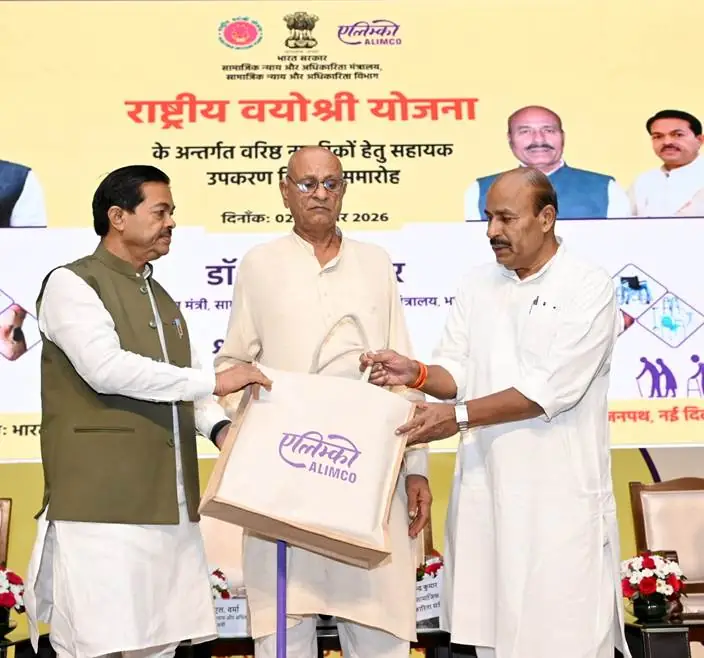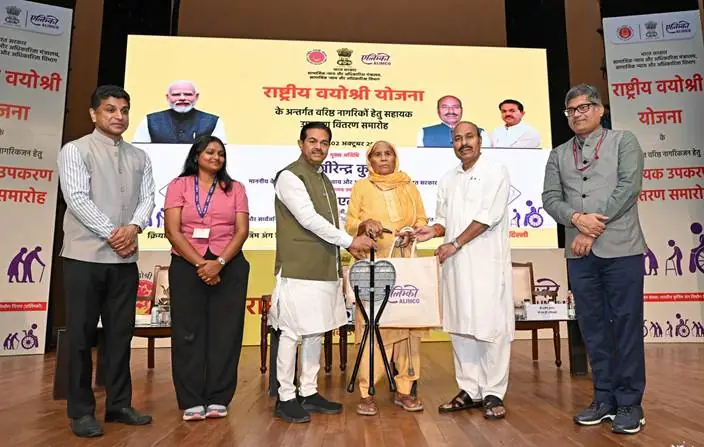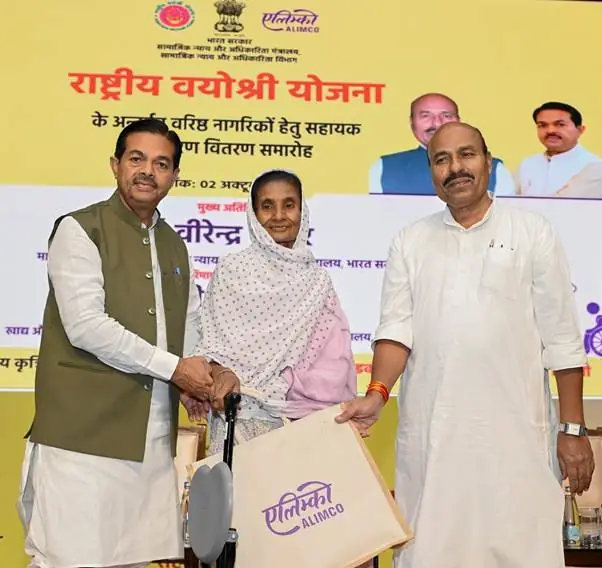
Union ministers Dr. Virendra Kumar and B. L. Verma on Tuesday distributed 662 assistive devices to 114 senior citizens across the Delhi-NCR region under the National Vayoshri Scheme, in a welfare exercise valued at more than ₹10 lakh. The distribution drive, aimed at elderly beneficiaries facing age-related physical limitations, reflects the government's effort to translate social protection policy into direct, visible support for a vulnerable demographic.
The National Vayoshri Scheme is designed to provide free assistive devices to senior citizens belonging to economically weaker sections who suffer from age-related disabilities, including reduced mobility, impaired vision, hearing loss and other functional limitations. By focusing on practical aids rather than cash transfers, the programme seeks to improve day-to-day independence, reduce dependence on caregivers and help older citizens remain active in family and community life.
Welfare Through Mobility
The Delhi-NCR distribution is significant not for its scale alone, but for what it signals about the government's broader welfare architecture. Assistive devices such as walking aids, hearing aids, spectacles, wheelchairs and other support equipment can have an outsized impact on quality of life, particularly for elderly people living on fixed or limited incomes. In policy terms, such interventions are often considered high-efficiency welfare because they address immediate functional needs with relatively modest public expenditure.
For the beneficiaries, the value of the programme lies in accessibility. Many older citizens delay or forgo treatment and support equipment because of cost, lack of awareness or difficulty navigating health and welfare systems. A government-led distribution drive reduces these barriers and brings assistance directly to recipients, especially in an urban region where the elderly population is growing and where the burden of chronic illness and reduced mobility is increasingly visible.
The presence of two Union ministers at the event also points to the political and administrative importance attached to senior citizen welfare. The government has repeatedly framed such schemes as part of a broader commitment to dignity, inclusion and social security for ageing Indians. In a country where family structures are changing and urban migration often leaves older adults with fewer daily support networks, the policy relevance of assistive care is rising.
Policy With Visible Impact
The National Vayoshri Scheme sits within a wider set of welfare measures aimed at senior citizens, including health support, pension-linked assistance and social protection initiatives. Its appeal lies in its directness: the scheme does not depend on complex reimbursement systems or long-term institutional care, both of which can be difficult for elderly citizens to access. Instead, it delivers tangible equipment that can be used immediately.
That practical design matters in a governance environment where public programmes are increasingly judged by measurable outcomes. A distribution of 662 devices to 114 people suggests that multiple aids were tailored to individual needs, indicating a more personalized approach than a one-size-fits-all model. Such customization is important in elderly care, where a single beneficiary may require several forms of support to maintain basic mobility and function.
The initiative also highlights a policy challenge that will only grow more pressing: India's ageing population. As life expectancy rises and the share of senior citizens expands, demand for age-sensitive welfare, accessible healthcare and assistive technology is likely to increase. Schemes like National Vayoshri are therefore not merely symbolic gestures; they are part of a longer-term response to demographic change.
Ageing Becomes Policy Priority
The Delhi-NCR event comes at a time when public policy is being tested by the need to support both scale and specificity. Senior citizens are not a uniform group; their needs vary by income, health status, urban or rural location and family support. A scheme that targets assistive devices acknowledges that ageing policy must go beyond broad rhetoric and address the concrete limitations that affect independence and dignity.
For the government, such programmes also serve an administrative purpose: they demonstrate the ability to identify beneficiaries, deliver benefits and publicize welfare outcomes in a visible format. For recipients, however, the significance is more immediate and personal. A hearing aid, a walking stick or a wheelchair can restore confidence, reduce isolation and make routine tasks manageable again.
The distribution in Delhi-NCR therefore stands as a small but telling example of how social policy is being operationalized on the ground. It combines welfare delivery, public visibility and demographic foresight in a single event. As India's elderly population continues to expand, the political and administrative pressure to deepen such targeted support is likely to intensify.