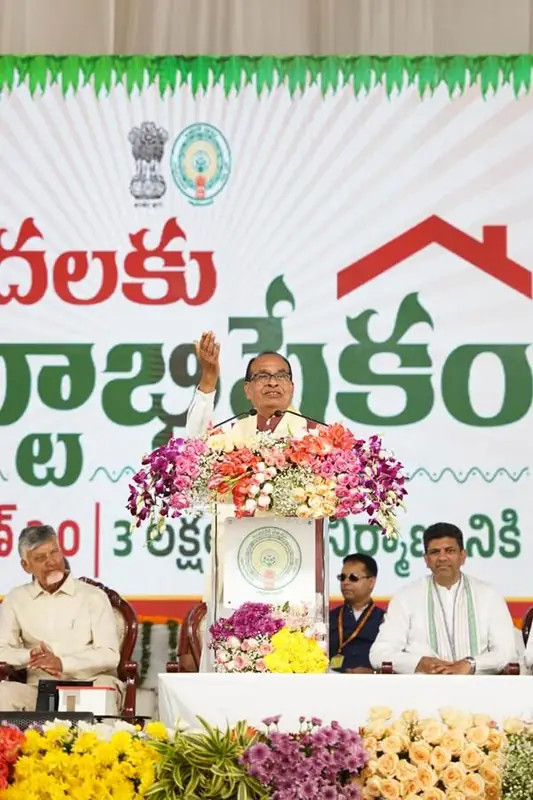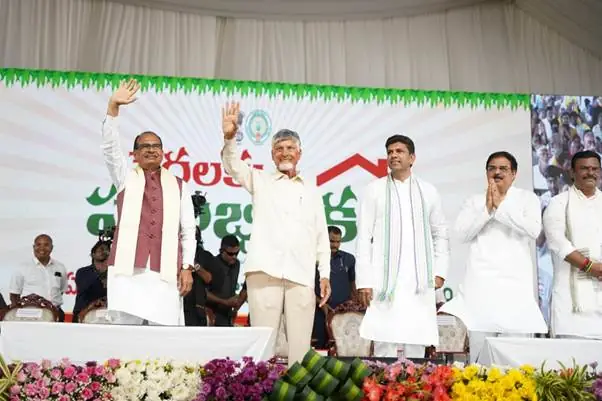
The Union government on Thursday unveiled a major housing commitment for Andhra Pradesh, announcing support for 300,000 permanent homes in what officials described as a significant welfare and development intervention for the state. The announcement, made at Burripalem in the presence of Union Minister Shivraj Singh Chouhan and Chief Minister N. Chandrababu Naidu, is being positioned as both a social policy measure and a political statement about the Centre's development agenda in the southern state.
The pledge comes at a time when housing remains one of the most visible and politically consequential welfare priorities in India. For millions of low-income households, a pucca home is not only a symbol of security and dignity but also a marker of access to state capacity. In Andhra Pradesh, where rural livelihoods, migration pressures and post-disaster reconstruction needs continue to shape public policy, the scale of the commitment is likely to draw close scrutiny over implementation, beneficiary identification and delivery timelines.
Housing as welfare signal
The announcement underscores the continuing centrality of housing in India's welfare architecture. Successive governments have treated permanent housing as a high-impact intervention because it combines asset creation, social protection and visible state presence. In political terms, housing schemes often carry a stronger emotional and electoral resonance than many other forms of public expenditure, particularly in rural constituencies where land, shelter and basic services remain unevenly distributed.
For Andhra Pradesh, the promise of 300,000 homes could materially alter the pace of rural housing delivery if backed by timely fund flows, clear beneficiary lists and coordination with state agencies. The challenge, however, lies in execution. Large housing programmes in India frequently encounter delays related to land availability, local approvals, construction quality, and the matching of central assistance with state-level administrative capacity. The success of this initiative will therefore depend less on the announcement itself than on whether the homes move from paper to completion within a credible timeframe.
Burripalem message
By choosing Burripalem as the venue, the leadership sought to project the scheme as grounded in the realities of ordinary households rather than in abstract policy language. The joint appearance of Chouhan and Naidu also carried clear political symbolism. It presented the Centre and the state government as aligned on a development-first narrative, with housing framed as a shared governance priority rather than a partisan contest.
Chouhan, who has been closely associated with rural development and welfare administration, has increasingly been used by the government to communicate the Centre's outreach to farmers, villagers and low-income families. Naidu, meanwhile, has long cultivated an image of administrative modernisation and infrastructure-led growth. Their joint presence at the event helped reinforce the message that housing is being treated as a foundational development asset, not merely a subsidy.
The announcement also fits into a broader national pattern in which the Union government has sought to highlight direct-benefit and asset-creation programmes as evidence of delivery-oriented governance. In states where political competition is intense, such programmes often serve a dual purpose: they address genuine social needs while also strengthening the Centre's visibility in local development.
Delivery will decide impact
Despite the scale of the commitment, the real test will be implementation. Housing programmes require more than financial sanction; they depend on land records, beneficiary verification, construction supervision and coordination between multiple layers of government. Any mismatch between announced numbers and actual completion rates could quickly dilute the political and social value of the initiative.
The announcement is also likely to be watched for its fiscal and administrative implications. A commitment of this size will require sustained budgetary support and close monitoring to ensure that the promised homes are not delayed by bottlenecks in procurement, site preparation or contractor execution. For households awaiting permanent shelter, the distinction between announcement and delivery is critical.
At a broader level, the move reflects the government's continued reliance on visible welfare infrastructure to demonstrate governance outcomes. In a state like Andhra Pradesh, where development narratives often intersect with regional aspirations and Centre-state coordination, the housing push may become an important benchmark for how effectively the Union and state administrations can translate political alignment into measurable public benefit.
If executed on schedule, the 300,000-home commitment could become one of the most consequential rural housing interventions in the state in recent years. If delayed, it risks joining the long list of ambitious welfare promises that generated headlines before confronting the realities of administrative delivery. For now, the announcement from Burripalem has set a high bar for both governments involved.