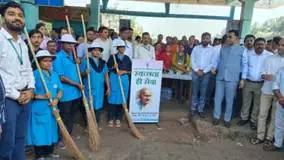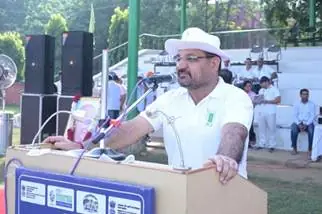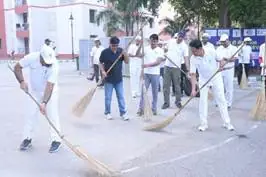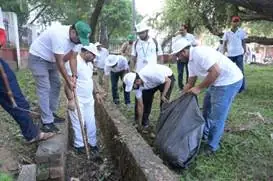
The Department of Agricultural Research and Education (DARE) and the Indian Council of Agricultural Research (ICAR) have launched Special Campaign 6 across the country, placing cleanliness, administrative efficiency, and the recognition of sanitation workers at the center of a coordinated public-sector exercise. The campaign, rolled out nationwide, is part of a broader government effort to embed cleanliness and service discipline into the functioning of institutions under the agricultural research and education system.
The initiative comes at a time when the Union government has increasingly used special campaigns to push measurable improvements in office management, record disposal, space utilization, and public-facing cleanliness. In that context, the latest drive is not merely symbolic. It signals an attempt to convert sanitation into an institutional priority rather than a periodic event, while also drawing attention to the often-invisible labor of safai mitras, the workers who keep public offices and campuses operational and hygienic.
Cleanliness As Governance
The campaign's framing is significant because it places cleanliness within the language of governance rather than ceremonial observance. In government systems, special campaigns are often used to clear pending files, reduce clutter, improve workplace conditions, and strengthen accountability. By linking these administrative goals with a cleanliness drive, DARE and ICAR are aligning with a model of governance that treats physical order, efficiency, and public service as interconnected.
For an institution such as ICAR, which manages a large network of research bodies, laboratories, field stations, and educational establishments, the operational implications are substantial. Clean and orderly premises are not only a matter of appearance. They affect laboratory safety, staff productivity, visitor experience, and the credibility of public institutions that are expected to set standards for scientific and educational excellence.
The campaign also carries a wider policy message. In recent years, the government has sought to normalize cleanliness as a daily administrative responsibility rather than a one-off publicity exercise. That approach has been reinforced through periodic special campaigns across ministries and departments, each designed to produce visible outcomes within a fixed timeframe. Special Campaign 6 appears to continue that pattern, with DARE and ICAR using the platform to reinforce discipline across their institutional network.
Honoring Safai Mitras
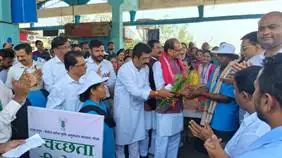
A defining feature of the campaign is the emphasis on honoring safai mitras, the sanitation workers whose labor is essential to the functioning of public institutions but is often overlooked in official narratives. By publicly recognizing them, the campaign attempts to shift the tone from routine maintenance to dignity of labor.
This recognition matters because sanitation work in India has historically been undervalued despite its centrality to public health and institutional functioning. Government campaigns that spotlight safai mitras can help challenge that invisibility, especially when the recognition is tied to concrete appreciation rather than symbolic gestures alone. In practice, such acknowledgment can also improve morale among support staff and encourage a more respectful workplace culture.
The focus on safai mitras also reflects a broader administrative trend: the state is increasingly trying to present itself not only as a provider of services but as an employer and institution that values the workers who sustain those services. In a large public system, that cultural shift can have practical consequences, including better compliance with hygiene standards and stronger ownership of cleanliness responsibilities across staff categories.
Wider Administrative Signal
Special Campaign 6 should also be read as part of the government's continuing effort to demonstrate administrative responsiveness through visible, measurable interventions. In the absence of major policy announcements, such campaigns offer a way to show action on governance reform at the ground level. They are especially useful in large bureaucratic systems where small operational improvements can accumulate into meaningful institutional change.
For DARE and ICAR, the campaign may also serve an internal management function. Agricultural research institutions operate across diverse geographies and often manage significant physical infrastructure. A nationwide cleanliness and recognition drive can help standardize expectations across offices and campuses, while also reinforcing the idea that public institutions must maintain not only scientific rigor but also civic discipline.
The timing of the campaign, in the early hours of the day as it gains attention, underscores the government's preference for immediate, visible mobilization. Yet the real test will be whether the exercise produces durable changes in housekeeping, waste management, and staff culture after the campaign period ends. Such initiatives are most effective when they leave behind systems, not just photographs.
In that sense, Special Campaign 6 is best understood as both a cleanliness drive and a governance signal. It seeks to improve the physical environment of public institutions, elevate the status of sanitation workers, and reinforce the administrative ethic that cleanliness is not peripheral to governance but part of its core functioning.