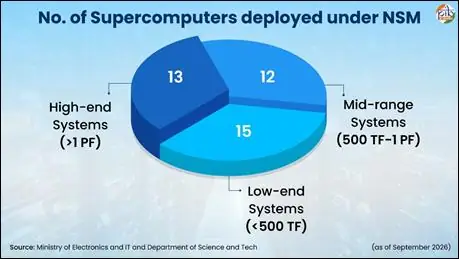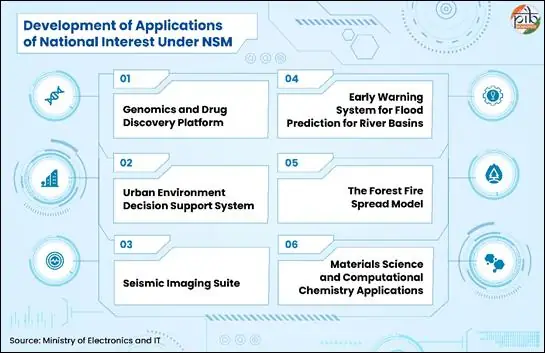
India's supercomputing push is moving from a niche scientific programme to a broader national capability play, reflecting how advanced compute has become central to governance, innovation, and strategic autonomy. What was once largely the preserve of elite research institutions is now being positioned as critical infrastructure for weather forecasting, drug discovery, materials science, artificial intelligence, and national security planning. The shift underscores a larger policy recognition in New Delhi: countries that control high-performance computing capacity will increasingly shape the pace of scientific and industrial progress.
Policy Becomes Strategy
The current phase of India's supercomputing expansion is being driven by a more integrated policy approach, one that links public investment in compute infrastructure with domestic technology development and institutional access. Rather than treating supercomputers as isolated prestige assets, policymakers are increasingly viewing them as shared national platforms that can support universities, laboratories, startups, and government agencies. That framing matters because it broadens the political and economic case for sustained funding.
India has long had strong technical talent in computational science, but access to top-tier compute has often lagged behind demand. That gap has constrained research timelines and limited the scale of projects that Indian institutions can pursue independently. The emerging policy response is aimed at closing that gap through a combination of public procurement, indigenous hardware development, and distributed access models that allow more users to tap into national compute resources.
The strategic logic is clear. In an era when artificial intelligence models, climate simulations, and advanced engineering design all require massive processing power, supercomputing is no longer a specialized luxury. It is an enabling layer for the entire innovation economy. For India, which is trying to deepen manufacturing, improve disaster preparedness, and accelerate scientific discovery, the ability to run large-scale simulations domestically has direct policy value.
Indigenous Capacity Matters
A central theme in India's supercomputing ecosystem is the push for greater indigenous capability. This does not mean complete technological self-sufficiency in the short term, but it does signal a desire to reduce exposure to external supply chains and imported systems that can be costly, constrained, or strategically sensitive. The emphasis on domestic design, integration, and software optimization reflects a broader national technology agenda that also appears in semiconductors, telecom, and cloud infrastructure.
The challenge is not merely to buy more machines. It is to build an ecosystem around them. That includes skilled operators, application developers, domain scientists, and institutions capable of translating raw compute into usable outputs. Without that layer, even the most powerful systems can remain underutilized. India's policy planners appear increasingly aware that supercomputing success depends as much on human capital and institutional coordination as on hardware deployment.
There is also a competitive dimension. Countries across Asia, Europe, and North America are racing to expand high-performance computing capacity as AI workloads intensify. India's ability to remain relevant in this environment will depend on whether it can move from periodic upgrades to a sustained national pipeline of compute investment. That requires predictable budgets, procurement discipline, and a clearer map of which sectors receive priority access.
Governance And Scale
The governance question is now as important as the technology question. Supercomputing infrastructure is expensive to build, costly to maintain, and difficult to distribute equitably. If access is concentrated in a few metropolitan institutions, the national benefits will remain limited. If, however, the ecosystem is designed to serve a wider network of public universities, regional research centres, and mission-driven agencies, it could become a powerful multiplier for public policy.
That is why the emerging supercomputing narrative in India is best understood as a governance story. It is about how the state allocates advanced infrastructure, how it coordinates across ministries and scientific bodies, and how it ensures that strategic technologies serve public goals rather than isolated institutional interests. The policy stakes are especially high in areas such as weather prediction, where better compute can improve early warning systems and disaster response, and in healthcare, where simulation-driven research can accelerate the development of treatments.
The broader implication is that India is beginning to treat supercomputing as part of its national development architecture. That marks an important evolution. If sustained, the approach could help India build a more resilient scientific base, strengthen digital sovereignty, and improve its ability to compete in a world where compute power is becoming a core measure of national capability.