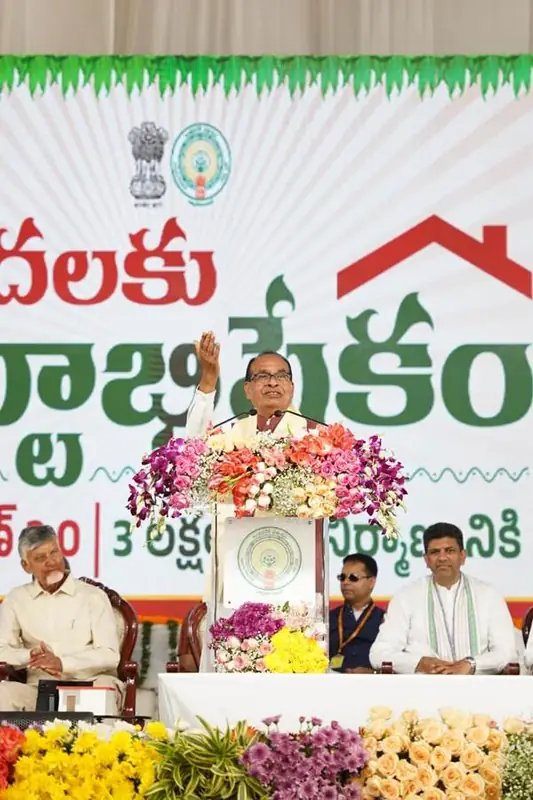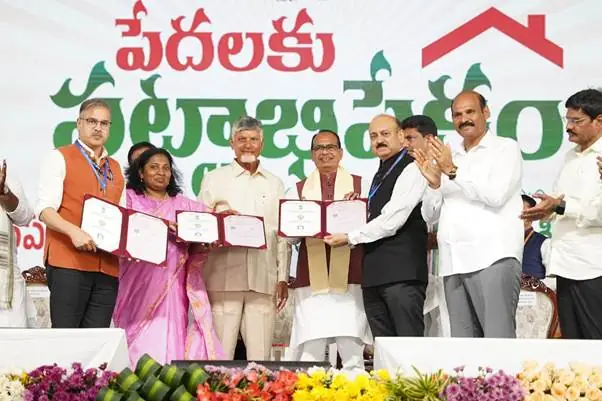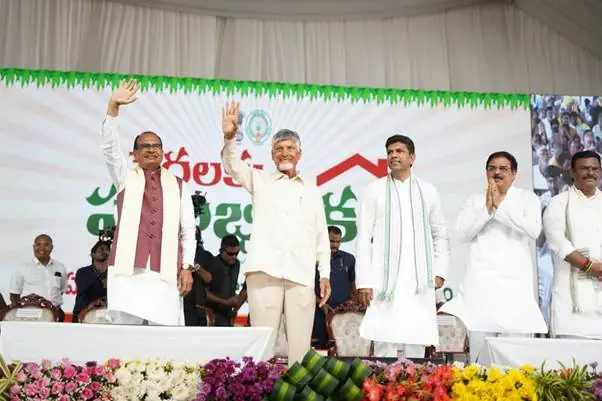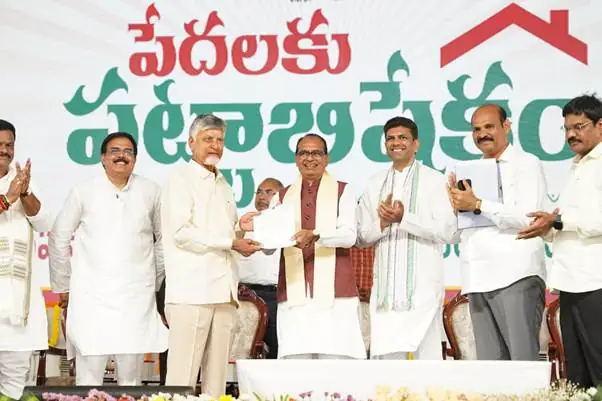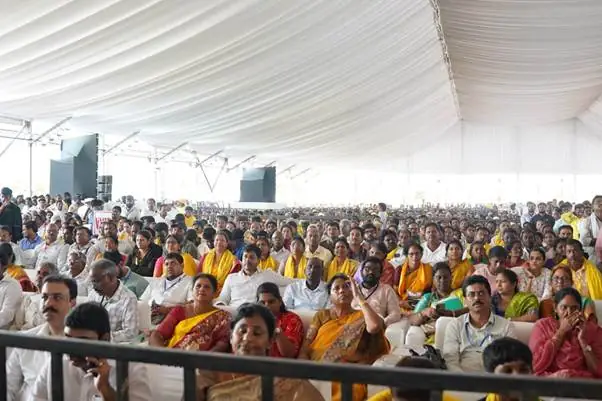
The Union government has unveiled a major housing commitment for Andhra Pradesh, pledging 300,000 permanent homes in what officials described as a historic welfare intervention for the state. The announcement, made in the presence of Union Minister Shivraj Singh Chouhan and Chief Minister N. Chandrababu Naidu at Burripalem, signals a renewed push by the Centre to translate its development narrative into tangible household assets for lower-income families.
The scale of the promise is politically and administratively significant. Housing remains one of the most visible markers of state capacity in India, and large-scale permanent home construction is often used as a benchmark for welfare delivery that can be measured, photographed, and politically credited. For Andhra Pradesh, where post-bifurcation development demands have remained a persistent issue, the commitment is likely to be presented as both a social intervention and a statement of federal partnership.
Housing as policy signal
The announcement comes at a time when the Union government continues to position infrastructure-linked welfare as a central plank of governance. Permanent housing, unlike cash transfers or short-term relief, creates a durable asset that can alter household security, improve access to sanitation and electricity, and strengthen long-term social mobility. In policy terms, the pledge reflects a preference for capital-intensive welfare that is easier to showcase and harder to reverse.
For Andhra Pradesh, the promise of 300,000 homes could have wide-ranging implications if implemented on schedule. Beyond the direct benefit to eligible families, such a programme would generate demand for construction materials, labour, transport, and local contracting. It would also place pressure on state and district administrations to identify beneficiaries, clear land, coordinate approvals, and ensure timely execution. Large housing programmes often succeed or stall not on announcement day, but in the bureaucratic machinery that follows.
The presence of Shivraj Singh Chouhan and Chandrababu Naidu at Burripalem added political weight to the event. Chouhan, a senior Union minister with a long record in rural and welfare administration, has often been associated with people-centric development messaging. Naidu, meanwhile, has built his political identity around infrastructure, technology, and administrative reform. Their joint appearance projected a message of Centre-state alignment around development delivery, even as the practical burden of implementation will rest on multiple layers of government.
Burripalem moment
Burripalem served as more than a ceremonial backdrop. Public events in smaller towns and villages are increasingly used to anchor national policy announcements in local geography, allowing governments to frame large schemes as direct interventions in ordinary lives. By choosing such a setting, the leadership sought to underline the human scale of the housing promise: not abstract numbers, but roofs, walls, and ownership documents for families that have long awaited permanent shelter.
The political messaging is clear. The Centre wants to be seen not merely as a funder but as an enabler of visible transformation. In a period when voters increasingly evaluate governments through delivery metrics rather than ideology alone, housing offers a powerful narrative of competence. It is also one of the few welfare domains where the outcome is physically undeniable. A completed house is evidence, not promise.
Still, the announcement will now be judged by execution. Questions remain about the timeline, funding architecture, beneficiary selection, and whether the homes will be delivered through central schemes, state coordination, or a blended model. The success of the initiative will depend on land availability, local planning, and the ability of agencies to avoid delays that have historically affected large public housing drives.
For now, the pledge marks one of the most consequential housing announcements for Andhra Pradesh in recent years. It reinforces the Modi government's broader strategy of combining welfare with infrastructure and using high-visibility public commitments to demonstrate developmental intent. If delivered effectively, the 300,000-home promise could reshape not only the housing landscape in Andhra Pradesh, but also the political language of governance in the state.