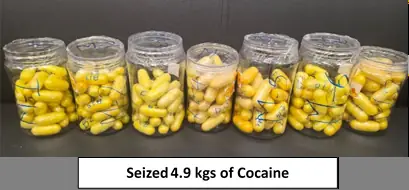
India's Directorate of Revenue Intelligence has intensified its anti-narcotics enforcement push with a series of three operations that together yielded a significant haul of illicit drugs and five arrests, according to officials familiar with the action. The seizures — nearly 7 kilograms of amphetamine, 5 kilograms of cocaine, and 3.5 kilograms of heroin — point to the scale and diversity of the trafficking channels being targeted by the agency.
The operations are the latest evidence of a broader enforcement strategy aimed at disrupting both supply-side smuggling and downstream distribution networks. While the DRI has not publicly detailed every operational aspect of the cases, the quantities involved suggest the drugs were intended for high-value urban markets rather than small-scale street-level circulation. In particular, amphetamine and cocaine are typically associated with organized trafficking routes, while heroin remains a persistent concern in India's narcotics landscape because of its links to cross-border smuggling and domestic consumption corridors.
Enforcement Pressure Rises
The DRI's action comes at a time when Indian enforcement agencies are under sustained pressure to curb the movement of synthetic and semi-synthetic narcotics through ports, airports, courier channels, and land routes. The agency, which operates under the Department of Revenue, has increasingly been used as a frontline instrument in cases involving customs evasion, smuggling, and drug trafficking that intersect with financial crime and cross-border logistics.
Officials say the significance of the latest seizures lies not only in the volume recovered but also in the fact that the drugs span multiple categories. That breadth often indicates a network with access to diverse sourcing channels and the ability to move different narcotics through layered concealment methods. The arrests of five individuals further suggest that investigators are pursuing the chain beyond mere couriers, potentially toward handlers, financiers, and end-market distributors.
The timing of the operations also reflects the government's continuing emphasis on narcotics interdiction as a national governance priority. Drug trafficking has increasingly been framed not just as a law-and-order issue, but as a challenge with implications for public health, border security, organized crime, and money laundering. In that context, agencies such as the DRI are expected to work in tandem with customs, police, and other central enforcement bodies to map trafficking routes and dismantle networks rather than merely intercept consignments.
High-Value Drug Networks
Amphetamine, cocaine, and heroin each occupy distinct positions in the illicit drug economy, but their simultaneous seizure in one enforcement cycle is notable. Amphetamine is often linked to synthetic drug production and trafficking ecosystems that can be highly adaptive and difficult to detect. Cocaine, by contrast, is typically associated with international trafficking chains and premium urban demand. Heroin remains one of the most entrenched narcotics in South Asia, with trafficking patterns often shaped by regional supply routes and local distribution networks.
The combined seizure of 15.5 kilograms across three operations indicates a substantial enforcement success, though it also highlights the continuing scale of the challenge. Drug syndicates frequently evolve quickly, shifting routes, concealment techniques, and intermediaries in response to enforcement pressure. That makes sustained intelligence-led action essential, especially in a market where even relatively small quantities can translate into large illicit profits.
For the DRI, the cases may also provide an opportunity to trace financial flows associated with the consignments. In narcotics investigations, the movement of money often reveals more about the structure of a network than the seized contraband itself. Follow-up scrutiny of communications, transport records, shell entities, and payment trails can help authorities identify the broader architecture behind the shipments.
The arrests of five suspects are likely to be followed by custodial questioning and forensic examination of the seized material, transport links, and digital evidence. Such cases often expand as investigators identify additional participants or corroborate earlier intelligence. The agency's next steps will be watched closely for signs of whether the operations were isolated interdictions or part of a larger coordinated campaign against a wider trafficking ring.
The latest action reinforces a clear message from enforcement authorities: India's anti-narcotics apparatus is moving beyond reactive seizures toward more aggressive disruption of organized drug supply chains. With synthetic drugs and hard narcotics continuing to circulate through complex routes, the DRI's operations suggest that interdiction efforts are likely to remain a central feature of the country's security and governance agenda.