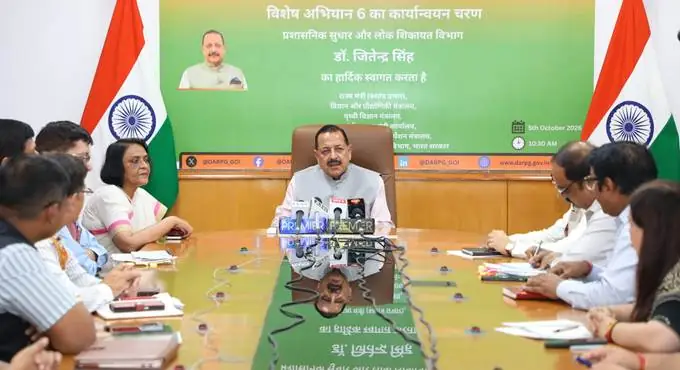
Union Minister Dr. Jitendra Singh on Tuesday reviewed the progress of Special Campaign 6 at the Department of Administrative Reforms and Public Grievances (DARPG) office in Sardar Patel Bhavan, New Delhi, in a move that reflects the government's continuing emphasis on administrative efficiency, institutional cleanliness, and systematic disposal of pending work.
The review is part of a wider central government drive that has, over successive editions, sought to convert symbolic cleanliness exercises into measurable governance outcomes. Special campaigns in government offices are no longer being treated merely as housekeeping initiatives; they are increasingly being used as instruments to reduce file backlogs, improve record management, free up office space, and strengthen the public-facing discipline of ministries and departments.
Governance Push
Dr. Singh's review of Special Campaign 6 places DARPG at the centre of this administrative reform architecture. As the department responsible for administrative reforms and public grievances, DARPG occupies a particularly visible role in shaping how the Union government frames efficiency, responsiveness, and citizen service delivery. A campaign review at this level signals that the exercise is being monitored not as a routine internal checklist, but as part of a broader governance narrative.
The timing is also significant. With ministries under pressure to demonstrate measurable outcomes, special campaigns have become a recurring test of execution. They require departments to identify pending references, weed out obsolete records, improve workplace cleanliness, and report progress in a structured manner. In practice, this means the campaign serves both operational and reputational purposes: it helps clear administrative clutter while also projecting an image of a government focused on order and accountability.
For DARPG, the review carries added weight because the department often acts as a policy signal for the rest of the bureaucracy. When the minister inspects progress there, it effectively reinforces expectations across the wider administrative system that compliance will be tracked, documented, and publicly visible. That matters in a governance environment where process reform is increasingly linked to service delivery outcomes.
Administrative Reform Signal
Special campaigns have become a familiar feature of the Centre's administrative calendar, but their importance lies in the cumulative effect rather than the ceremonial moment. Each edition is designed to push departments toward measurable housekeeping targets, including disposal of pending references, digitisation of records, and better use of office space. The underlying logic is straightforward: a cleaner and more organised bureaucracy is expected to respond faster and function with fewer bottlenecks.
The review at Sardar Patel Bhavan also reflects the government's preference for visible administrative discipline. In a large and complex system, symbolic actions can matter when they are tied to concrete performance metrics. The challenge, however, is sustaining momentum beyond the campaign window. Past editions have shown that the real test is not whether departments can produce a burst of activity during the campaign period, but whether those gains translate into durable changes in workflow and file management.
That is where DARPG's role becomes especially important. As the nodal department for administrative reform, it is expected to model the standards it asks of others. A review by the minister therefore serves both as oversight and as a reminder that reform is not limited to policy announcements; it must be reflected in the daily functioning of offices.
What The Review Means
The review of Special Campaign 6 is likely to be read within government circles as part of a broader effort to sharpen administrative accountability ahead of future governance milestones. While the campaign itself is operational in nature, it sits within a larger policy framework that prioritises efficiency, transparency, and citizen-centric administration.
For the public, the significance lies in whether such campaigns produce tangible improvements: faster grievance resolution, better record retrieval, cleaner offices, and less bureaucratic delay. For the government, the value lies in demonstrating that reform can be embedded in routine administration rather than left to occasional structural overhauls.
Dr. Singh's review therefore serves as a reaffirmation of a governance style that relies on periodic measurement, ministerial oversight, and visible compliance. In an era when administrative credibility is increasingly judged by execution rather than intent, Special Campaign 6 is another test of whether the machinery of government can deliver order, efficiency, and responsiveness at scale.