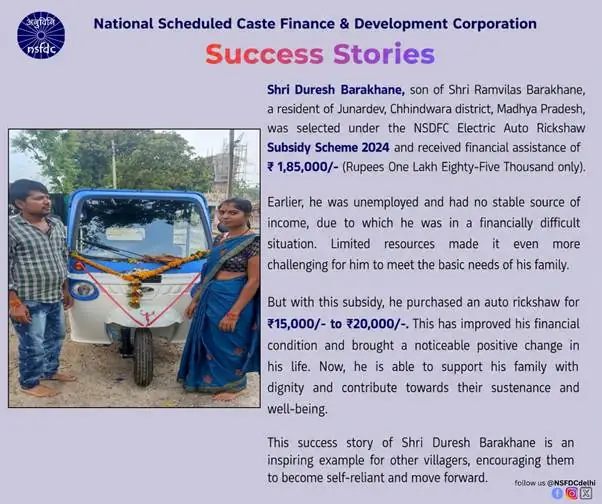
India's policy conversation is entering a new phase, one that seeks to move beyond the familiar language of unemployment and toward a more ambitious framework of self-reliance. The shift is not merely rhetorical. It reflects mounting recognition in New Delhi that the country's labour market cannot be stabilized by public hiring alone, nor can it rely indefinitely on short-term relief measures. Instead, the central challenge is to create conditions in which citizens can generate income through enterprise, skills, and local economic activity.
Policy Reframing
The idea of moving from joblessness to self-sufficiency has become increasingly central to national governance debates because it speaks to both economic necessity and political urgency. India's working-age population remains large, and every year millions of young people enter the labour force seeking stable work. Yet formal employment growth has not kept pace with demand, leaving policymakers to search for models that can absorb labour more broadly across sectors.
This is where the self-reliance narrative has gained traction. Rather than treating unemployment solely as a deficit to be managed, the new policy lens frames citizens as potential producers, entrepreneurs, and contributors to local value chains. The underlying logic is that if the state can reduce barriers to credit, training, market access, and digital infrastructure, more people may be able to create livelihoods on their own terms.
That approach also aligns with India's wider governance priorities. The government has repeatedly emphasized economic resilience, domestic manufacturing, and the strengthening of small businesses as pillars of national growth. In practice, this means policy attention is increasingly directed toward micro, small and medium enterprises, skill development, and schemes that encourage self-employment rather than only wage-based work.
Jobs Versus Livelihoods
The distinction between jobs and livelihoods is becoming more important in policy circles. A job implies a formal employer-employee relationship, often in the organized sector. A livelihood, by contrast, can include self-employment, small-scale trade, services, farming-linked activity, and micro-enterprise. For a country as large and diverse as India, the latter may offer a more realistic path for many households, especially in semi-urban and rural areas where formal vacancies are limited.
But the transition is not automatic. Self-reliance can become a slogan unless it is backed by measurable support. Entrepreneurs need affordable finance, predictable regulation, transport connectivity, and access to buyers. Workers need training that matches market demand, not just classroom certification. Women, in particular, often face additional barriers in accessing capital and formal markets, making targeted support essential if self-employment is to become genuinely inclusive.
There is also a political dimension. Governments are under pressure to show visible progress on employment, but large-scale public sector recruitment is fiscally constrained and administratively slow. Promoting self-reliance offers a way to broaden the employment conversation without promising what the state may not be able to deliver at scale. Still, the credibility of that strategy will depend on whether it produces stable incomes rather than precarious survival activity.
The Governance Test
The real test for this policy direction lies in implementation. India has no shortage of schemes aimed at skill-building, entrepreneurship, and financial inclusion. The challenge is coordination, quality, and follow-through. Too often, programmes are fragmented across ministries and states, with uneven outcomes on the ground. A successful self-reliance agenda would require tighter integration between education, industrial policy, local administration, and credit institutions.
It would also require a more granular understanding of regional labour markets. What works in an industrial corridor may not work in a district dependent on agriculture or informal services. Policy design must therefore be flexible enough to reflect local conditions while still offering a national framework for opportunity creation.
At a deeper level, the shift from unemployment to self-reliance signals a change in how the state imagines economic citizenship. The goal is no longer only to provide relief, but to enable participation. That is a more demanding standard, because it asks whether public policy can help people move from dependence to agency. If executed well, it could widen economic inclusion and strengthen resilience. If executed poorly, it risks becoming another slogan in a country where the demand for dignified work remains far ahead of supply.