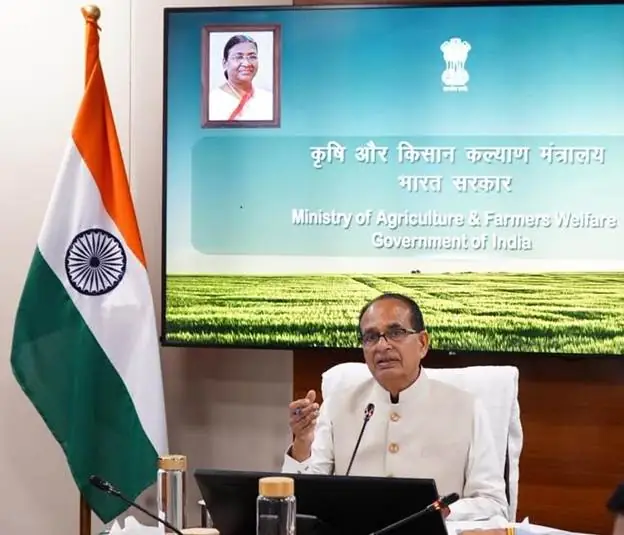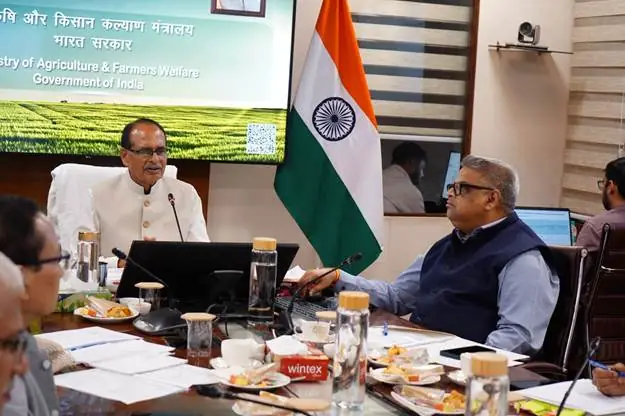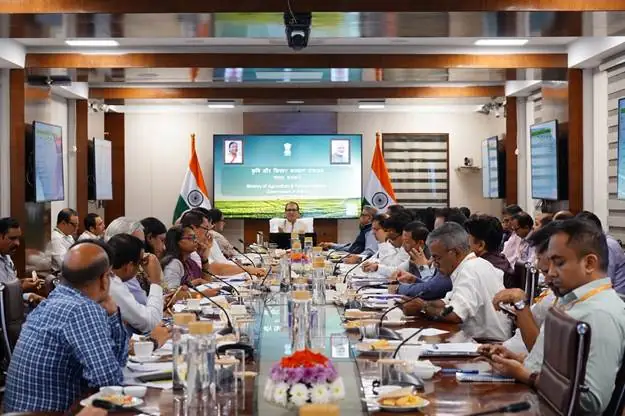
Union Agriculture Minister Shivraj Singh Chouhan chaired the Ministry of Agriculture and Farmers' Welfare's first comprehensive monthly review meeting at Krishi Bhawan in New Delhi, marking what officials described as a new phase of routine, system-wide monitoring inside one of the government's most politically sensitive ministries. The meeting comes at a time when agriculture remains central to India's economic stability, rural livelihoods, food security, and the broader policy agenda of the Union government.
The decision to institute a full monthly review format suggests a stronger emphasis on execution rather than announcement. In a sector where policy outcomes are often shaped by weather shocks, procurement cycles, input costs, and uneven state-level implementation, regular ministerial scrutiny can serve as a corrective mechanism. It also reflects the government's recognition that agriculture policy cannot be managed through episodic interventions alone; it requires continuous oversight, faster feedback loops, and closer coordination between departments.
Administrative Reset
The review meeting at Krishi Bhawan is significant not merely because it was the first of its kind under Chouhan's chairmanship, but because it points to a more disciplined administrative architecture. Monthly reviews, when conducted seriously, can expose bottlenecks in scheme delivery, identify delays in fund flow, and improve accountability across the ministry's various verticals. For a ministry that oversees everything from crop production and extension services to market support and farmer welfare measures, such a format can help convert broad policy goals into measurable operational targets.
Chouhan's leadership style has long been associated with hands-on political management, and the new review mechanism appears consistent with that approach. By bringing senior officials into a structured monthly assessment, the ministry is likely aiming to ensure that policy priorities do not remain confined to files and announcements. Instead, the focus appears to be on implementation discipline, inter-departmental coordination, and timely course correction.
Agriculture Under Pressure
The timing of the meeting is also important. Indian agriculture continues to face multiple pressures, including climate variability, fragmented landholdings, rising input expenses, and the challenge of improving farm incomes without distorting markets. These structural issues make the ministry's role unusually complex. It must balance short-term relief with long-term productivity gains, while also maintaining political sensitivity to rural distress and farmer expectations.
A comprehensive monthly review can help the ministry track whether flagship interventions are reaching intended beneficiaries and whether administrative systems are responding quickly enough to field realities. In practical terms, this means monitoring not only scheme performance but also the quality of coordination with states, the pace of digital and institutional reforms, and the responsiveness of the ministry to seasonal and regional agricultural demands.
The meeting also underscores the centrality of agriculture in the Union government's governance model. Even as India's economy diversifies, the farm sector remains a decisive factor in inflation management, rural demand, and social stability. Any attempt to strengthen agricultural administration therefore has implications well beyond the ministry itself.
Policy Delivery Focus
The broader message from the review meeting is that the ministry is moving toward a more performance-oriented governance style. That shift matters because Indian agriculture has often suffered from a gap between policy intent and field-level execution. Regular reviews can narrow that gap by forcing departments to present progress, explain delays, and align priorities more tightly with outcomes.
If sustained, the monthly review mechanism could become an important instrument for improving administrative accountability in agriculture. It may also help the minister identify which programmes require redesign, which need stronger state partnerships, and where institutional capacity must be reinforced. In a sector where small delays can have large consequences for farmers, the value of such oversight lies in speed, clarity, and follow-through.
For now, the meeting at Krishi Bhawan signals intent: a more active ministerial hand on the levers of agricultural governance, and a clearer expectation that policy delivery will be tracked not annually or sporadically, but every month. In the context of India's vast and vulnerable farm economy, that shift may prove as important as any new announcement.