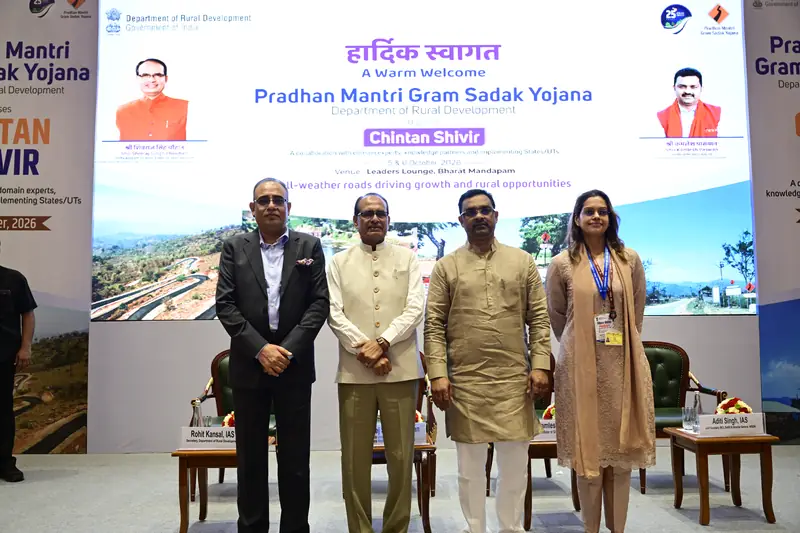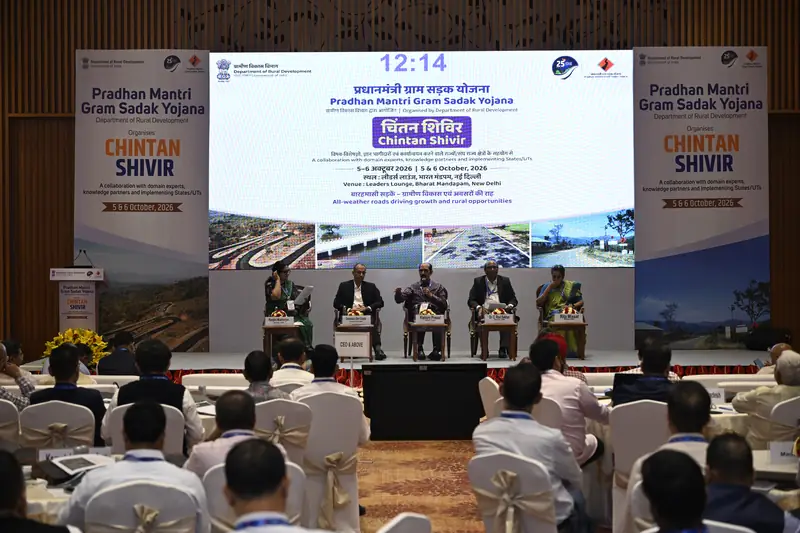
The Pradhan Mantri Gram Sadak Yojana Chintan Shivir has laid out a strategic framework for the next phase of rural road development, placing equal emphasis on quality assurance, maintenance discipline and technology adoption. The discussions come at a time when India's rural connectivity agenda is moving beyond the first-order challenge of building roads and toward the more complex task of ensuring that those roads remain usable, resilient and economically productive.
Quality First Approach
The central message emerging from the Shivir is that rural connectivity can no longer be measured only by the number of roads built or habitations linked. Officials and stakeholders underscored that construction quality must become the primary benchmark, because poor workmanship, weak drainage, substandard materials and inadequate supervision can quickly erode the value of public investment. In a programme as geographically expansive as PMGSY, even small lapses in execution can translate into large-scale maintenance burdens and reduced service life.
This quality-first framing is significant because rural roads are not merely transport assets; they are lifelines for access to schools, health centres, markets and emergency services. A road that fails early can isolate communities just as effectively as no road at all. The Shivir's emphasis suggests a policy recalibration toward lifecycle performance, where durability and usability matter as much as initial completion.
Maintenance As Policy Priority
Maintenance has long been the weakest link in rural road programmes, often receiving less attention than new construction. The Chintan Shivir appears to have treated that gap as a structural issue rather than a routine administrative one. By elevating maintenance into the core policy conversation, the programme is acknowledging that asset preservation is essential to protecting public spending and sustaining connectivity gains.
This is especially relevant in regions exposed to heavy rainfall, flooding, soil erosion or extreme temperature variation, where roads deteriorate faster and require more systematic upkeep. A maintenance-led approach also has fiscal implications: preventive care is typically cheaper than major reconstruction, and a predictable maintenance regime can reduce the long-term cost of the network. The policy direction emerging from the Shivir therefore points to a more mature infrastructure model, one that values continuity over one-time delivery.
Technology For Rural Roads
Technology featured prominently in the deliberations, reflecting the government's broader push to digitize infrastructure governance. In the PMGSY context, technology can strengthen planning, monitoring, inspection and accountability. Digital tools can help map remote habitations more accurately, track project progress in real time, flag defects earlier and improve transparency in contractor performance and fund utilization.
The technology agenda also carries a governance dimension. Rural road programmes often span difficult terrain and dispersed administrative jurisdictions, making oversight challenging. Data-driven systems can reduce information gaps between field execution and central monitoring, while geospatial tools and mobile-based reporting can improve the precision of interventions. If implemented effectively, such systems could help shift PMGSY from a largely construction-centric programme to a more intelligent infrastructure platform.
The broader significance lies in the possibility of institutionalizing evidence-based decision-making. Rather than relying solely on periodic inspections or paper-based reporting, authorities can use digital records to identify recurring defects, prioritize vulnerable stretches and plan maintenance cycles more efficiently. That would mark an important step toward making rural connectivity both scalable and sustainable.
A Next-Phase Framework
The Chintan Shivir's focus indicates that PMGSY is entering a more demanding phase of implementation. The easy political gains of announcing new roads have already been largely harvested; the harder task now is to preserve and upgrade the network so that it continues to deliver social and economic returns. That requires stronger engineering standards, tighter supervision, better maintenance financing and a more sophisticated use of technology.
For rural India, the implications are substantial. Reliable roads can lower transport costs, improve access to services, support farm-to-market linkages and reduce isolation during emergencies. But those benefits depend on roads that remain functional through seasons and over years. The Shivir's agenda suggests that policymakers are increasingly aware that connectivity is not a one-time achievement but an ongoing obligation.
If translated into execution, the framework could help PMGSY evolve from a flagship road-building scheme into a more resilient rural infrastructure system. The real test will be whether the emphasis on quality, maintenance and technology is matched by institutional discipline on the ground, where the success or failure of the programme is ultimately determined.