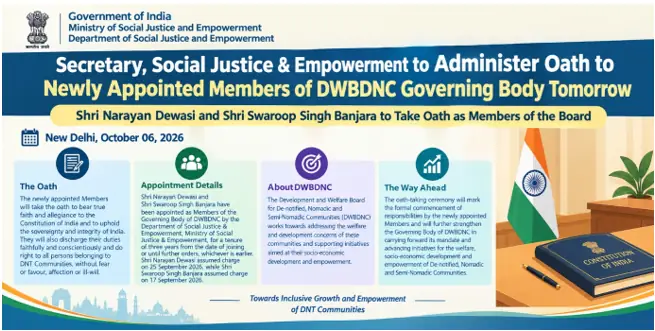
Secretary of the Ministry of Social Justice and Empowerment, Sudhansh Pant, is scheduled to administer the oath of office to the newly appointed members of the governing body of the DWBDNC on Tuesday, marking an important administrative transition in one of the government's key disability-focused institutions.
The oath-taking ceremony is more than a procedural formality. In the architecture of Indian governance, such appointments are often the first visible step in resetting institutional priorities, aligning leadership with policy goals, and ensuring continuity in implementation. For the disability sector, where outcomes depend heavily on coordination between ministries, commissions, and state-level systems, the composition and functioning of the governing body can directly influence how effectively rights and welfare measures are translated into action.
Institutional Reset
The DWBDNC occupies a critical space in the broader framework of social justice administration. Its mandate, while technical in nature, carries significant public policy weight because it is tied to accessibility, inclusion, grievance redress, and the enforcement of entitlements for persons with disabilities. The induction of newly appointed governing body members signals an effort to refresh institutional leadership at a time when expectations around measurable delivery remain high.
Such transitions are particularly relevant in sectors where policy intent often outpaces ground-level execution. India has expanded its legal and administrative emphasis on disability inclusion over the years, but persistent gaps remain in accessibility, awareness, and inter-departmental coordination. A governing body that is active, informed, and aligned with the ministry's priorities can help sharpen oversight and improve the pace of implementation.
The presence of the ministry secretary at the oath ceremony also reflects the administrative significance attached to the body. In government practice, direct involvement by senior officials often indicates that the institution is expected to play a substantive role in policy execution rather than functioning as a symbolic forum. That matters in a sector where the quality of governance can affect access to education, employment, mobility, and public services for millions of citizens.
Policy Stakes Ahead
The timing of the induction comes against a backdrop of continuing national attention to inclusive governance. Disability policy in India has increasingly moved beyond welfare language toward a rights-based framework, but the challenge remains in converting that framework into consistent service delivery. That requires not only rules and schemes, but also capable institutions that can monitor compliance, identify bottlenecks, and respond to complaints with speed and credibility.
The governing body's new members are likely to be assessed on how effectively they contribute to these objectives. Their role will be especially important in areas where policy design intersects with implementation, including accessibility standards, institutional coordination, and the practical enforcement of protections available under law. In that sense, the oath-taking is the opening marker of a broader administrative test.
For the ministry, the event also serves a signaling function. It communicates continuity in governance while allowing for a renewed emphasis on accountability and outcomes. In a policy domain that often requires sustained attention rather than episodic announcements, the effectiveness of such bodies is measured less by ceremony than by follow-through.
The ceremony in New Delhi is therefore likely to be watched closely by stakeholders in the disability rights and social welfare ecosystem. While the immediate event is ceremonial, its implications are operational: it sets the tone for how the governing body will engage with the ministry's agenda and how seriously the government intends to pursue inclusion as a matter of administrative practice, not just policy rhetoric.