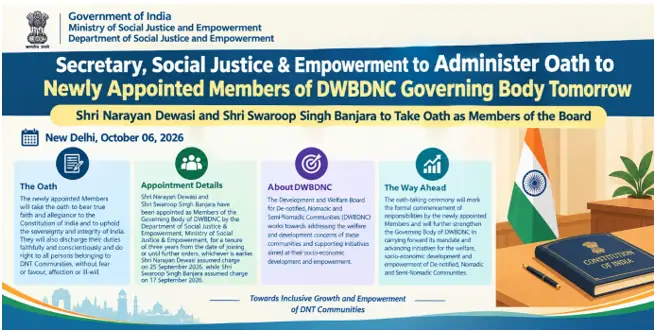
The Ministry of Social Justice and Empowerment is set to mark a significant administrative transition as Secretary Sudhansh Pant prepares to administer the oath of office to the newly appointed members of the governing body of the Department of Welfare of the Differently Abled and the National Centre for the Disabled (DWBDNC) tomorrow. The development, while procedural on the surface, carries broader policy significance because the governing body is expected to influence how disability welfare priorities are translated into institutional action.
The oath-taking ceremony comes at a time when disability inclusion remains a key governance challenge across India. From accessible public infrastructure and assistive technology to education, employment, and social protection, the policy agenda for persons with disabilities requires sustained coordination between ministries, state administrations, and implementing bodies. A newly constituted governing body can provide momentum, but it also raises expectations that the institution will move beyond symbolic representation toward measurable delivery.
Governance Reset
The appointment of new governing body members typically marks more than a routine administrative exercise. In institutions linked to social justice and disability welfare, such changes often signal an effort to refresh oversight, sharpen priorities, and align implementation with current policy needs. DWBDNC's governing body is likely to be expected to examine operational gaps, improve institutional responsiveness, and strengthen the link between policy formulation and ground-level outcomes.
Secretary Sudhansh Pant's role in administering the oath underscores the ministry's direct oversight of the body and reflects the centrality of bureaucratic leadership in India's social welfare architecture. In the Indian administrative system, senior officials often play a decisive role in setting the tone for institutions that work at the intersection of rights, welfare, and service delivery. The ceremony therefore has both procedural and symbolic value: it formally inducts the new members while also reaffirming the ministry's stewardship over disability-related governance.
The timing is also notable. As public expectations rise around inclusive development, institutions responsible for disability welfare are under pressure to demonstrate practical progress. That includes improving access to services, ensuring that schemes are better targeted, and addressing persistent barriers in mobility, communication, and participation. A governing body with fresh members may be better positioned to review these issues with renewed urgency, provided it is given clear mandates and administrative support.
Policy Stakes Ahead
For the disability sector, governance quality is often as important as policy design. India has made legal and institutional commitments to inclusion, but implementation remains uneven across regions and sectors. The effectiveness of bodies such as DWBDNC depends on whether they can coordinate across departments, monitor compliance, and push for outcomes that are visible to the communities they serve.
The new governing body will likely be watched for the kind of agenda it sets in its early meetings. Stakeholders in the disability rights ecosystem generally look for concrete signals: stronger accessibility standards, better data systems, improved outreach, and more consistent engagement with civil society and affected communities. If the body can establish a disciplined work programme, it may help bridge the gap between policy intent and administrative execution.
The oath-taking event also comes amid a broader national conversation on inclusive governance. Disability policy is increasingly being viewed not as a narrow welfare subject but as a cross-cutting governance issue touching transport, digital access, education, labour markets, and urban planning. That shift places greater responsibility on institutions like DWBDNC to act as conveners and coordinators, not merely as administrative units.
While the ceremony itself is scheduled for tomorrow, its implications extend beyond the formal induction of members. It represents the start of a new institutional cycle, one that will be judged by whether it can convert administrative continuity into policy effectiveness. For a sector where delays and fragmentation can have immediate human consequences, the performance of the new governing body will matter well beyond the ministry's walls.
As the ministry prepares for the oath-taking, attention will turn to the composition of the body, the priorities it adopts, and the extent to which it can strengthen the governance framework for disability welfare. In a policy area where inclusion is measured by access, dignity, and participation, the real test will begin after the ceremony ends.