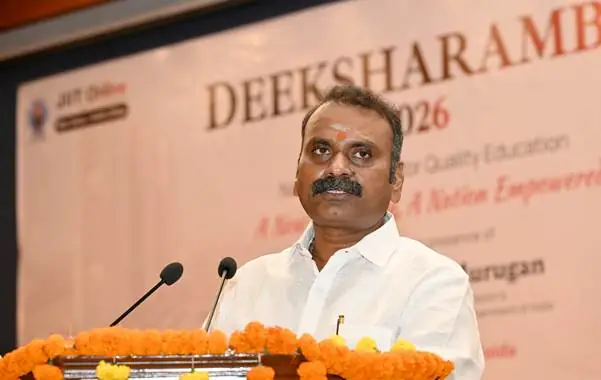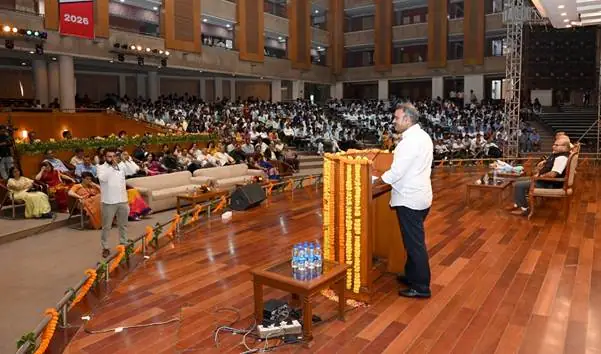
Union Minister of State Dr. L. Murugan has urged India's youth to step forward as the principal force behind the country's long-term development agenda, positioning the next generation at the center of the national vision for a developed India by 2047. His appeal comes at a time when the government is increasingly emphasizing youth-led growth, skill formation, entrepreneurship, and civic responsibility as essential pillars of the Viksit Bharat roadmap.
Youth as National Force
Dr. Murugan's message reflects a broader policy narrative that has gained prominence in New Delhi: India's demographic advantage can only be converted into economic and social strength if young people are equipped to lead, innovate, and participate meaningfully in public life. With one of the world's largest youth populations, India faces both an opportunity and a challenge. The opportunity lies in harnessing energy, talent, and digital fluency. The challenge lies in ensuring that education, employment, and institutional pathways are strong enough to absorb and empower that talent.
By urging youth to lead the 2047 journey, the minister effectively placed generational participation at the heart of national governance. The statement aligns with the government's broader framing of Viksit Bharat as a long-horizon transformation project rather than a short-term political slogan. In that context, youth are not merely beneficiaries of policy but active agents expected to shape outcomes in technology, administration, industry, and social development.
Development Beyond Slogans
The significance of such remarks extends beyond ceremonial encouragement. India's development agenda over the next two decades will require sustained gains in productivity, skilling, digital infrastructure, manufacturing capacity, and social inclusion. Youth leadership, in this sense, is not symbolic. It is tied to the practical demands of a rapidly changing economy where artificial intelligence, automation, green energy, and platform-based work are redefining job markets and public expectations.
Dr. Murugan's appeal also fits into a wider political effort to cultivate a sense of ownership among younger citizens. Governments often invoke youth in speeches, but the policy test lies in whether institutions create real avenues for participation. That includes access to quality education, vocational training, startup support, research opportunities, and transparent governance systems that allow young Indians to contribute beyond electoral cycles.
The minister's remarks are likely to resonate with the administration's emphasis on self-reliance, innovation, and national confidence. Yet the underlying policy question remains whether India can convert aspiration into measurable outcomes. For the 2047 target to be credible, youth engagement must be matched by reforms that improve employability, reduce barriers to entrepreneurship, and strengthen the link between learning and labor-market demand.
2047 Policy Horizon
The 2047 milestone has become a defining reference point in India's governance discourse, marking 100 years of independence and serving as a benchmark for long-term planning across sectors. In that framework, youth are expected to carry forward not only economic growth but also institutional continuity, social cohesion, and democratic resilience. Dr. Murugan's call is therefore part of a larger state narrative that seeks to prepare citizens for a multi-decade national project.
Analytically, the emphasis on youth leadership also reflects a recognition that India's future competitiveness will depend on the quality of its human capital. Countries that successfully navigate long development cycles typically do so by investing early in education, research, and civic leadership. India's challenge is to do this at scale, across regions and income groups, while keeping pace with technological disruption and global uncertainty.
For young Indians, the minister's message is both an invitation and an expectation. It asks them to see themselves not only as participants in India's growth story but as architects of it. Whether that vision translates into durable policy change will depend on how effectively the state can align ambition with opportunity in the years ahead.