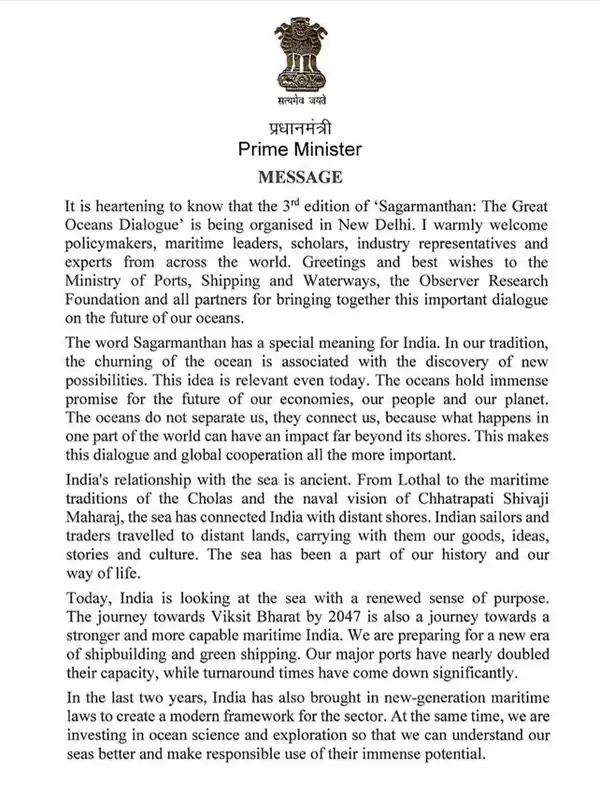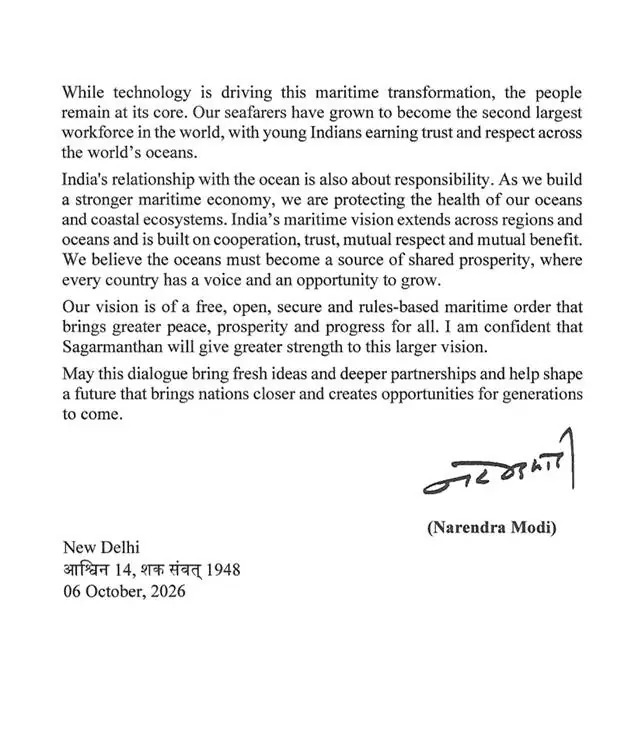
Prime Minister Narendra Modi has called for a rules-based maritime order in a message sent for the Third Sagar Manthan Dialogue, reinforcing India's view that the oceans must remain governed by predictable norms rather than coercion or unilateral advantage. The message, delivered against a backdrop of intensifying geopolitical competition at sea, places maritime stability at the centre of India's broader national security and economic agenda.
The Prime Minister's intervention is significant not only for its diplomatic tone but also for its strategic framing. By invoking a rules-based order, Modi aligned India with a wider international consensus that seeks to preserve freedom of navigation, respect for international law, and peaceful resolution of disputes. For a country whose trade, energy supplies, and regional outreach depend heavily on the sea, the message reflects a policy position that is both practical and geopolitical.
Maritime Rules Matter
India has increasingly positioned itself as a stakeholder in the Indo-Pacific maritime architecture, where sea lanes carry the bulk of global commerce and where tensions over territorial claims, naval deployments, and access routes have sharpened in recent years. Modi's message to the dialogue appears intended to reinforce that India sees maritime governance not as an abstract legal issue but as a core national interest.
The emphasis on rules also carries a broader diplomatic signal. In a region where power asymmetries can shape outcomes, New Delhi is arguing that stability at sea must be anchored in agreed norms rather than the preferences of stronger actors. That position resonates with India's longstanding support for the United Nations Convention on the Law of the Sea and with its broader advocacy of a free, open, and inclusive Indo-Pacific.
India's Strategic Sea View
The Sagar Manthan platform has emerged as a forum for discussing maritime policy, security, and cooperation, and the Prime Minister's message gives the dialogue added political weight. It suggests that the government wants maritime affairs to be treated as a cross-cutting policy domain, linking defence, commerce, energy security, and regional diplomacy.
For India, the stakes are immediate. The country's export economy relies on secure shipping routes, while its energy imports are overwhelmingly sea-borne. Any disruption in the maritime domain can quickly translate into higher costs, supply-chain stress, and strategic vulnerability. Modi's call for a rules-based order therefore speaks to the material foundations of India's growth model as much as to its foreign policy doctrine.
The message also fits into India's broader effort to project itself as a responsible regional power. By advocating predictable maritime conduct, New Delhi is seeking to present itself as a stabilising actor that supports cooperation, capacity-building, and lawful behaviour at sea. That posture has become increasingly important as India deepens engagement with partners across the Indian Ocean and the wider Indo-Pacific.
Wider Geopolitical Signal
The timing of the message is notable. Maritime security has become one of the defining arenas of global competition, with states increasingly attentive to chokepoints, undersea infrastructure, naval presence, and the resilience of trade routes. In that environment, India's insistence on rules-based conduct is both a normative statement and a strategic hedge.
It also reflects the government's recognition that maritime power is no longer limited to naval strength alone. It now includes legal frameworks, port connectivity, domain awareness, technology, and multilateral coordination. Modi's message, by foregrounding rules, suggests that India wants to shape the conversation around governance rather than merely respond to crises as they emerge.
For policymakers, the signal is clear: India intends to remain vocal on the principles that govern the seas, and it sees those principles as inseparable from national development and security. The Third Sagar Manthan Dialogue, in that sense, becomes more than a policy conference. It is a platform through which India is articulating its maritime worldview — one that links sovereignty, commerce, and international order.