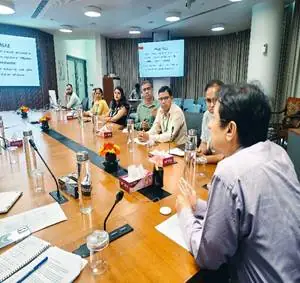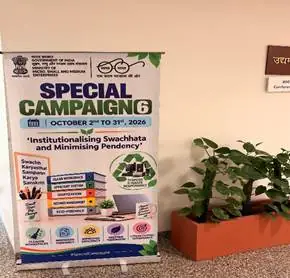
The Ministry of Micro, Small and Medium Enterprises has rolled out Special Campaign 6.0, a government-wide cleanliness and pendency-reduction drive that seeks to embed sanitation as a regular part of office functioning rather than a periodic exercise. The campaign is being positioned as both an administrative reform and a workplace management tool, with the ministry aligning itself to the Union government's broader emphasis on efficiency, record management, and visible governance outcomes.
The initiative comes at a time when central ministries are under increasing pressure to demonstrate that internal process reform can translate into better public service delivery. Special Campaign 6.0 is designed to address two persistent concerns in government offices: the upkeep of physical workspaces and the accumulation of unresolved files, references, and administrative cases. By linking cleanliness with pendency reduction, the ministry is signaling that operational discipline and file management are not separate tasks, but part of the same governance architecture.
Cleanliness as Routine Practice
The campaign's central premise is that cleanliness should become a normal operating standard inside government offices, not an occasional compliance activity. That framing matters because public-sector housekeeping drives in India have often been criticized for being symbolic, with visible clean-up efforts concentrated around campaign periods and then fading once attention shifts elsewhere. Special Campaign 6.0 attempts to move beyond that pattern by making cleanliness part of daily workflow, office culture, and supervisory accountability.
For the MSME ministry, this has practical significance. The ministry handles policy and administrative matters affecting a vast ecosystem of micro, small, and medium enterprises, which depend on timely decisions, clear communication, and efficient processing. A cleaner, better organized office environment is not merely cosmetic; it can improve document retrieval, reduce delays, and support more disciplined handling of correspondence and records. In that sense, the campaign is also a statement about administrative readiness.
The ministry's participation also reflects the continuing central government effort to use special campaigns as a governance instrument. Such drives typically combine cleanliness, space optimization, record disposal, and grievance or file pendency resolution. Their success is often measured not only in visual improvements but in the number of files closed, records digitized or weeded out, and office spaces freed from clutter.
Pendency Under Scrutiny
The second pillar of Special Campaign 6.0 is the reduction of pending matters, a longstanding challenge across Indian bureaucracy. Pendency can arise from procedural bottlenecks, inter-departmental coordination gaps, incomplete documentation, or simple accumulation over time. Whatever the cause, unresolved cases can slow decision-making and create friction for citizens, businesses, and subordinate offices seeking timely action.
For a ministry focused on MSMEs, the issue carries added weight. Small businesses often operate with limited financial and administrative buffers, making delays in approvals, clarifications, or policy implementation more costly than they would be for larger firms. A campaign that emphasizes clearing pending files therefore has implications beyond internal housekeeping: it can influence the speed and predictability of the ministry's interface with the sector it serves.
The government has increasingly treated pendency reduction as a governance metric in its own right, alongside digitalization and service delivery reform. Special campaigns are intended to create short-term momentum, but they also serve a longer-term purpose by forcing offices to review workflow, identify obsolete records, and establish clearer responsibility chains. If implemented seriously, such exercises can expose where delays originate and whether they are procedural, staffing-related, or managerial.
Governance Through Discipline
Special Campaign 6.0 is best understood as part of a broader administrative philosophy that equates visible order with institutional efficiency. The logic is straightforward: offices that are organized, uncluttered, and routinely monitored are more likely to process work faster and maintain better records. While cleanliness alone cannot solve structural delays, it can support a culture of discipline that makes reform easier to sustain.
The challenge, however, lies in durability. Government campaigns often generate initial enthusiasm, but their long-term value depends on whether ministries convert campaign targets into standard operating practice. If Special Campaign 6.0 is to have lasting impact, it will need consistent monitoring, measurable benchmarks, and follow-through after the campaign window closes. Otherwise, the exercise risks becoming another short-lived administrative burst.
Still, the ministry's decision to foreground both cleanliness and pendency reduction is politically and administratively significant. It reflects a governance model that prizes efficiency, accountability, and visible improvement in public institutions. For the MSME ministry, whose mandate is closely tied to the functioning of millions of enterprises across the country, even incremental gains in internal efficiency can have outsized relevance. The campaign therefore serves not only as an office-cleanliness drive, but as a test of whether routine discipline can be institutionalized inside the machinery of government.